

A MONOPOD GRAVITY PLATFORM
233
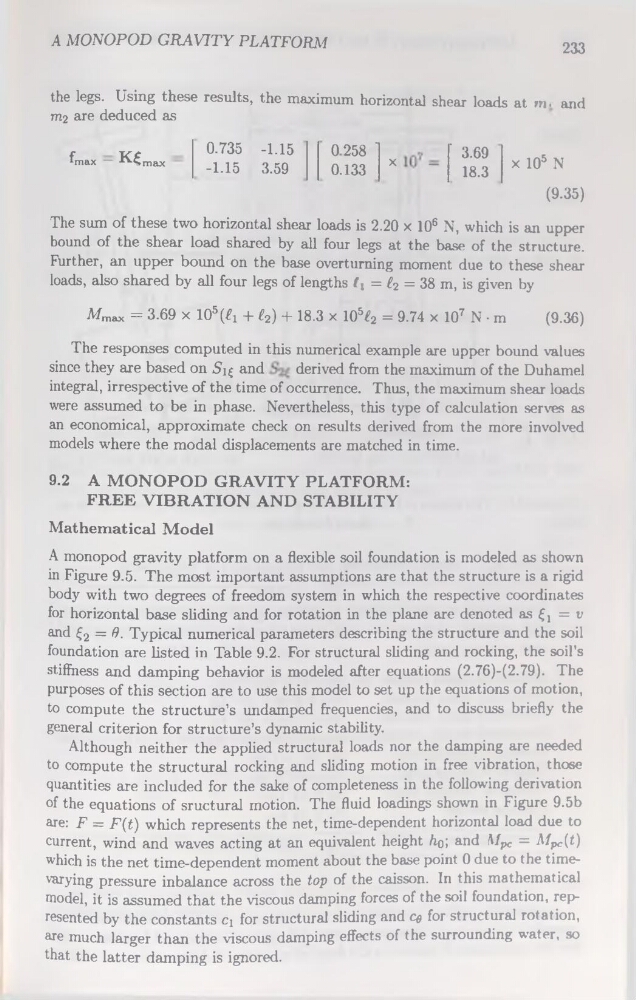
the legs. Using these results, the maximum horizontal shear loads at m ■ and
m2 are deduced as
f £max
0.735 -1.15
-1.15 3.59
0 258 '
’ 3.69
0.133
x
~
18.3
x 105 N
KCax
(9.35)
The sum of these two horizontal shear loads is 2.20 x 10⁶ N, which is an upper
bound of the shear load shared by ail four legs at the base of the structure.
Further, an upper bound on the base overturning moment due to these shear
loads, also shared by ail four legs of lengths ft = £2 = 38 m, is given by
Mmax = 3.69 x 10⁵(£i + t2) + 18.3 x 10⁵£2 = 9.74 x 10⁷ N ■ m
(9.36)
The responses computed in this numerical example are upper bound values
since they are based on Si£ and
derived from the maximum of the Duhamel
intégral, irrespective of the time of occurrence. Thus, the maximum shear loads
were assumed to be in phase. Nevertheless, this type of calculation serves as
an economical, approximate check on results derived from the more involved
models where the modal displacements are matched in time.
9.2 A MONOPOD GRAVITY PLATFORM:
FREE VIBRATION AND STABILITY
Mathematical Model
A monopod gravity platform on a flexible soil foundation is modeled as shown
in Figure 9.5. The most important assumptions are that the structure is a rigid
body with two degrees of freedom System in which the respective coordinates
for horizontal base sliding and for rotation in the plane are denoted as Ç, = v
and Ç2 = f). Typical numerical parameters describing the structure and the soil
foundation are listed in Table 9.2. For structural sliding and rocking, the soil's
stiffness and damping behavior is modeled after équations (2.76)-(2.79). The
purposes of this section are to use this model to set up the équations of motion,
to compute the structure’s undamped frequencies, and to discuss briefly the
general criterion for structure’s dynamic stability.
Although neither the applied structural loads nor the damping are needed
to compute the structural rocking and sliding motion in free vibration, those
quantifies are included for the sake of completeness in the following dérivation
of the équations of sructural motion. The fluid loadings shown in Figure 9.5b
are: F = F(t) which represents the net, time-dependent horizontal load due to
current, wind and waves acting at an équivalent height ho’ , and Mpc = Mpc(t)
which is the net time-dependent moment about the base point 0 due to the time'-’arying pressure inbalance across the top of the caisson. In this mathematical
model, it is assumed that the viscous damping forces of the soil foundation, represented by the constants cj for structural sliding and c$ for structural rotation,
are much larger than the viscous damping effects of the surrounding water, so
that the latter damping is ignored.
233
the legs. Using these results, the maximum horizontal shear loads at m ■ and
m2 are deduced as
f £max
0.735 -1.15
-1.15 3.59
0 258 '
’ 3.69
0.133
x
~
18.3
x 105 N
KCax
(9.35)
The sum of these two horizontal shear loads is 2.20 x 10⁶ N, which is an upper
bound of the shear load shared by ail four legs at the base of the structure.
Further, an upper bound on the base overturning moment due to these shear
loads, also shared by ail four legs of lengths ft = £2 = 38 m, is given by
Mmax = 3.69 x 10⁵(£i + t2) + 18.3 x 10⁵£2 = 9.74 x 10⁷ N ■ m
(9.36)
The responses computed in this numerical example are upper bound values
since they are based on Si£ and
derived from the maximum of the Duhamel
intégral, irrespective of the time of occurrence. Thus, the maximum shear loads
were assumed to be in phase. Nevertheless, this type of calculation serves as
an economical, approximate check on results derived from the more involved
models where the modal displacements are matched in time.
9.2 A MONOPOD GRAVITY PLATFORM:
FREE VIBRATION AND STABILITY
Mathematical Model
A monopod gravity platform on a flexible soil foundation is modeled as shown
in Figure 9.5. The most important assumptions are that the structure is a rigid
body with two degrees of freedom System in which the respective coordinates
for horizontal base sliding and for rotation in the plane are denoted as Ç, = v
and Ç2 = f). Typical numerical parameters describing the structure and the soil
foundation are listed in Table 9.2. For structural sliding and rocking, the soil's
stiffness and damping behavior is modeled after équations (2.76)-(2.79). The
purposes of this section are to use this model to set up the équations of motion,
to compute the structure’s undamped frequencies, and to discuss briefly the
general criterion for structure’s dynamic stability.
Although neither the applied structural loads nor the damping are needed
to compute the structural rocking and sliding motion in free vibration, those
quantifies are included for the sake of completeness in the following dérivation
of the équations of sructural motion. The fluid loadings shown in Figure 9.5b
are: F = F(t) which represents the net, time-dependent horizontal load due to
current, wind and waves acting at an équivalent height ho’ , and Mpc = Mpc(t)
which is the net time-dependent moment about the base point 0 due to the time'-’arying pressure inbalance across the top of the caisson. In this mathematical
model, it is assumed that the viscous damping forces of the soil foundation, represented by the constants cj for structural sliding and c$ for structural rotation,
are much larger than the viscous damping effects of the surrounding water, so
that the latter damping is ignored.