

FORCED, DAMPED MOTION
217
summarized. Numerical examples and applications illustrating the methodology
are deferred to Chapter 9.
The Mode Shape Matrix, X
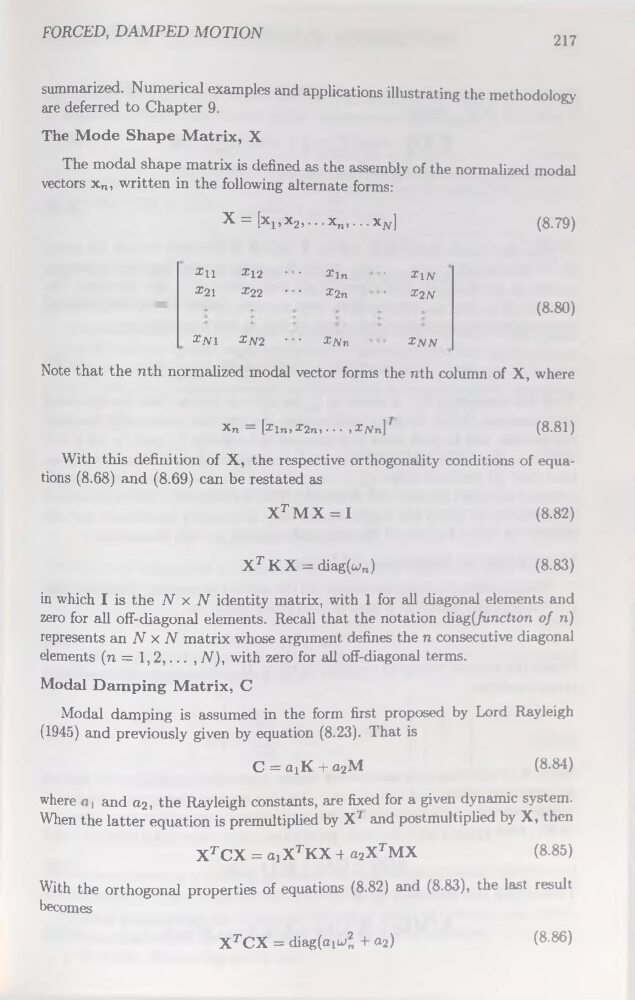
The modal shape matrix is defined as the assembly of the normalized modal
vectors xn, written in the following alternate forms:
X = [x1,x2,...xn,...xN]
(8.79)
xn
^21
X12
•
^22
•
■
æln
’
æ2n
■
X1N
'
X2N
(8.80)
X/Vl
XN2
' '
%Nn
Xnn
Note that the nth normalized modal vector forms the nth column of X, where
Xn = [æln,æ2n,-.. ,æNn]?
(8.81)
With this définition of X, the respective orthogonality conditions of équations (8.68) and (8.69) can be restated as
XtMX-I
(8.82)
XrKX = diag(w„)
(8.83)
in which I is the N x N identity matrix, with 1 for ail diagonal éléments and
zéro for ail off-diagonal éléments. Recall that the notation diag(/unction of n)
represents an N x N matrix whose argument defines the n consecutive diagonal
éléments (n = 1,2,... , N), with zéro for ail off-diagonal terms.
Modal Damping Matrix, C
Modal damping is assumed in the form first proposed by Lord Rayleigh
(1945) and previously given by équation (8.23). That is
C = aïK + a2M
(8.84)
where
XTCX = a, XtKX + a2XTMX
(8.85)
With the orthogonal properties of équations (8.82) and (8.83), the last resuit
becomes
XTCX = diag(ai^ + a2)
(8.86)
217
summarized. Numerical examples and applications illustrating the methodology
are deferred to Chapter 9.
The Mode Shape Matrix, X
The modal shape matrix is defined as the assembly of the normalized modal
vectors xn, written in the following alternate forms:
X = [x1,x2,...xn,...xN]
(8.79)
xn
^21
X12
•
^22
•
■
æln
’
æ2n
■
X1N
'
X2N
(8.80)
X/Vl
XN2
' '
%Nn
Xnn
Note that the nth normalized modal vector forms the nth column of X, where
Xn = [æln,æ2n,-.. ,æNn]?
(8.81)
With this définition of X, the respective orthogonality conditions of équations (8.68) and (8.69) can be restated as
XtMX-I
(8.82)
XrKX = diag(w„)
(8.83)
in which I is the N x N identity matrix, with 1 for ail diagonal éléments and
zéro for ail off-diagonal éléments. Recall that the notation diag(/unction of n)
represents an N x N matrix whose argument defines the n consecutive diagonal
éléments (n = 1,2,... , N), with zéro for ail off-diagonal terms.
Modal Damping Matrix, C
Modal damping is assumed in the form first proposed by Lord Rayleigh
(1945) and previously given by équation (8.23). That is
C = aïK + a2M
(8.84)
where
XTCX = a, XtKX + a2XTMX
(8.85)
With the orthogonal properties of équations (8.82) and (8.83), the last resuit
becomes
XTCX = diag(ai^ + a2)
(8.86)