

STRUCTURAL RESPONSE STATISTICS: PART II
183
spectrum is modifiée! when the mean is not zéro, which corresponds to the case
of steady current forces and wave forces acting simultaneously on the structure.
In typical examples, however, Tung showed that such simultaneous action had a
definite but relatively small effect on the structural response. Thus the practice
of superimposing the effects of current as a static loading on the structure under
wave excitation seems to be justified, providing that ail loading due to vortex
shedding in the current field is negligible.
Another extension is the case of two or more stationary wave excitation
forces that are uncorrelated or statistically independent, and ail with a zéro
mean value. Suppose that the N such spectral densities are known and denoted
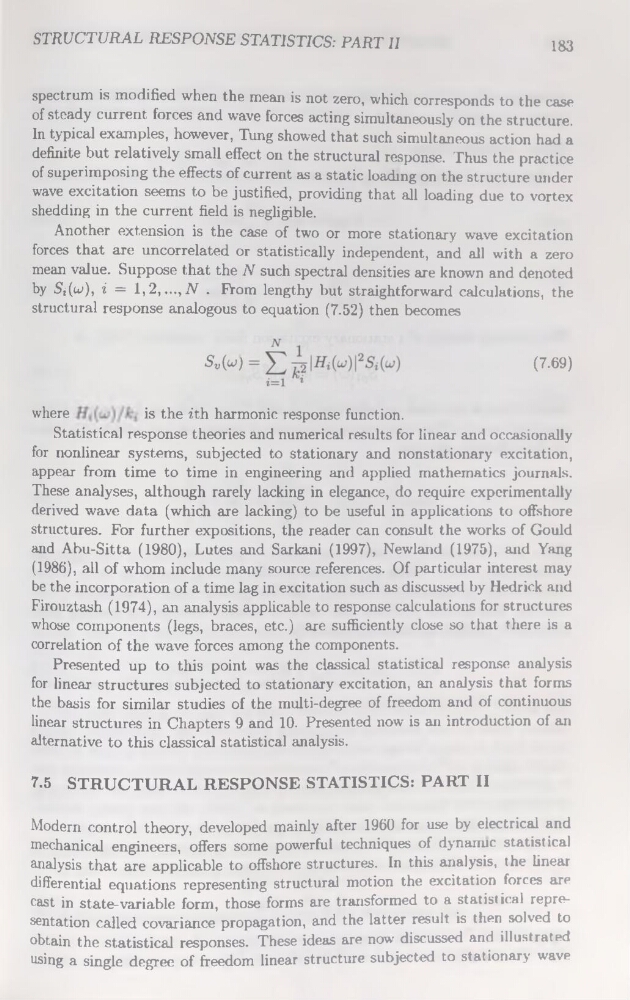
by S'i(cu), i = 1,2, ...,7V . From lengthy but straightforward calculations, the
structural response analogous to équation (7.52) then becomes
(7.69)
where
is the ith harmonie response function.
Statistical response théories and numerical results for linear and occasionally
for nonlinear Systems, subjected to stationary and nonstationary excitation,
appear from time to time in engineering and applied mathematics journals.
These analyses, although rarely lacking in elegance, do require experimentaliy
derived wave data (which are lacking) to be useful in applications to offshore
structures. For further expositions, the reader can consult the works of Gould
and Abu-Sitta (1980), Lûtes and Sarkani (1997), Newland (1975), and Yang
(1986), ail of whom include many source references. Of particular interest may
be the incorporation of a time lag in excitation such as discussed by Hedrick and
Firouztash (1974), an analysis applicable to response calculations for structures
whose components (legs, braces, etc.) are sufficiently close so that there is a
corrélation of the wave forces among the components.
Presented up to this point was the classical statistical response analysis
for linear structures subjected to stationary excitation, an analysis that forms
the basis for similar studies of the multi-degree of freedom and of continuons
linear structures in Chapters 9 and 10. Presented now is an introduction of an
alternative to this classical statistical analysis.
7.5 STRUCTURAL RESPONSE STATISTICS: PART II
Modem control theory, developed mainly after 1960 for use by electrical and
mechanical engineers, offers some powerful techniques of dynamic statistical
analysis that are applicable to offshore structures. In this analysis, the linear
differential équations representing structural motion the excitation forces are
cast in State-variable form, those forms are transformed to a statistical représentation called covariance propagation, and the latter resuit is then solved to
obtain the statistical responses. These ideas are now discussed and illustrated
using a single degree of freedom linear structure subjected to stationary wave
183
spectrum is modifiée! when the mean is not zéro, which corresponds to the case
of steady current forces and wave forces acting simultaneously on the structure.
In typical examples, however, Tung showed that such simultaneous action had a
definite but relatively small effect on the structural response. Thus the practice
of superimposing the effects of current as a static loading on the structure under
wave excitation seems to be justified, providing that ail loading due to vortex
shedding in the current field is negligible.
Another extension is the case of two or more stationary wave excitation
forces that are uncorrelated or statistically independent, and ail with a zéro
mean value. Suppose that the N such spectral densities are known and denoted
by S'i(cu), i = 1,2, ...,7V . From lengthy but straightforward calculations, the
structural response analogous to équation (7.52) then becomes
(7.69)
where
is the ith harmonie response function.
Statistical response théories and numerical results for linear and occasionally
for nonlinear Systems, subjected to stationary and nonstationary excitation,
appear from time to time in engineering and applied mathematics journals.
These analyses, although rarely lacking in elegance, do require experimentaliy
derived wave data (which are lacking) to be useful in applications to offshore
structures. For further expositions, the reader can consult the works of Gould
and Abu-Sitta (1980), Lûtes and Sarkani (1997), Newland (1975), and Yang
(1986), ail of whom include many source references. Of particular interest may
be the incorporation of a time lag in excitation such as discussed by Hedrick and
Firouztash (1974), an analysis applicable to response calculations for structures
whose components (legs, braces, etc.) are sufficiently close so that there is a
corrélation of the wave forces among the components.
Presented up to this point was the classical statistical response analysis
for linear structures subjected to stationary excitation, an analysis that forms
the basis for similar studies of the multi-degree of freedom and of continuons
linear structures in Chapters 9 and 10. Presented now is an introduction of an
alternative to this classical statistical analysis.
7.5 STRUCTURAL RESPONSE STATISTICS: PART II
Modem control theory, developed mainly after 1960 for use by electrical and
mechanical engineers, offers some powerful techniques of dynamic statistical
analysis that are applicable to offshore structures. In this analysis, the linear
differential équations representing structural motion the excitation forces are
cast in State-variable form, those forms are transformed to a statistical représentation called covariance propagation, and the latter resuit is then solved to
obtain the statistical responses. These ideas are now discussed and illustrated
using a single degree of freedom linear structure subjected to stationary wave