

176
STATISTICAL RESPONSES FOR LINEAR STRUCTURES
/
oo rOO
/
hiO^h^E^t-SMt + T - e2)]d9ide2
(7.42)
-oo J — oc
Next assume that pi (t) is stationary and ergodic. The autocorrélation function for this loading is then independent of time t and that portion of the
integrand of équation (7.42) involving pi (t) can be written as
E[pi(t - ». ipti.* + t - 02)] = -RpK'f -B2 + #i)
(7-43)
Equation (7.43) is simply the autocorrélation function for pj(r) with a time lag
of (_02 + flj). The last two équations are combined to give
/■OC roo
Æt,(r) = /
I
h(0i)h(02)Rpi(T — 02 + 0i)d6idf)2
(7.44)
J —oo J—oo
Response Parameters
The spectral density of the response v is defined as the Foncier transform of
Rv(t). That is, from équation (7.20),
i
.
S„(W) = —
R^e'^dr
(7.45)
J-oo
When the last two équations are combined, then
1
/'OO
yOO
/«OO
Sv(w) = — / e~^Tdr I
I
- 02 + »1)d»1d»2 (7.46)
- J-x
J—oo J-oo
After interchanging the order of intégration in équation (7.46) and inserting the
following identity in the integrands,
e3^le-j^e2e-ju(ei-e2) _ ।
(7-47)
the resuit is a product of three intégrais given by
/•oo
/*oo
Sv(u)= I
h<0.1^-"
/
h{02)e~j^de2
J-OO
J-oo
-B^e^e-^-^+^dr
(7.48)
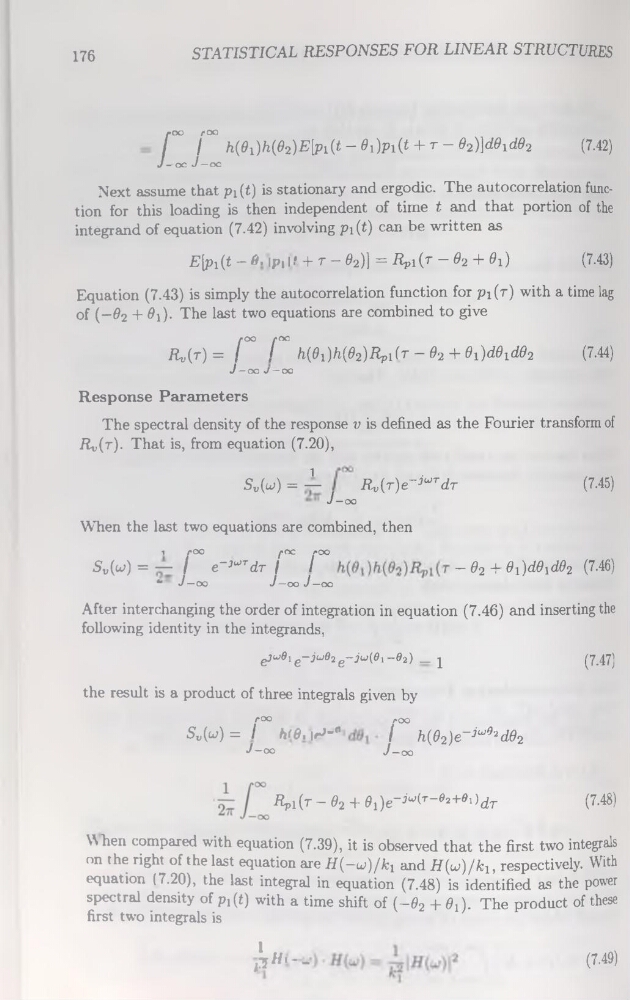
When compared with équation (7.39), it is observed that the first two intégrais
on the right of the last équation are H(-u)/ki and H(w)/fci, respectively. With
équation (7.20), the last integra! in équation (7.48) is identified as the power
spectral density of pi(t) with a time shift of (-02 + 0i). The product of these
first two intégrais is
;V'"(7.49)
STATISTICAL RESPONSES FOR LINEAR STRUCTURES
/
oo rOO
/
hiO^h^E^t-SMt + T - e2)]d9ide2
(7.42)
-oo J — oc
Next assume that pi (t) is stationary and ergodic. The autocorrélation function for this loading is then independent of time t and that portion of the
integrand of équation (7.42) involving pi (t) can be written as
E[pi(t - ». ipti.* + t - 02)] = -RpK'f -B2 + #i)
(7-43)
Equation (7.43) is simply the autocorrélation function for pj(r) with a time lag
of (_02 + flj). The last two équations are combined to give
/■OC roo
Æt,(r) = /
I
h(0i)h(02)Rpi(T — 02 + 0i)d6idf)2
(7.44)
J —oo J—oo
Response Parameters
The spectral density of the response v is defined as the Foncier transform of
Rv(t). That is, from équation (7.20),
i
.
S„(W) = —
R^e'^dr
(7.45)
J-oo
When the last two équations are combined, then
1
/'OO
yOO
/«OO
Sv(w) = — / e~^Tdr I
I
- 02 + »1)d»1d»2 (7.46)
- J-x
J—oo J-oo
After interchanging the order of intégration in équation (7.46) and inserting the
following identity in the integrands,
e3^le-j^e2e-ju(ei-e2) _ ।
(7-47)
the resuit is a product of three intégrais given by
/•oo
/*oo
Sv(u)= I
h<0.1^-"
/
h{02)e~j^de2
J-OO
J-oo
-B^e^e-^-^+^dr
(7.48)
When compared with équation (7.39), it is observed that the first two intégrais
on the right of the last équation are H(-u)/ki and H(w)/fci, respectively. With
équation (7.20), the last integra! in équation (7.48) is identified as the power
spectral density of pi(t) with a time shift of (-02 + 0i). The product of these
first two intégrais is
;V'"(7.49)