

STRUCTURAL RESPONSE STATISTICS: PART I
175
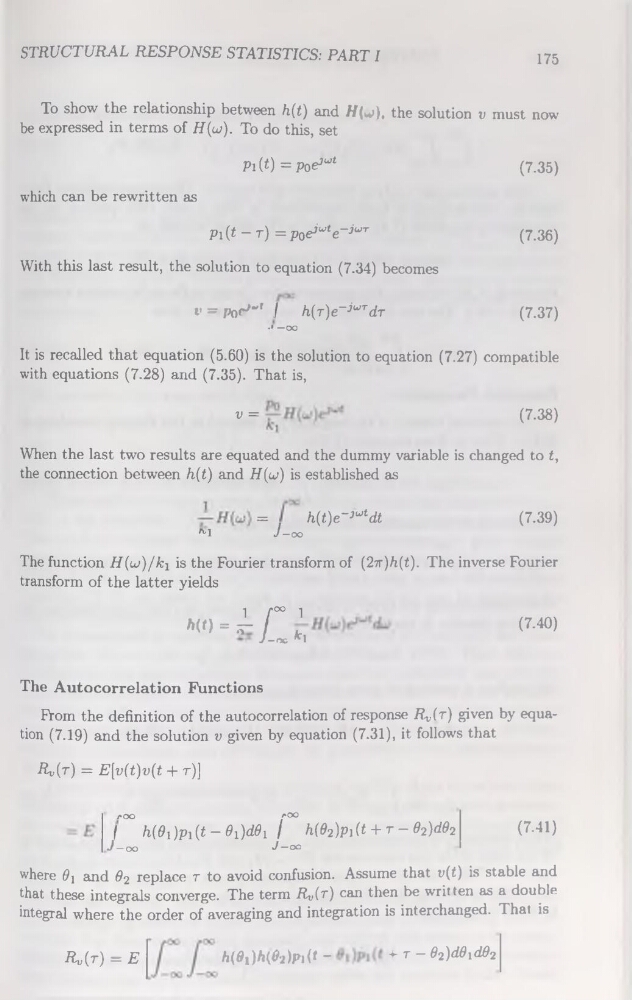
To show the relationship between h(t) and //(«>), the solution v must now
be expressed in terms of H(w). To do this, set
Pi(t)=Poe3ut
(7.35)
which can be rewritten as
pi (t - r) = poejute~juT
(7.36)
With this last resuit, the solution to équation (7.34) becomes
v = poc7-' /
/i(r)e_j“TdT
(7.37)
•’ — oc
It is recalled that équation (5.60) is the solution to équation (7.27) compatible
with équations (7.28) and (7.35). That is,
v =
(7.38)
When the last two results are equated and the dummy variable is changed to t,
the connection between h(t) and H(w) is established as
=
h(t)e-]uidt
(7.39)
M
J-oo
The function H(w)/fci is the Fourier transform of (2tt) Ji(t). The inverse Fourier
transform of the latter yields
1
f°° 1
h(t) = ^-/
(7.40)
J.oc *.'1
The Autocorrélation Functions
From the définition of the autocorrélation of response Ry(r) given by équation (7.19) and the solution v given by équation (7.31), it follows that
Rv(r) = E[v(t)v(t + r)]
rOO
/»OO
I
hïdiÏpiÇt-dijdûi I
J—OQ
J—OQ
(7.41)
h(02)pi(t + T - 02)^2
where 0] and 62 replace t to avoid confusion. Assume that v(t) is stable and
that these intégrais converge. The term Rv(t) can then be written as a double
intégral where the order of averaging and intégration is interchanged. That is
R„(t) = E
A(®l)A(^)Pl(t -
+ T~ ^2)^1^2
175
To show the relationship between h(t) and //(«>), the solution v must now
be expressed in terms of H(w). To do this, set
Pi(t)=Poe3ut
(7.35)
which can be rewritten as
pi (t - r) = poejute~juT
(7.36)
With this last resuit, the solution to équation (7.34) becomes
v = poc7-' /
/i(r)e_j“TdT
(7.37)
•’ — oc
It is recalled that équation (5.60) is the solution to équation (7.27) compatible
with équations (7.28) and (7.35). That is,
v =
(7.38)
When the last two results are equated and the dummy variable is changed to t,
the connection between h(t) and H(w) is established as
=
h(t)e-]uidt
(7.39)
M
J-oo
The function H(w)/fci is the Fourier transform of (2tt) Ji(t). The inverse Fourier
transform of the latter yields
1
f°° 1
h(t) = ^-/
(7.40)
J.oc *.'1
The Autocorrélation Functions
From the définition of the autocorrélation of response Ry(r) given by équation (7.19) and the solution v given by équation (7.31), it follows that
Rv(r) = E[v(t)v(t + r)]
rOO
/»OO
I
hïdiÏpiÇt-dijdûi I
J—OQ
J—OQ
(7.41)
h(02)pi(t + T - 02)^2
where 0] and 62 replace t to avoid confusion. Assume that v(t) is stable and
that these intégrais converge. The term Rv(t) can then be written as a double
intégral where the order of averaging and intégration is interchanged. That is
R„(t) = E
A(®l)A(^)Pl(t -
+ T~ ^2)^1^2