

SYNTHESIS OF TIME HISTORIES FROM SPECTRA
161
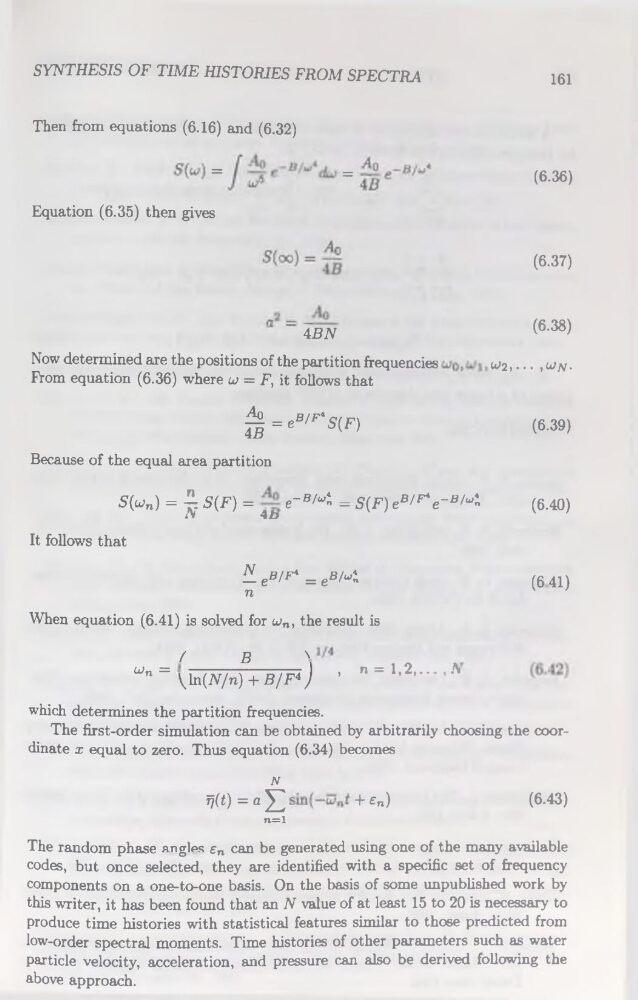
Then from équations (6.16) and (6.32)
=
=
<6-36)
Equation (6.35) then gives
(6.37)
4BN
(6.38)
Now determinedare thepositionsof thepartitionfrequenciesW2, • •. ,unFrom équation (6.36) where w = F, it follows that
^=eB/F‘$(F)
(6.39)
Because of the equal area partition
S(un) = -J 5(F) =
e~B^ = S(F) eB'F*e~B^
(6.40)
ZV
42>
It follows that
^eS/F4=eB/Wl
(641)
When équation (6.41) is solved for un, the resuit is
/
B
\
Wn = Vln(2V/n) + B/F4 J
’ n = ’'2........A
which détermines the partition frequencies.
The first-order simulation can be obtained by arbitrarily choosing the coordinate x equal to zéro. Thus équation (6.34) becomes
N
7j(t) = a 52
+ £n)
ns=l
(6.43)
The random phase angles en can be generated using one of the many available
codes, but once selected, they are identified with a spécifie set of frequency
components on a one-to-one basis. On the basis of some unpublished work by
this writer, it has been found that an N value of at least 15 to 20 is necessary to
produce time historiés with statistical features similar to thoee predicted from
low-order spectral moments. Time historiés of other parameters such as water
particle velocity, accélération, and pressure can also be derived following the
above approach.
161
Then from équations (6.16) and (6.32)
=
=
<6-36)
Equation (6.35) then gives
(6.37)
4BN
(6.38)
Now determinedare thepositionsof thepartitionfrequenciesW2, • •. ,unFrom équation (6.36) where w = F, it follows that
^=eB/F‘$(F)
(6.39)
Because of the equal area partition
S(un) = -J 5(F) =
e~B^ = S(F) eB'F*e~B^
(6.40)
ZV
42>
It follows that
^eS/F4=eB/Wl
(641)
When équation (6.41) is solved for un, the resuit is
/
B
\
Wn = Vln(2V/n) + B/F4 J
’ n = ’'2........A
which détermines the partition frequencies.
The first-order simulation can be obtained by arbitrarily choosing the coordinate x equal to zéro. Thus équation (6.34) becomes
N
7j(t) = a 52
+ £n)
ns=l
(6.43)
The random phase angles en can be generated using one of the many available
codes, but once selected, they are identified with a spécifie set of frequency
components on a one-to-one basis. On the basis of some unpublished work by
this writer, it has been found that an N value of at least 15 to 20 is necessary to
produce time historiés with statistical features similar to thoee predicted from
low-order spectral moments. Time historiés of other parameters such as water
particle velocity, accélération, and pressure can also be derived following the
above approach.