

160
STATISTICAL DESCRIPTIONS OF OFFSHORE WAVES
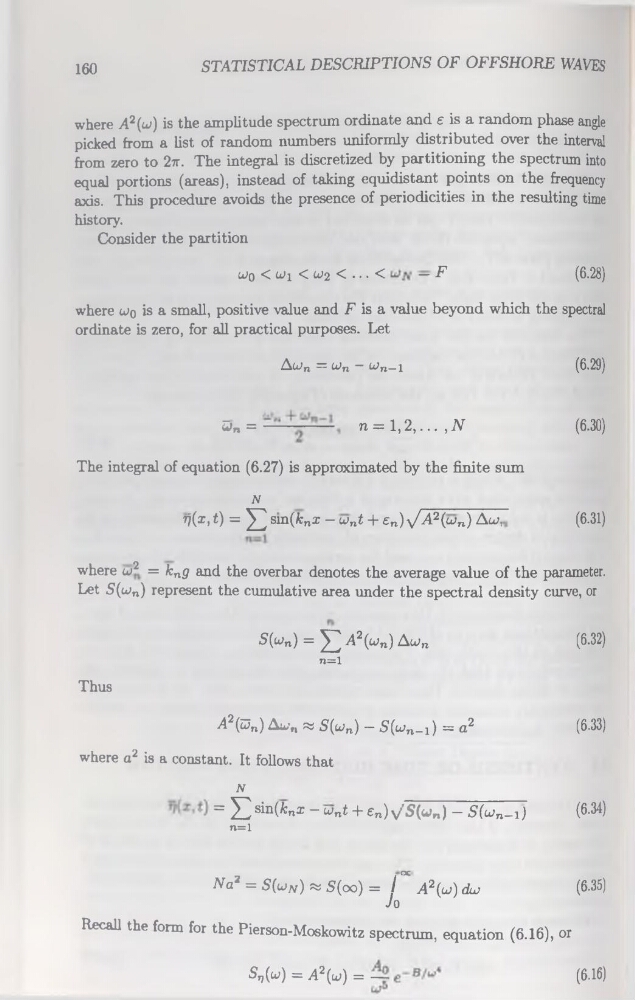
where A2(w) is the amplitude spectrum ordinate and e is a random phase angle
picked from a list of random numbers uniformly distributed over the interval
from zéro to 2tt. The intégral is discretized by partitioning the spectrum into
equal portions (areas), instead of taking équidistant points on the frequency
axis. This procedure avoids the presence of periodicities in the resulting time
his tory.
Consider the partition
cuq < Wj < eu2 < ... <
— F
(6.28)
where u>o is a small, positive value and F is a value beyond which the spectral
ordinate is zéro, for ali practical purposes. Let
Aw„ = w„ - w„_i
(6.29)
ü>w =
n = l,2,...,N
(6.30)
The intégral of équation (6.27) is approximated by the finite sum
N
Tj(x, t) = 52 s*n(knx - wnt + En) V' A2(a>„)Au;,
(6.31)
where w2 = kng and the overbar dénotés the average value of the parameter.
Let S(wn) represent the cumulative area under the spectral density curve, or
S(cun) = £A2(cun)Acun
(6.32)
n=l
Thus
A2(iû„)Au-,1«S(Wn)-S(Wn_1) = a2
(6.33)
where a2 is a constant. It follows that
N
= 52sin(/rna: — wnt + en) V'S(W») — S(un-i)
(6.34)
n=l
NaJ = S(u>N) « S(oo) = / ' A2 (eu) dw
(6-35)
Jo
Recall the form for the Pierson-Moskowitz spectrum, équation (6.16), or
S^(u) = A2(u) = ~
(6.16)
STATISTICAL DESCRIPTIONS OF OFFSHORE WAVES
where A2(w) is the amplitude spectrum ordinate and e is a random phase angle
picked from a list of random numbers uniformly distributed over the interval
from zéro to 2tt. The intégral is discretized by partitioning the spectrum into
equal portions (areas), instead of taking équidistant points on the frequency
axis. This procedure avoids the presence of periodicities in the resulting time
his tory.
Consider the partition
cuq < Wj < eu2 < ... <
— F
(6.28)
where u>o is a small, positive value and F is a value beyond which the spectral
ordinate is zéro, for ali practical purposes. Let
Aw„ = w„ - w„_i
(6.29)
ü>w =
n = l,2,...,N
(6.30)
The intégral of équation (6.27) is approximated by the finite sum
N
Tj(x, t) = 52 s*n(knx - wnt + En) V' A2(a>„)Au;,
(6.31)
where w2 = kng and the overbar dénotés the average value of the parameter.
Let S(wn) represent the cumulative area under the spectral density curve, or
S(cun) = £A2(cun)Acun
(6.32)
n=l
Thus
A2(iû„)Au-,1«S(Wn)-S(Wn_1) = a2
(6.33)
where a2 is a constant. It follows that
N
= 52sin(/rna: — wnt + en) V'S(W») — S(un-i)
(6.34)
n=l
NaJ = S(u>N) « S(oo) = / ' A2 (eu) dw
(6-35)
Jo
Recall the form for the Pierson-Moskowitz spectrum, équation (6.16), or
S^(u) = A2(u) = ~
(6.16)