

CONCEPT OF THE SIGNIFICANT WAVE
149
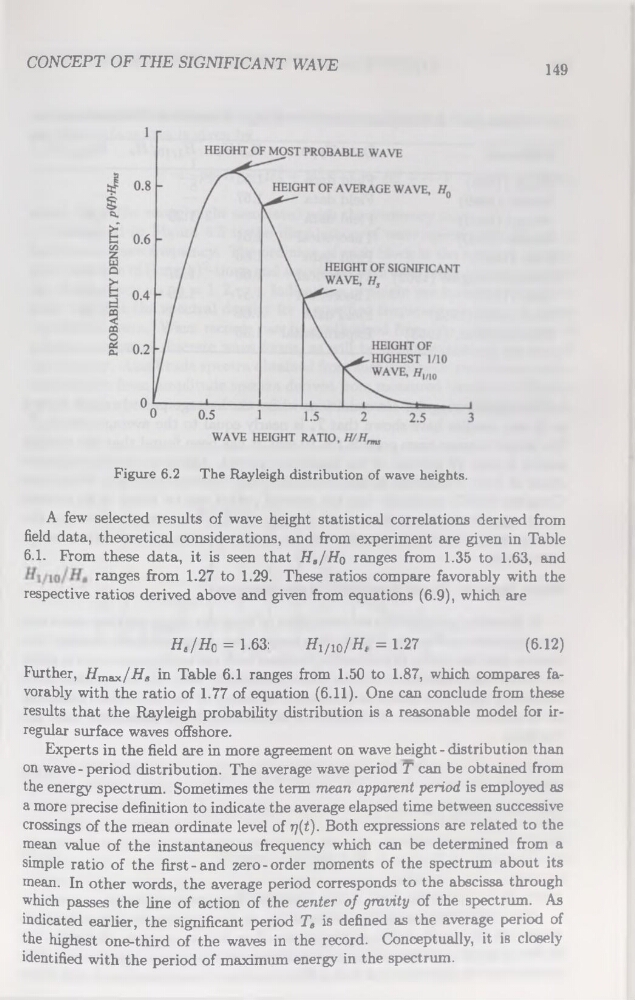
Figure 6.2 The Rayleigh distribution of wave heights.
A few selected results of wave height statistical corrélations derived from
field data, theoretical considérations, and from experiment are given in Table
6.1. From these data, it is seen that Hs/Hq ranges from 1.35 to 1.63, and
ranges from 1.27 to 1.29. These ratios compare favorably with the
respective ratios derived above and given from équations (6.9), which are
H6/Hg = 1.63:
H^/H, = 1.27
(6.12)
Further, Hmax/H8 in Table 6.1 ranges from 1.50 to 1.87, which compares favorably with the ratio of 1.77 of équation (6.11). One can conclude from these
results that the Rayleigh probability distribution is a reasonable model for irregular surface waves offshore.
Experts in the field are in more agreement on wave height - distribution than
on wave - period distribution. The average wave period T can be obtained from
the energy spectrum. Sometimes the tenu mean apparent period is employed as
a more précisé définition to indicate the average elapsed time between successive
crossings of the mean ordinate level of ?/(<). Both expressions are related to the
mean value of the instantaneous frequency which can be determined from a
simple ratio of the first-and zero-order moments of the spectrum about its
mean. In other words, the average period corresponds to the abscissa through
which passes the line of action of the center of gravity of the spectrum. As
indicated earlier, the significant period Te is defined as the average period of
the highest one-third of the waves in the record. Conceptually, it is closely
identified with the period of maximum energy in the spectrum.
149
Figure 6.2 The Rayleigh distribution of wave heights.
A few selected results of wave height statistical corrélations derived from
field data, theoretical considérations, and from experiment are given in Table
6.1. From these data, it is seen that Hs/Hq ranges from 1.35 to 1.63, and
ranges from 1.27 to 1.29. These ratios compare favorably with the
respective ratios derived above and given from équations (6.9), which are
H6/Hg = 1.63:
H^/H, = 1.27
(6.12)
Further, Hmax/H8 in Table 6.1 ranges from 1.50 to 1.87, which compares favorably with the ratio of 1.77 of équation (6.11). One can conclude from these
results that the Rayleigh probability distribution is a reasonable model for irregular surface waves offshore.
Experts in the field are in more agreement on wave height - distribution than
on wave - period distribution. The average wave period T can be obtained from
the energy spectrum. Sometimes the tenu mean apparent period is employed as
a more précisé définition to indicate the average elapsed time between successive
crossings of the mean ordinate level of ?/(<). Both expressions are related to the
mean value of the instantaneous frequency which can be determined from a
simple ratio of the first-and zero-order moments of the spectrum about its
mean. In other words, the average period corresponds to the abscissa through
which passes the line of action of the center of gravity of the spectrum. As
indicated earlier, the significant period Te is defined as the average period of
the highest one-third of the waves in the record. Conceptually, it is closely
identified with the period of maximum energy in the spectrum.