

PROBLEME
139
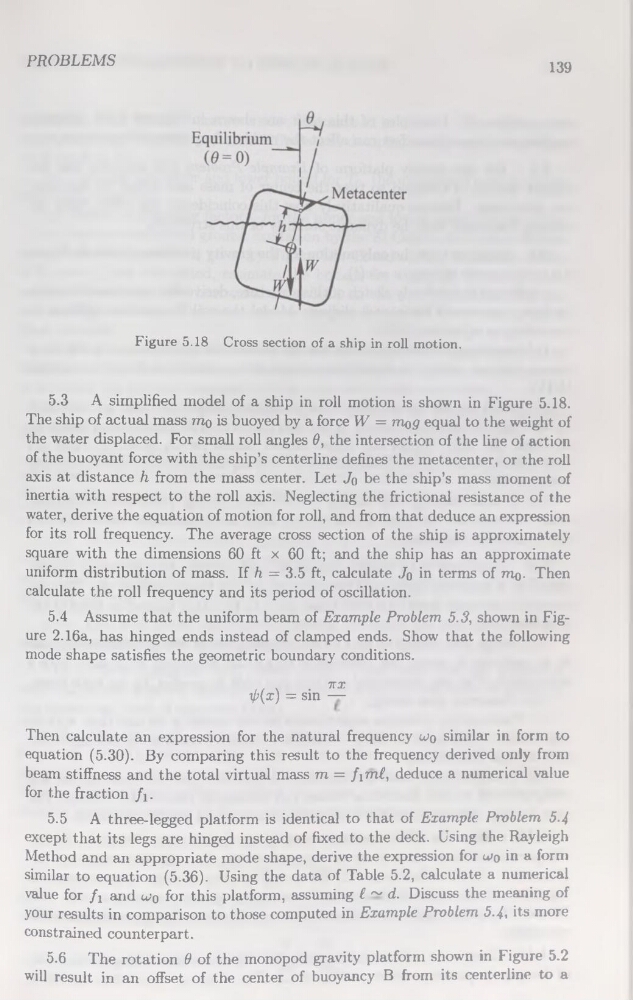
Figure 5.18 Cross section of a ship in roll motion.
5.3 A simplifiée! model of a ship in roll motion is shown in Figure 5.18.
The ship of actual mass rriQ is buoyed by a force W = m$g equal to the weight of
the water displaced. For small roll angles ô, the intersection of the line of action
of the buoyant force with the ship’s centerline defines the metacenter, or the roll
axis at distance h from the mass center. Let Jq be the ship’s mass moment of
inertia with respect to the roll axis. Neglecting the frictional résistance of the
water, dérivé the équation of motion for roll, and from that deduce an expression
for its roll frequency. The average cross section of the ship is approximately
square with the dimensions 60 ft x 60 ft; and the ship has an approximate
uniform distribution of mass. If h = 3.5 ft, calculate Jq in terms of mo- Then
calculate the roll frequency and its period of oscillation.
5.4
Assume that the uniform beam of Example Problem 5.3, shown in Figure 2.16a, has hinged ends instead of clamped ends. Show that the following
mode shape satisfies the géométrie boundary conditions.
7TX
V’(x) = sin —
Then calculate an expression for the natural frequency u>q similar in form to
équation (5.30). By comparing this resuit to the frequency derived only from
beam stiffness and the total virtual mass m = famé, deduce a numerical value
for the fraction /j.
5.5 A three-legged platform is identical to that of Example Problem 5-4
except that its legs are hinged instead of fixed to the deck. Using the Rayleigh
Method and an appropriate mode shape, dérivé the expression for u>o in a form
similar to équation (5.36). Using the data of Table 5.2, calculate a numerical
value for /j and wq for this platform, assuming £ ~ d. Discuss the meaning of
your results in comparison to those computed in Example Problem 5-4, its more
constrained counterpart.
5.6
The rotation 0 of the monopod gravity platform shown in Figure 5.2
will resuit in an offset of the center of buoyancy B from its centerline to a
139
Figure 5.18 Cross section of a ship in roll motion.
5.3 A simplifiée! model of a ship in roll motion is shown in Figure 5.18.
The ship of actual mass rriQ is buoyed by a force W = m$g equal to the weight of
the water displaced. For small roll angles ô, the intersection of the line of action
of the buoyant force with the ship’s centerline defines the metacenter, or the roll
axis at distance h from the mass center. Let Jq be the ship’s mass moment of
inertia with respect to the roll axis. Neglecting the frictional résistance of the
water, dérivé the équation of motion for roll, and from that deduce an expression
for its roll frequency. The average cross section of the ship is approximately
square with the dimensions 60 ft x 60 ft; and the ship has an approximate
uniform distribution of mass. If h = 3.5 ft, calculate Jq in terms of mo- Then
calculate the roll frequency and its period of oscillation.
5.4
Assume that the uniform beam of Example Problem 5.3, shown in Figure 2.16a, has hinged ends instead of clamped ends. Show that the following
mode shape satisfies the géométrie boundary conditions.
7TX
V’(x) = sin —
Then calculate an expression for the natural frequency u>q similar in form to
équation (5.30). By comparing this resuit to the frequency derived only from
beam stiffness and the total virtual mass m = famé, deduce a numerical value
for the fraction /j.
5.5 A three-legged platform is identical to that of Example Problem 5-4
except that its legs are hinged instead of fixed to the deck. Using the Rayleigh
Method and an appropriate mode shape, dérivé the expression for u>o in a form
similar to équation (5.36). Using the data of Table 5.2, calculate a numerical
value for /j and wq for this platform, assuming £ ~ d. Discuss the meaning of
your results in comparison to those computed in Example Problem 5-4, its more
constrained counterpart.
5.6
The rotation 0 of the monopod gravity platform shown in Figure 5.2
will resuit in an offset of the center of buoyancy B from its centerline to a