

138
SINGLE DEGREE OF FREEDOM STRUCTURES
A typical time history of buoy response is shown in Figure 5.15. This response is for a wave excitation frequency of u = 8.7 rad/sec, an excitation
frequency that produced three distinct amplitudes (jumps) as shown in Figure
5 14. The time history clearly shows an amplitude variation between the extrêmes of 5.4 in. and 3.2 in. However, the oscillation between these extremes is
not so abrupt as the word jump implies because it takes two or three response
cycles to effect an amplitude excursion. Further, the time history shows that although the excitation frequency is constant, the response frequency is not, since
the time between crossings is not constant. This is characteristic of Systems
with nonlinear restoring forces.
PROBLEMS
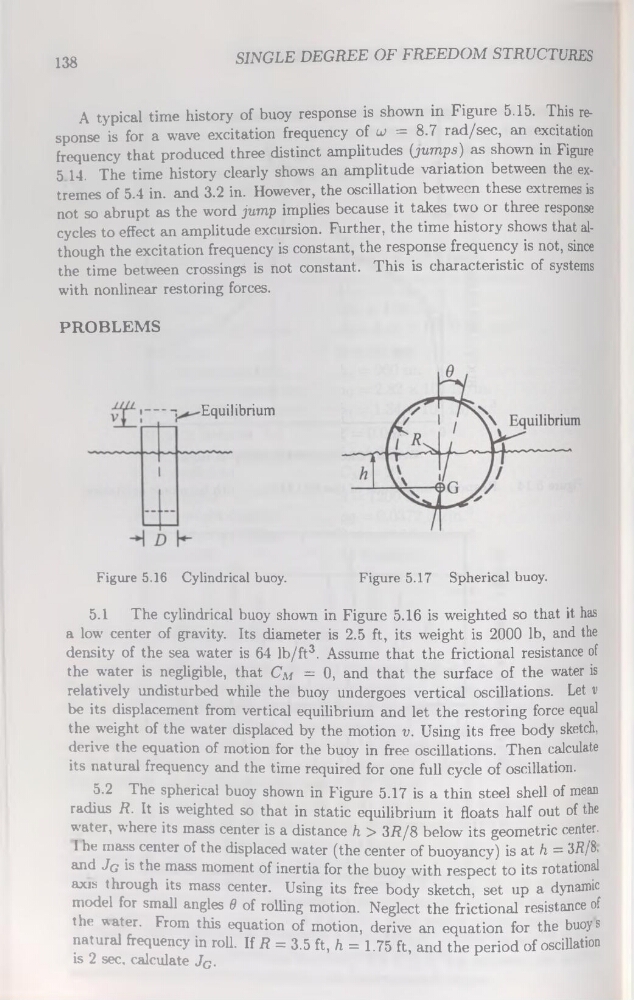
Figure 5.16 Cylindrical buoy.
Equilibrium
Figure 5.17 Spherical buoy.
5.1
The cylindrical buoy shown in Figure 5.16 is weighted so that it has
a low center of gravity. Its diameter is 2.5 ft, its weight is 2000 1b, and the
density of the sea water is 64 lb/ft3. Assume that the frictional résistance of
the water is negligible, that CM = 0, and that the surface of the water is
relatively undisturbed while the buoy undergoes vertical oscillations. Let v
be its displacement from vertical equilibrium and let the restoring force equal
the weight of the water displaced by the motion v. Using its free body sketch,
dérivé the équation of motion for the buoy in free oscillations. Then calculate
its natural frequency and the time required for one full cycle of oscillation.
5.2
The spherical buoy shown in Figure 5.17 is a thin steel shell of mean
radius R. It is weighted so that in static equilibrium it floats half out of the
water, where its mass center is a distance h > 377/8 below its géométrie center.
I he mass center of the displaced water (the center of buoyancy) is at h = 3H/8.
and Jq is the mass moment of inertia for the buoy with respect to its rotational
axis through its mass center. Using its free body sketch, set up a dynamic
model for small angles 9 of rolling motion. Neglect the frictional résistance of
the water. From this équation of motion, dérivé an équation for the buoys
natural frequency in roll. If R = 3.5 ft, h = 1.75 ft, and the period of oscillation
is 2 sec. calculate JG.
SINGLE DEGREE OF FREEDOM STRUCTURES
A typical time history of buoy response is shown in Figure 5.15. This response is for a wave excitation frequency of u = 8.7 rad/sec, an excitation
frequency that produced three distinct amplitudes (jumps) as shown in Figure
5 14. The time history clearly shows an amplitude variation between the extrêmes of 5.4 in. and 3.2 in. However, the oscillation between these extremes is
not so abrupt as the word jump implies because it takes two or three response
cycles to effect an amplitude excursion. Further, the time history shows that although the excitation frequency is constant, the response frequency is not, since
the time between crossings is not constant. This is characteristic of Systems
with nonlinear restoring forces.
PROBLEMS
Figure 5.16 Cylindrical buoy.
Equilibrium
Figure 5.17 Spherical buoy.
5.1
The cylindrical buoy shown in Figure 5.16 is weighted so that it has
a low center of gravity. Its diameter is 2.5 ft, its weight is 2000 1b, and the
density of the sea water is 64 lb/ft3. Assume that the frictional résistance of
the water is negligible, that CM = 0, and that the surface of the water is
relatively undisturbed while the buoy undergoes vertical oscillations. Let v
be its displacement from vertical equilibrium and let the restoring force equal
the weight of the water displaced by the motion v. Using its free body sketch,
dérivé the équation of motion for the buoy in free oscillations. Then calculate
its natural frequency and the time required for one full cycle of oscillation.
5.2
The spherical buoy shown in Figure 5.17 is a thin steel shell of mean
radius R. It is weighted so that in static equilibrium it floats half out of the
water, where its mass center is a distance h > 377/8 below its géométrie center.
I he mass center of the displaced water (the center of buoyancy) is at h = 3H/8.
and Jq is the mass moment of inertia for the buoy with respect to its rotational
axis through its mass center. Using its free body sketch, set up a dynamic
model for small angles 9 of rolling motion. Neglect the frictional résistance of
the water. From this équation of motion, dérivé an équation for the buoys
natural frequency in roll. If R = 3.5 ft, h = 1.75 ft, and the period of oscillation
is 2 sec. calculate JG.