

NONLINEAR RESPONSES FOR A SALM BUOY
133
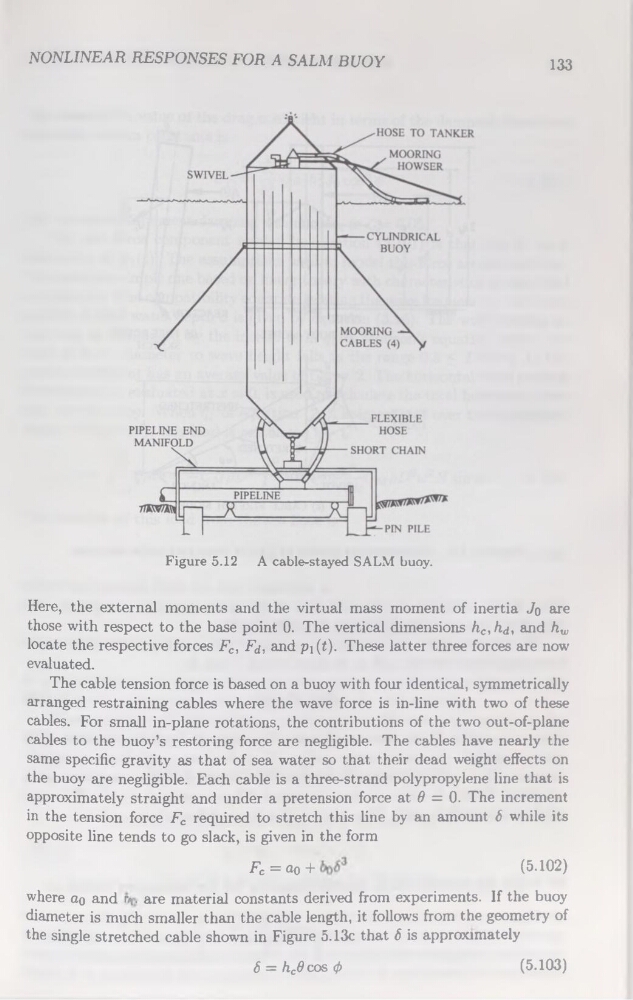
Figure 5.12 A cable-stayed SALM buoy.
Here, the external moments and the virtual mass moment of inertia Jo are
those with respect to the base point 0. The vertical dimensions hc,h.d, and hw
locate the respective forces Fc, Fd, and pi(t). These latter three forces are now
evaluated.
The cable tension force is based on a buoy with four identical, symmetrically
arranged restraining cables where the wave force is in-line with two of these
cables. For small in-plane rotations, the contributions of the two out-of-plane
cables to the buoy’s restoring force are negligible. The cables hâve nearly the
same spécifie gravity as that of sea water so that their dead weight effects on
the buoy are negligible. Each cable is a three-strand polypropylene line that is
approximately straight and under a pretension force at 6 = 0. The incrément
in the tension force Fc required to stretch this line by an amount 6 while its
opposite line tends to go slack, is given in the form
Fc = do +
(5.102)
where ûq and r^. are material constants derived from experiments. If the buoy
diameter is much smaller than the cable length, it follows from the geometry of
the single stretched cable shown in Figure 5.13c that 6 is approximately
6 = hc6 cos 0
(5.103)
133
Figure 5.12 A cable-stayed SALM buoy.
Here, the external moments and the virtual mass moment of inertia Jo are
those with respect to the base point 0. The vertical dimensions hc,h.d, and hw
locate the respective forces Fc, Fd, and pi(t). These latter three forces are now
evaluated.
The cable tension force is based on a buoy with four identical, symmetrically
arranged restraining cables where the wave force is in-line with two of these
cables. For small in-plane rotations, the contributions of the two out-of-plane
cables to the buoy’s restoring force are negligible. The cables hâve nearly the
same spécifie gravity as that of sea water so that their dead weight effects on
the buoy are negligible. Each cable is a three-strand polypropylene line that is
approximately straight and under a pretension force at 6 = 0. The incrément
in the tension force Fc required to stretch this line by an amount 6 while its
opposite line tends to go slack, is given in the form
Fc = do +
(5.102)
where ûq and r^. are material constants derived from experiments. If the buoy
diameter is much smaller than the cable length, it follows from the geometry of
the single stretched cable shown in Figure 5.13c that 6 is approximately
6 = hc6 cos 0
(5.103)