

RESPONSE OF NONLINEAR STRUCTURES
125
In these nondimensional parameters, p0/fci is the static deflection of its linear
System counterpart for a constant excitation force po; and K is interpreted as
the nonlinear stiffness parameter, assuming that ki, po, and iv0 are constant.
For instance, when K = 0, the amplitude of motion is equal to that of the
undamped linear System previously derived. That is, |4| of équation (5.88) is
equal to |H(w)| of équation (5.65) for K = Ç = 0.
Example Problem 5.8. In the San Diego harbor a ship moored with multiple
lines was observed to oscillate or gallop in an erratic manner, even though the
harbor waves were reasonably regular and were of normal height. The initially
rather taut mooring lines were then tightened further, and after that this ship
ceased to gallop and oscillated in the same regular manner as the ships moored
nearby. Can the initially erratic ship motion and its subséquent correction be
explained using a simple, nonlinear dynamic model?
Consider the simplified nonlinear dynamic model of the ship-wave System
described by équation (5.81) in which a single incident harbor wave produced
a hull force of amplitude po at a excitation frequency u>. The connection of the
ship’s response amplitude a to w and the restraint constants is équation (5.86).
The task is to investigate the nature of the ship’s response amplitude to the
System parameters.
The mathematical question is: for what combination of System parameters
does ü of équation (5.86) hâve one or more real roots? If there is only one
real root for ü, then the motion v(t) is given by équation (5.56) with û> =
uj, and is quite regular, without gallops. If more than one real root exists,
then the motion could pass from one amplitude to another, giving rise to the
observed erratic behavior of the moored ship. Fortunately, the nature of the
roots for a third-order reduced cubic polynomial in ü, such as équation (5.87),
was thoroughly studied early in the sixteenth century, and the results presented
below are available in standard algebra texts (Rosenbach et al.,1958). Rewrite
the latter équation in the form
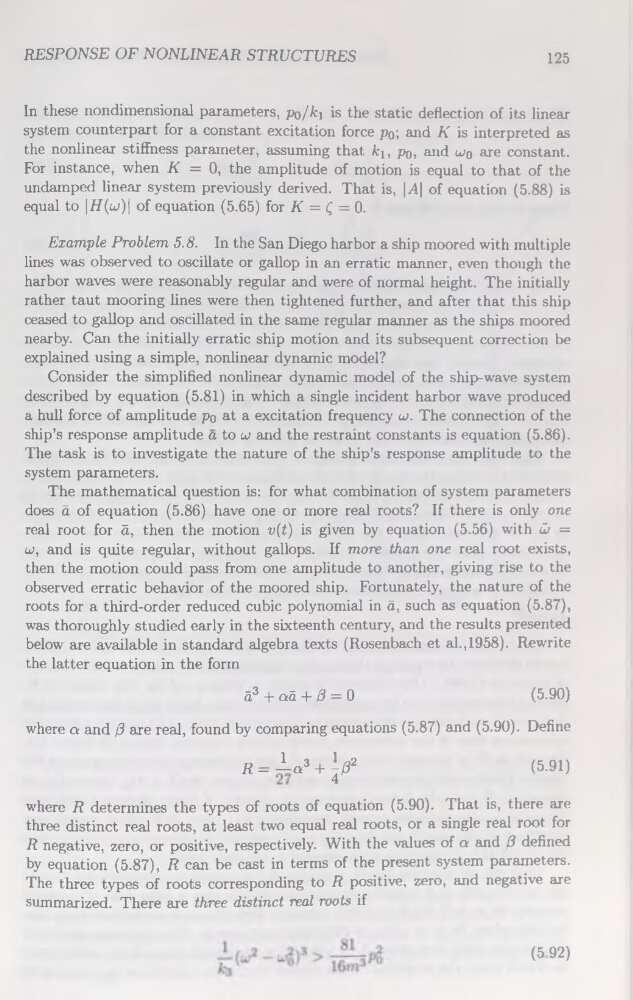
â3 + aâ + 0 = 0
(5.90)
where a and 0 are real, found by comparing équations (5.87) and (5.90). Define
R=La^+^
(5.91)
where R détermines the types of roots of équation (5.90). That is, there are
three distinct real roots, at least two equal real roots, or a single real root for
R négative, zéro, or positive, respectively. With the values of a and 0 defined
by équation (5.87), R can be cast in terms of the présent System parameters.
The three types of roots corresponding to R positive, zéro, and négative are
summarized. There are three distinct real roots if
(592)
125
In these nondimensional parameters, p0/fci is the static deflection of its linear
System counterpart for a constant excitation force po; and K is interpreted as
the nonlinear stiffness parameter, assuming that ki, po, and iv0 are constant.
For instance, when K = 0, the amplitude of motion is equal to that of the
undamped linear System previously derived. That is, |4| of équation (5.88) is
equal to |H(w)| of équation (5.65) for K = Ç = 0.
Example Problem 5.8. In the San Diego harbor a ship moored with multiple
lines was observed to oscillate or gallop in an erratic manner, even though the
harbor waves were reasonably regular and were of normal height. The initially
rather taut mooring lines were then tightened further, and after that this ship
ceased to gallop and oscillated in the same regular manner as the ships moored
nearby. Can the initially erratic ship motion and its subséquent correction be
explained using a simple, nonlinear dynamic model?
Consider the simplified nonlinear dynamic model of the ship-wave System
described by équation (5.81) in which a single incident harbor wave produced
a hull force of amplitude po at a excitation frequency u>. The connection of the
ship’s response amplitude a to w and the restraint constants is équation (5.86).
The task is to investigate the nature of the ship’s response amplitude to the
System parameters.
The mathematical question is: for what combination of System parameters
does ü of équation (5.86) hâve one or more real roots? If there is only one
real root for ü, then the motion v(t) is given by équation (5.56) with û> =
uj, and is quite regular, without gallops. If more than one real root exists,
then the motion could pass from one amplitude to another, giving rise to the
observed erratic behavior of the moored ship. Fortunately, the nature of the
roots for a third-order reduced cubic polynomial in ü, such as équation (5.87),
was thoroughly studied early in the sixteenth century, and the results presented
below are available in standard algebra texts (Rosenbach et al.,1958). Rewrite
the latter équation in the form
â3 + aâ + 0 = 0
(5.90)
where a and 0 are real, found by comparing équations (5.87) and (5.90). Define
R=La^+^
(5.91)
where R détermines the types of roots of équation (5.90). That is, there are
three distinct real roots, at least two equal real roots, or a single real root for
R négative, zéro, or positive, respectively. With the values of a and 0 defined
by équation (5.87), R can be cast in terms of the présent System parameters.
The three types of roots corresponding to R positive, zéro, and négative are
summarized. There are three distinct real roots if
(592)