

NATURAL FREQUENCIES OF LINEAR SYSTEMS
109
With the last two équations, the natural frequency from équation (5.5) becomes
u>o =
192E7
(5.33)
By equating the frequencies of équations (5.33) and (5.30), then fi - 0.370.
Note that this value of fi is tempered by the choice of t/j(x). However, Den
Hartog (1947) points out that the exact frequency for this problem is only 1.3
percent lower than that of équation (5.30). Thus, Jumping 37 percent of the
beam’s virtual mass at midspan is a good approximation in this case.
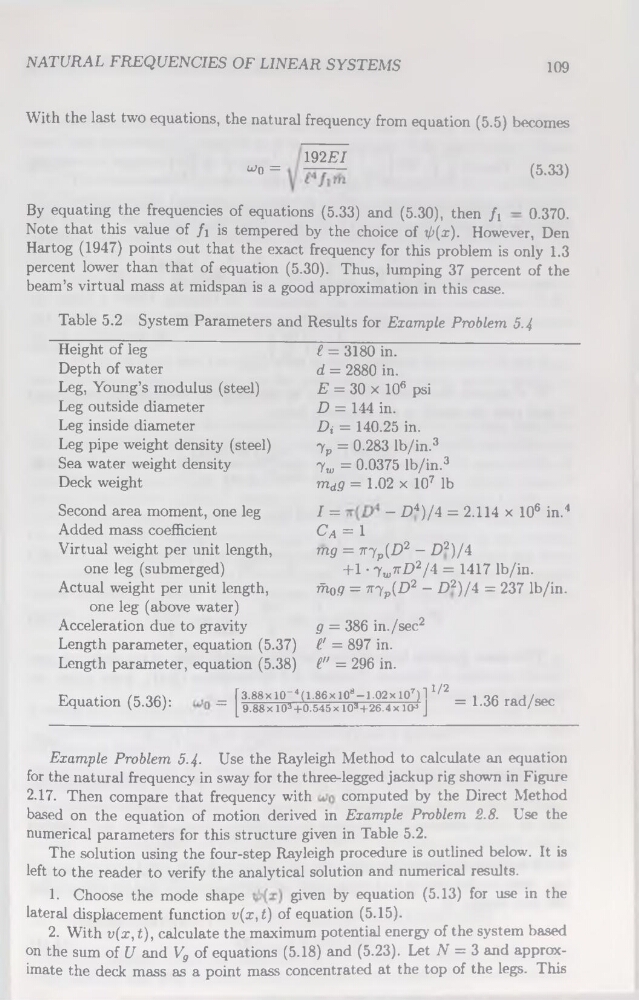
Table 5.2 System Parameters and Results for Example Problem 5.4
Height of leg
Depth of water
Leg, Young’s modulus (steel)
Leg outside diameter
Leg inside diameter
Leg pipe weight density (steel)
Sea water weight density
Deck weight
Second area moment, one leg
Added mass coefficient
Virtual weight per unit length,
one leg (submerged)
Actual weight per unit length,
one leg (above water)
Accélération due to gravity
Length parameter, équation (5.37)
Length parameter, équation (5.38)
£ = 3180 in.
d = 2880 in.
E = 30 x 106 psi
Example Problem 5-4- Use the Rayleigh Method to calculate an équation
for the natural frequency in sway for the three-legged jackup rig shown in Figure
2.17. Then compare that frequency with
computed by the Direct Method
based on the équation of motion derived in Example Problem 2.8. Use the
numerical parameters for this structure given in Table 5.2.
The solution using the four-step Rayleigh procedure is outlined below. It is
left to the reader to verify the analytical solution and numerical results.
1. Choose the mode shape
given by équation (5.13) for use in the
latéral displacement function v(x,t) of équation (5.15).
2. With v(x, t), calculate the maximum potential energy of the System based
on the sum of U and Vg of équations (5.18) and (5.23). Let N = 3 and approximate the deck mass as a point mass concentrated at the top of the legs. This
D = 144 in.
Di = 140.25 in.
7P = 0.283 lb/in.3
7W = 0.0375 lb/in.3
m^g = 1.02 x 10⁷ 1b
I =
- D*)/4 = 2.114 x 106 in.4
CA = 1
mg = TnP(D* 1 2 - D2)/4
+1 • 7w7rZ?2/4 = 1417 lb/in.
râo.<7 = 7r7P(^)2 - D2)/4 = 237 lb/in.
g = 386 in./sec2
t' = 897 in.
f" = 296 in.
Equation (5.36):
_ [3.88x 10~4(1.86x 10⁸ — 1.02x 10⁷) 1 1 /2
— [9.88xl03 +0.545xl03+26.4xlff) ]
= 1.36 rad/sec
109
With the last two équations, the natural frequency from équation (5.5) becomes
u>o =
192E7
(5.33)
By equating the frequencies of équations (5.33) and (5.30), then fi - 0.370.
Note that this value of fi is tempered by the choice of t/j(x). However, Den
Hartog (1947) points out that the exact frequency for this problem is only 1.3
percent lower than that of équation (5.30). Thus, Jumping 37 percent of the
beam’s virtual mass at midspan is a good approximation in this case.
Table 5.2 System Parameters and Results for Example Problem 5.4
Height of leg
Depth of water
Leg, Young’s modulus (steel)
Leg outside diameter
Leg inside diameter
Leg pipe weight density (steel)
Sea water weight density
Deck weight
Second area moment, one leg
Added mass coefficient
Virtual weight per unit length,
one leg (submerged)
Actual weight per unit length,
one leg (above water)
Accélération due to gravity
Length parameter, équation (5.37)
Length parameter, équation (5.38)
£ = 3180 in.
d = 2880 in.
E = 30 x 106 psi
Example Problem 5-4- Use the Rayleigh Method to calculate an équation
for the natural frequency in sway for the three-legged jackup rig shown in Figure
2.17. Then compare that frequency with
computed by the Direct Method
based on the équation of motion derived in Example Problem 2.8. Use the
numerical parameters for this structure given in Table 5.2.
The solution using the four-step Rayleigh procedure is outlined below. It is
left to the reader to verify the analytical solution and numerical results.
1. Choose the mode shape
given by équation (5.13) for use in the
latéral displacement function v(x,t) of équation (5.15).
2. With v(x, t), calculate the maximum potential energy of the System based
on the sum of U and Vg of équations (5.18) and (5.23). Let N = 3 and approximate the deck mass as a point mass concentrated at the top of the legs. This
D = 144 in.
Di = 140.25 in.
7P = 0.283 lb/in.3
7W = 0.0375 lb/in.3
m^g = 1.02 x 10⁷ 1b
I =
- D*)/4 = 2.114 x 106 in.4
CA = 1
mg = TnP(D* 1 2 - D2)/4
+1 • 7w7rZ?2/4 = 1417 lb/in.
râo.<7 = 7r7P(^)2 - D2)/4 = 237 lb/in.
g = 386 in./sec2
t' = 897 in.
f" = 296 in.
Equation (5.36):
_ [3.88x 10~4(1.86x 10⁸ — 1.02x 10⁷) 1 1 /2
— [9.88xl03 +0.545xl03+26.4xlff) ]
= 1.36 rad/sec