

108
SINGLE DEGREE OF FREEDOM STRUCTURES
energy of the deck is small in comparison to that in translation along the v
direction, then its kinetic energy is
A' = ±md
2
(5.26)
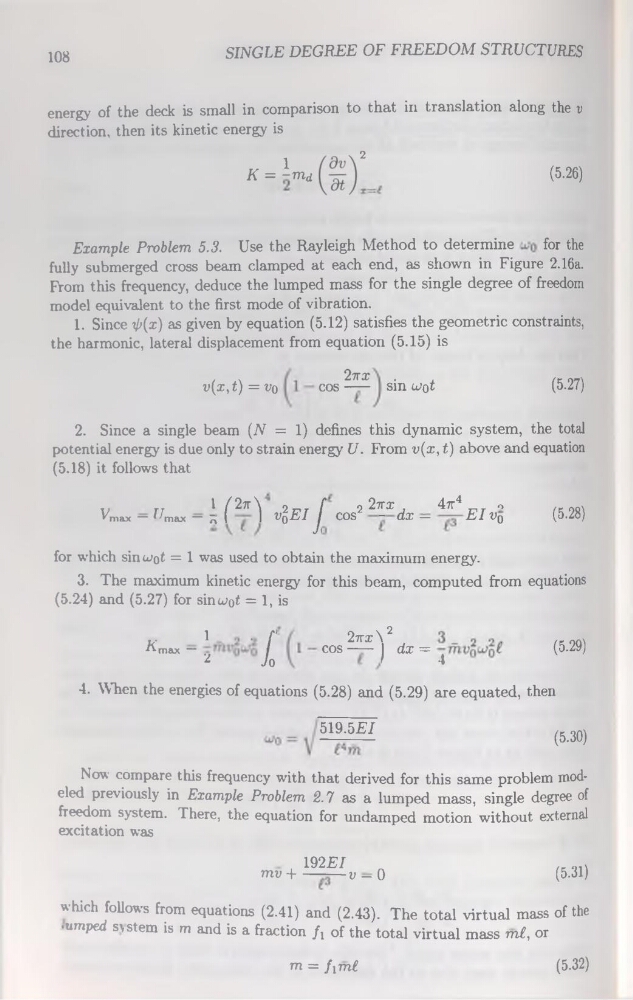
Example Problem 5.3. Use the Rayleigh Method to détermine
for the
fully submerged cross beam clamped at each end, as shown in Figure 2.16a.
From this frequency, deduce the lumped mass for the single degree of freedom
model équivalent to the first mode of vibration.
1. Since ^(x) as given by équation (5.12) satisfies the géométrie constraints,
the harmonie, latéral displacement from équation (5.15) is
v(x,t) = Uq
sin ajQt
(5-27)
2. Since a single beam (N = 1) defines this dynamic System, the total
potential energy is due only to strain energy U. From u(x, t) above and équation
(5.18) it follows that
TT
1 /2tt\ 2nr /
2 27FX ,
47T4
o
4. When the energies of équations (5.28) and (5.29) are equated, then
519.5FZ
Now compare this frequency with that derived for this same problem modeled previously in Example Problem 2.7 as a lumped mass, single degree of
freedom System. There, the équation for undamped motion without external
excitation was
Umax — Umax — 7» (
1 ^qFZ J COS - dx —
El Vq
(5.28)
for which sin a>ot = 1 was used to obtain the maximum energy.
3. The maximum kinetic energy for this beam, computed from équations
(5.24) and (5.27) for sinwot = 1, is
1
. f‘
Amax —
/
2
JO
cos
2tvx\ 2
-!
dx =
4
(5.29)
(5.30)
mv 4192EZ
(5.31)
v — 0
which follows from équations (2.41) and (2.43). The total virtual mass of the
‘Umped System is m and is a fraction /j of the total virtual mass m£, or
m = fiTn£
(5.32)
SINGLE DEGREE OF FREEDOM STRUCTURES
energy of the deck is small in comparison to that in translation along the v
direction, then its kinetic energy is
A' = ±md
2
(5.26)
Example Problem 5.3. Use the Rayleigh Method to détermine
for the
fully submerged cross beam clamped at each end, as shown in Figure 2.16a.
From this frequency, deduce the lumped mass for the single degree of freedom
model équivalent to the first mode of vibration.
1. Since ^(x) as given by équation (5.12) satisfies the géométrie constraints,
the harmonie, latéral displacement from équation (5.15) is
v(x,t) = Uq
sin ajQt
(5-27)
2. Since a single beam (N = 1) defines this dynamic System, the total
potential energy is due only to strain energy U. From u(x, t) above and équation
(5.18) it follows that
TT
1 /2tt\ 2nr /
2 27FX ,
47T4
o
4. When the energies of équations (5.28) and (5.29) are equated, then
519.5FZ
Now compare this frequency with that derived for this same problem modeled previously in Example Problem 2.7 as a lumped mass, single degree of
freedom System. There, the équation for undamped motion without external
excitation was
Umax — Umax — 7» (
1 ^qFZ J COS - dx —
El Vq
(5.28)
for which sin a>ot = 1 was used to obtain the maximum energy.
3. The maximum kinetic energy for this beam, computed from équations
(5.24) and (5.27) for sinwot = 1, is
1
. f‘
Amax —
/
2
JO
cos
2tvx\ 2
-!
dx =
4
(5.29)
(5.30)
mv 4192EZ
(5.31)
v — 0
which follows from équations (2.41) and (2.43). The total virtual mass of the
‘Umped System is m and is a fraction /j of the total virtual mass m£, or
m = fiTn£
(5.32)