

FLOW REGIMES FOR OFFSHORE STRUCTURES
91
4.3 FLOW REGIMES FOR OFFSHORE STRUCTURES
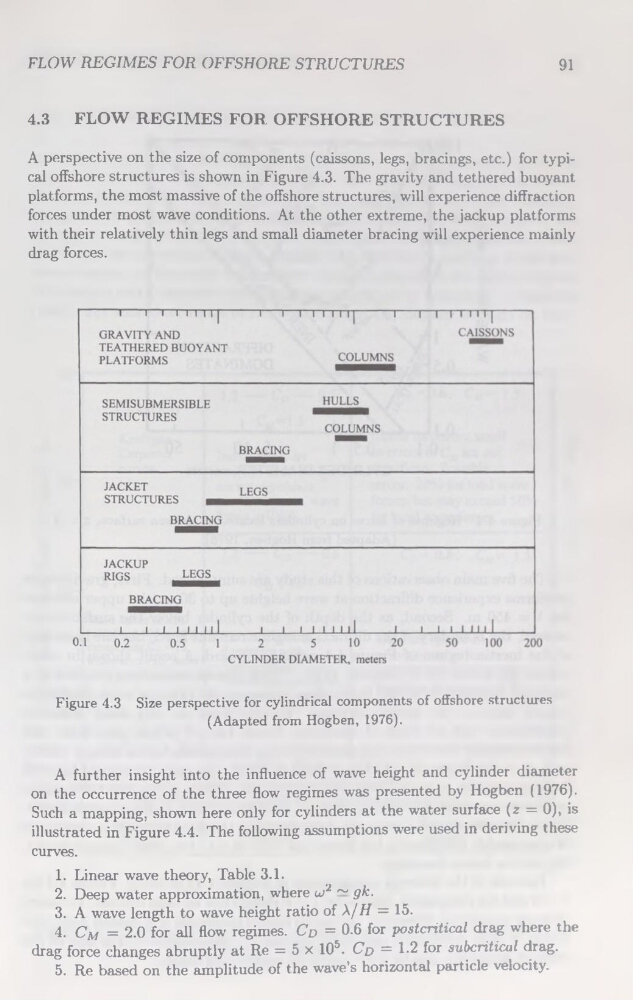
A perspective on the size of components (caissons, legs, bracings, etc.) for typical offshore structures is shown in Figure 4.3. The gravity and tethered buoyant
platforms, the most massive of the offshore structures, will expérience diffraction
forces under most wave conditions. At the other extreme, the jackup platforms
with their relatively thin legs and small diameter bracing will expérience mainly
drag forces.
Figure 4.3 Size perspective for cylindrical components of offshore structures
(Adapted from Hogben, 1976).
A further insight into the influence of wave height and cylinder diameter
on the occurrence of the three flow régimes was presented by Hogben (1976).
Such a mapping, shown here only for cylinders at the water surface (z = 0), is
illustrated in Figure 4.4. The following assumptions were used in deriving these
curves.
1. Linear wave theory, Table 3.1.
2. Deep water approximation, where u>2 ~ gk.
3. A wave length to wave height ratio of X(H = 15.
4. Cm = 2.0 for ail flow régimes. Cd = 0-6 for postcritical drag where the
drag force changes abruptly at Re = 5 x 10⁵. Cd = 1-2 for subcritical drag.
5. Re based on the amplitude of the wave’s horizontal particle velocity.
91
4.3 FLOW REGIMES FOR OFFSHORE STRUCTURES
A perspective on the size of components (caissons, legs, bracings, etc.) for typical offshore structures is shown in Figure 4.3. The gravity and tethered buoyant
platforms, the most massive of the offshore structures, will expérience diffraction
forces under most wave conditions. At the other extreme, the jackup platforms
with their relatively thin legs and small diameter bracing will expérience mainly
drag forces.
Figure 4.3 Size perspective for cylindrical components of offshore structures
(Adapted from Hogben, 1976).
A further insight into the influence of wave height and cylinder diameter
on the occurrence of the three flow régimes was presented by Hogben (1976).
Such a mapping, shown here only for cylinders at the water surface (z = 0), is
illustrated in Figure 4.4. The following assumptions were used in deriving these
curves.
1. Linear wave theory, Table 3.1.
2. Deep water approximation, where u>2 ~ gk.
3. A wave length to wave height ratio of X(H = 15.
4. Cm = 2.0 for ail flow régimes. Cd = 0-6 for postcritical drag where the
drag force changes abruptly at Re = 5 x 10⁵. Cd = 1-2 for subcritical drag.
5. Re based on the amplitude of the wave’s horizontal particle velocity.