

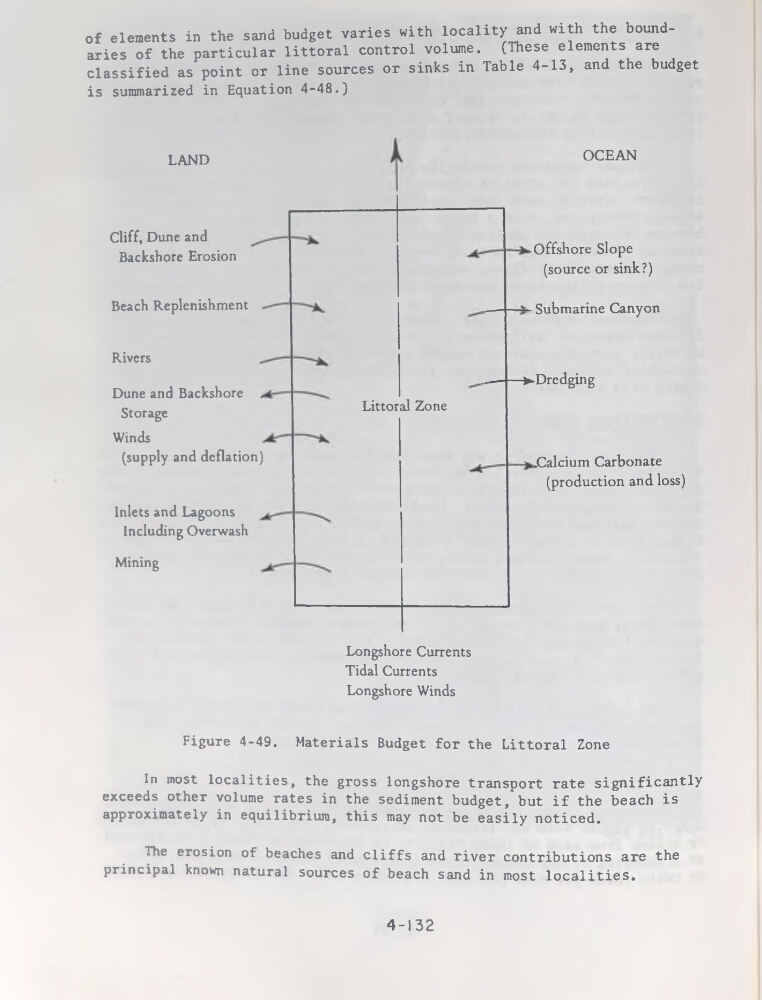
of éléments in the sand budget varies with locality and with the boundaries of the particular littoral control volume. (These éléments are
classified as point or line sources or sinks in Table 4-13, and the budget
is summarized in Equation 4-48.)
LAND
OCEAN
Cliff, Dune and
Backshore Erosion
Beach Replenishment
Rivers
Dune and Backshore >
Storage
Winds
(supply and déflation)
Littoral Zone
Offshore Slope
(source or sink?)
Submarine Canyon
■>■ Dredging
.Calcium Carbonate
(production and loss)
Inlets and Lagoons
Including Overwash
Mining
Longshore Currents
Tidal Currents
Longshore Winds
Figure 4-49. Materials Budget for the Littoral Zone
In most localities, the gross longshore transport rate significantly
exceeds other volume rates in the sédiment budget, but if the beach is
approximately in equilibrium, this may not be easily noticed.
The érosion of beaches and cliffs and river contributions are the
principal known natural sources of beach sand in most localities.
4-132
classified as point or line sources or sinks in Table 4-13, and the budget
is summarized in Equation 4-48.)
LAND
OCEAN
Cliff, Dune and
Backshore Erosion
Beach Replenishment
Rivers
Dune and Backshore >
Storage
Winds
(supply and déflation)
Littoral Zone
Offshore Slope
(source or sink?)
Submarine Canyon
■>■ Dredging
.Calcium Carbonate
(production and loss)
Inlets and Lagoons
Including Overwash
Mining
Longshore Currents
Tidal Currents
Longshore Winds
Figure 4-49. Materials Budget for the Littoral Zone
In most localities, the gross longshore transport rate significantly
exceeds other volume rates in the sédiment budget, but if the beach is
approximately in equilibrium, this may not be easily noticed.
The érosion of beaches and cliffs and river contributions are the
principal known natural sources of beach sand in most localities.
4-132