

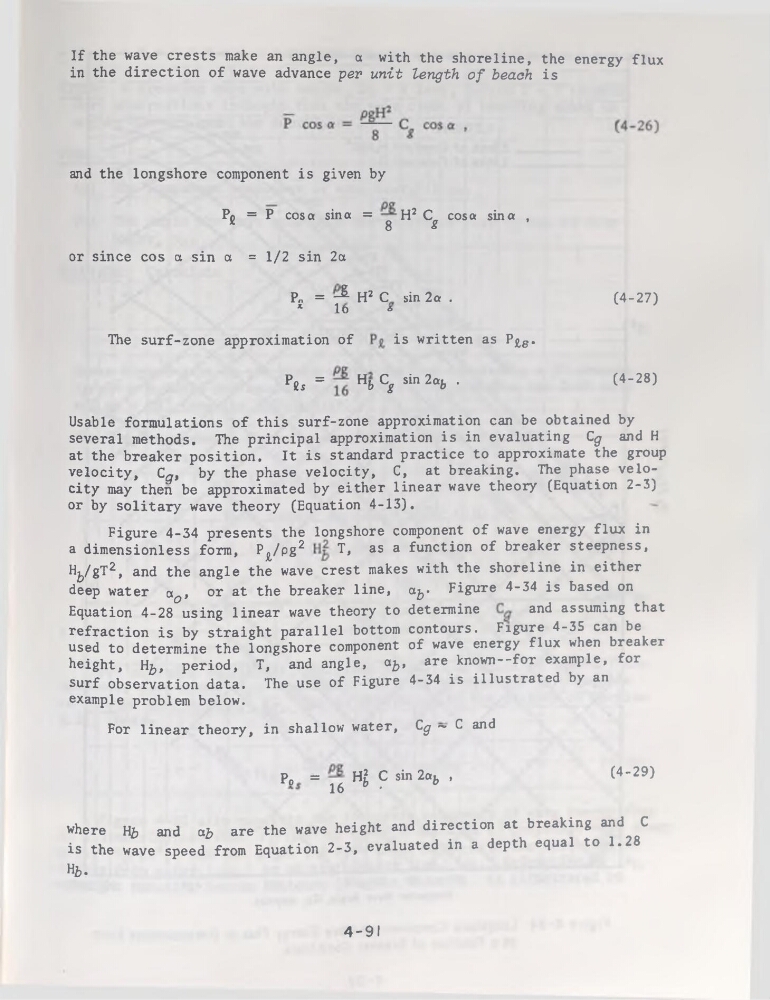
If the wave crests make an angle, a with the shoreline, the energy flux
in the direction of wave advance per unit length of beach is
and the longshore component is given by
Pp = P cos a sina =
H2 C cos a sina ,
*
8
Z
or since cos a sin a = 1/2 sin 2a
P„ = 7$ H2 C sin 2a .
(4-27)
*
lo
«
The surf-zone approximation of
is written as P£S.
pt, =
Hb C£ sin 2% •
(4-28)
Usable formulations of this surf-zone approximation can be obtained by
several methods. The principal approximation is in évaluâting Cg and H
at the breaker position. It is standard practice to approximate the group
velocity, Cqt by the phase velocity, C, at breaking. The phase velocity may then be approximated by either linear wave theory (Equation 2-3)
or by solitary wave theory (Equation 4-13).
Figure 4-34 présents the longshore component of wave energy flux in
a dimensionless form, P£/pg2
T» as a fonction of breaker steepness,
H^/gT2, and the angle the wave crest makes with the shoreline in either
deep water ao, or at the breaker line, a^. Figure 4-34 is based on
Equation 4-28 using linear wave theory to détermine
and assuming that
refraction is by straight parallel bottom contours. Figure 4-35 can be
used to détermine the longshore component of wave energy flux when breaker
height, Hh, period, T, and angle, ab, are known--for example, for
surf observation data. The use of Figure 4-34 is illustrated by an
example problem below.
For linear theory, in shallow water, Cg ~ C and
Po =
H? C sin 2afe ,
16 b • 0
(4-29)
where H/, and a£ are the wave height and direction at breaking and C
is the wave speed from Equation 2-3, evaluated in a depth equal to 1.28
H*.
4-91
in the direction of wave advance per unit length of beach is
and the longshore component is given by
Pp = P cos a sina =
H2 C cos a sina ,
*
8
Z
or since cos a sin a = 1/2 sin 2a
P„ = 7$ H2 C sin 2a .
(4-27)
*
lo
«
The surf-zone approximation of
is written as P£S.
pt, =
Hb C£ sin 2% •
(4-28)
Usable formulations of this surf-zone approximation can be obtained by
several methods. The principal approximation is in évaluâting Cg and H
at the breaker position. It is standard practice to approximate the group
velocity, Cqt by the phase velocity, C, at breaking. The phase velocity may then be approximated by either linear wave theory (Equation 2-3)
or by solitary wave theory (Equation 4-13).
Figure 4-34 présents the longshore component of wave energy flux in
a dimensionless form, P£/pg2
T» as a fonction of breaker steepness,
H^/gT2, and the angle the wave crest makes with the shoreline in either
deep water ao, or at the breaker line, a^. Figure 4-34 is based on
Equation 4-28 using linear wave theory to détermine
and assuming that
refraction is by straight parallel bottom contours. Figure 4-35 can be
used to détermine the longshore component of wave energy flux when breaker
height, Hh, period, T, and angle, ab, are known--for example, for
surf observation data. The use of Figure 4-34 is illustrated by an
example problem below.
For linear theory, in shallow water, Cg ~ C and
Po =
H? C sin 2afe ,
16 b • 0
(4-29)
where H/, and a£ are the wave height and direction at breaking and C
is the wave speed from Equation 2-3, evaluated in a depth equal to 1.28
H*.
4-91