

Longshore transport rates are usually given in units of volume per
time (cubic yards per year in the U.S.). Typical rates for oceanfront
beaches range from 105 to 106 cubic yards per year. (See Table 4-6.)
These volume rates typically include about 40 percent voids and 60 percent solids.
At présent, there are four basic methods to use for the prédiction
of longshore transport rate:
1. The best way to predict longshore transport at a site is to
adopt the best known rate from a nearby site, with modifictions based
on local conditions.
2. If rates from nearby sites are unknown, the next best way to
predict transport rates at a site is to compute them from data showing
historical changes in the topography of the littoral zone (charts, surveys, and dredging records are primary sources).
3. If neither Method 1 nor Method 2 is practical, then it is
accepted practice to use either measured or calculated wave conditions
to compute a longshore component of "wave energy flux" which is related
through an empirical curve to longshore transport rate. (Das, 1972.)
4. A recently developed empirical method (Galvin, 1972) is available to estimate gross longshore transport rate from mean annual nearshore breaker height. The gross rate, so obtained, can be used as an
upper limit on net longshore transport rate.
Method 1 dépends largely on engineering judgement and local data.
Method 2 is an application of historical data, which gives usable answers
if the basic data are reliable and available at reasonable cost, and the
interprétation is based on a thorough knowledge of the locality. By
choosing only a few représentative wave conditions, Method 3 can usually
supply an answer with less work than Method 2, but with correspondingly
less certainty. Because calculation of wave statistics in Method 3 follows
an established routine, it is often easier to use than researching t e
hydrographie records and computing the changes necessary for Met o
.
Method 4 requires mean nearshore breaker height data. Section 4.532
utilizes Methods 3 and 4. Methods 1 and 2 are discussed m Section 4.8.
4.532 Energy Flux Method. Method 3 is based on the assumption that longshore transport rate, Q, dépends on the longshore component of energy flux
in the surf zone. The longshore energy flux in the surf zone is approximated by assuming conservation of energy flux in shoaling waves, using
small-amplitude theory, and then evaluating the energy flux relation at
the breaker position. The energy flux per unit length of wave crest, or,
equivalently, the rate at which wave energy is transmitted across a plane
of unit width perpendicular to the direction of wave advan<.e is from
Section 2.238, combining Equations 2-39 and 2-40):
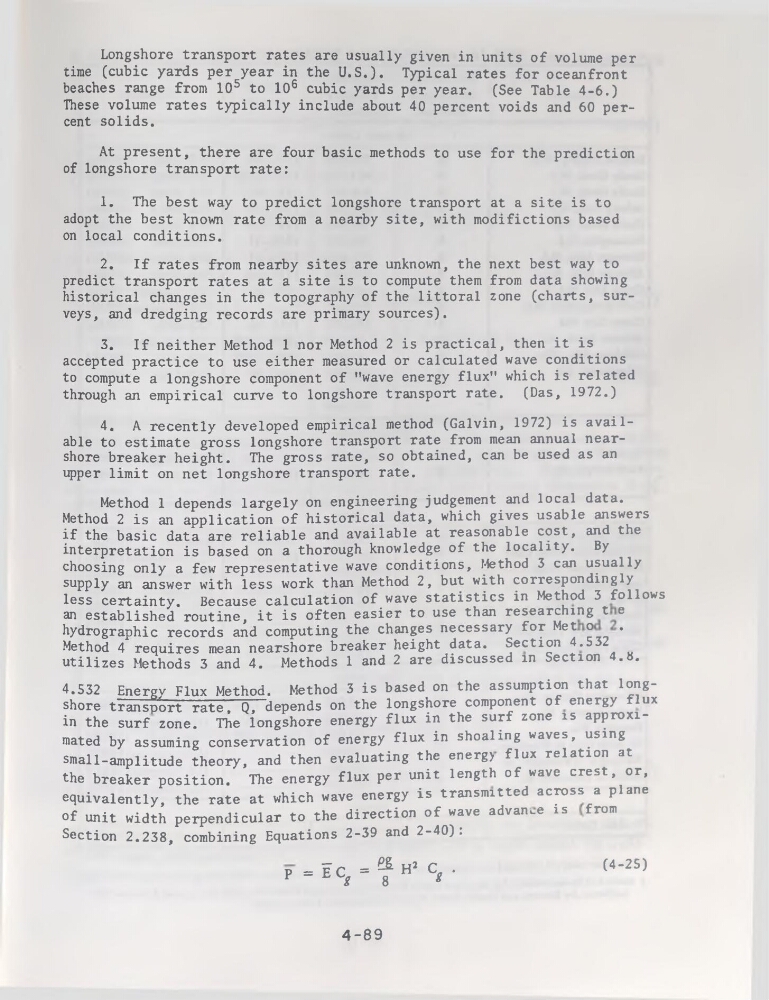
P-ÊC,-f H’C,.
(4-25)
4-89
time (cubic yards per year in the U.S.). Typical rates for oceanfront
beaches range from 105 to 106 cubic yards per year. (See Table 4-6.)
These volume rates typically include about 40 percent voids and 60 percent solids.
At présent, there are four basic methods to use for the prédiction
of longshore transport rate:
1. The best way to predict longshore transport at a site is to
adopt the best known rate from a nearby site, with modifictions based
on local conditions.
2. If rates from nearby sites are unknown, the next best way to
predict transport rates at a site is to compute them from data showing
historical changes in the topography of the littoral zone (charts, surveys, and dredging records are primary sources).
3. If neither Method 1 nor Method 2 is practical, then it is
accepted practice to use either measured or calculated wave conditions
to compute a longshore component of "wave energy flux" which is related
through an empirical curve to longshore transport rate. (Das, 1972.)
4. A recently developed empirical method (Galvin, 1972) is available to estimate gross longshore transport rate from mean annual nearshore breaker height. The gross rate, so obtained, can be used as an
upper limit on net longshore transport rate.
Method 1 dépends largely on engineering judgement and local data.
Method 2 is an application of historical data, which gives usable answers
if the basic data are reliable and available at reasonable cost, and the
interprétation is based on a thorough knowledge of the locality. By
choosing only a few représentative wave conditions, Method 3 can usually
supply an answer with less work than Method 2, but with correspondingly
less certainty. Because calculation of wave statistics in Method 3 follows
an established routine, it is often easier to use than researching t e
hydrographie records and computing the changes necessary for Met o
.
Method 4 requires mean nearshore breaker height data. Section 4.532
utilizes Methods 3 and 4. Methods 1 and 2 are discussed m Section 4.8.
4.532 Energy Flux Method. Method 3 is based on the assumption that longshore transport rate, Q, dépends on the longshore component of energy flux
in the surf zone. The longshore energy flux in the surf zone is approximated by assuming conservation of energy flux in shoaling waves, using
small-amplitude theory, and then evaluating the energy flux relation at
the breaker position. The energy flux per unit length of wave crest, or,
equivalently, the rate at which wave energy is transmitted across a plane
of unit width perpendicular to the direction of wave advan<.e is from
Section 2.238, combining Equations 2-39 and 2-40):
P-ÊC,-f H’C,.
(4-25)
4-89