

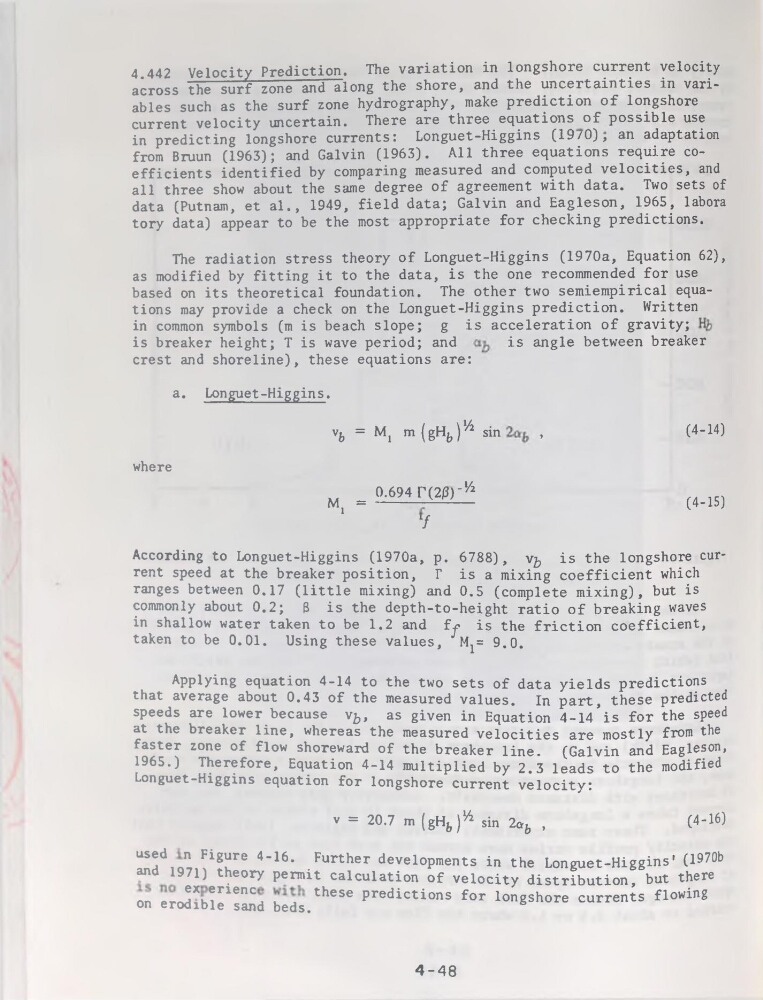
4.442 Velocity Prédiction. The variation in longshore current velocity
across the surf zone and along the shore, and the uncertainties in variables such as the surf zone hydrography, make prédiction of longshore
current velocity uncertain. There are three équations of possible use
in predicting longshore currents: Longuet-Higgins (19/0), an adaptation
from Bruun (1963); and Galvin (1963). Ail three équations require coefficients identified by comparing measured and computed velocities, and
ail three show about the saine degree of agreement with data. Two sets of
data (Putnam, et al., 1949, field data; Galvin and Eagleson, 1965, labora
tory data) appear to be the most appropriate for checking prédictions.
The radiation stress theory of Longuet-Higgins (1970a, Equation 62),
as modified by fitting it to the data, is the one recommended for use
based on its theoretical foundation. The other two semiempirical équations may provide a check on the Longuet-Higgins prédiction. Written
in common symbols (m is beach slope; g is accélération of gravity;
is breaker height; T is wave period; and
is angle between breaker
crest and shoreline), these équations are:
a. Longuet-Higgins.
vb = Mj m(gHb)1//2 sin
,
(4-14)
where
m, = °-694rœ)-*
(4.15)
7
According to Longuet-Higgins (1970a, p. 6788), v^ is the longshore current speed at the breaker position, T is a mixing coefficient which
ranges between 0.17 (little mixing) and 0.5 (complété mixing), but is
commonly about 0.2; B is the depth-to-height ratio of breaking waves
in shallow water taken to be 1.2 and fy? is the friction coefficient,
taken to be 0.01. Using these values, JMj= 9.0.
Applying équation 4-14 to the two sets of data yields prédictions
that average about 0.43 of the measured values. In part, these predicted
speeds are lower because v^, as given in Equation 4-14*is for the speed
at the breaker line, whereas the measured velocities are mostly from the
faster zone of flow shoreward of the breaker line. (Galvin and Eagleson,
1965.) Therefore, Equation 4-14 multiplied by 2.3 leads to the modified
Longuet-Higgins équation for longshore current velocity:
v = 20.7 m (gHb ),/2 sin 2% ,
(4-16)
US!d.on, FiTe 4'16’ Further developments in the Longuet-Higgins' (1970b
and 1971) theory permit calculation of velocity distribution, but there
nn oT-rJ*w^rienCj
these prédictions for longshore currents flowing
on erodible sand beds.
4-48
across the surf zone and along the shore, and the uncertainties in variables such as the surf zone hydrography, make prédiction of longshore
current velocity uncertain. There are three équations of possible use
in predicting longshore currents: Longuet-Higgins (19/0), an adaptation
from Bruun (1963); and Galvin (1963). Ail three équations require coefficients identified by comparing measured and computed velocities, and
ail three show about the saine degree of agreement with data. Two sets of
data (Putnam, et al., 1949, field data; Galvin and Eagleson, 1965, labora
tory data) appear to be the most appropriate for checking prédictions.
The radiation stress theory of Longuet-Higgins (1970a, Equation 62),
as modified by fitting it to the data, is the one recommended for use
based on its theoretical foundation. The other two semiempirical équations may provide a check on the Longuet-Higgins prédiction. Written
in common symbols (m is beach slope; g is accélération of gravity;
is breaker height; T is wave period; and
is angle between breaker
crest and shoreline), these équations are:
a. Longuet-Higgins.
vb = Mj m(gHb)1//2 sin
,
(4-14)
where
m, = °-694rœ)-*
(4.15)
7
According to Longuet-Higgins (1970a, p. 6788), v^ is the longshore current speed at the breaker position, T is a mixing coefficient which
ranges between 0.17 (little mixing) and 0.5 (complété mixing), but is
commonly about 0.2; B is the depth-to-height ratio of breaking waves
in shallow water taken to be 1.2 and fy? is the friction coefficient,
taken to be 0.01. Using these values, JMj= 9.0.
Applying équation 4-14 to the two sets of data yields prédictions
that average about 0.43 of the measured values. In part, these predicted
speeds are lower because v^, as given in Equation 4-14*is for the speed
at the breaker line, whereas the measured velocities are mostly from the
faster zone of flow shoreward of the breaker line. (Galvin and Eagleson,
1965.) Therefore, Equation 4-14 multiplied by 2.3 leads to the modified
Longuet-Higgins équation for longshore current velocity:
v = 20.7 m (gHb ),/2 sin 2% ,
(4-16)
US!d.on, FiTe 4'16’ Further developments in the Longuet-Higgins' (1970b
and 1971) theory permit calculation of velocity distribution, but there
nn oT-rJ*w^rienCj
these prédictions for longshore currents flowing
on erodible sand beds.
4-48