

mostly on breaker height. The outer edge of the surf zone is determined
by the breaker position. Since waves break in water depths approximately
proportional to wave height, the width of the surf zone on a beach increases with wave height. This increase in width increases the cross
section of the surf zone.
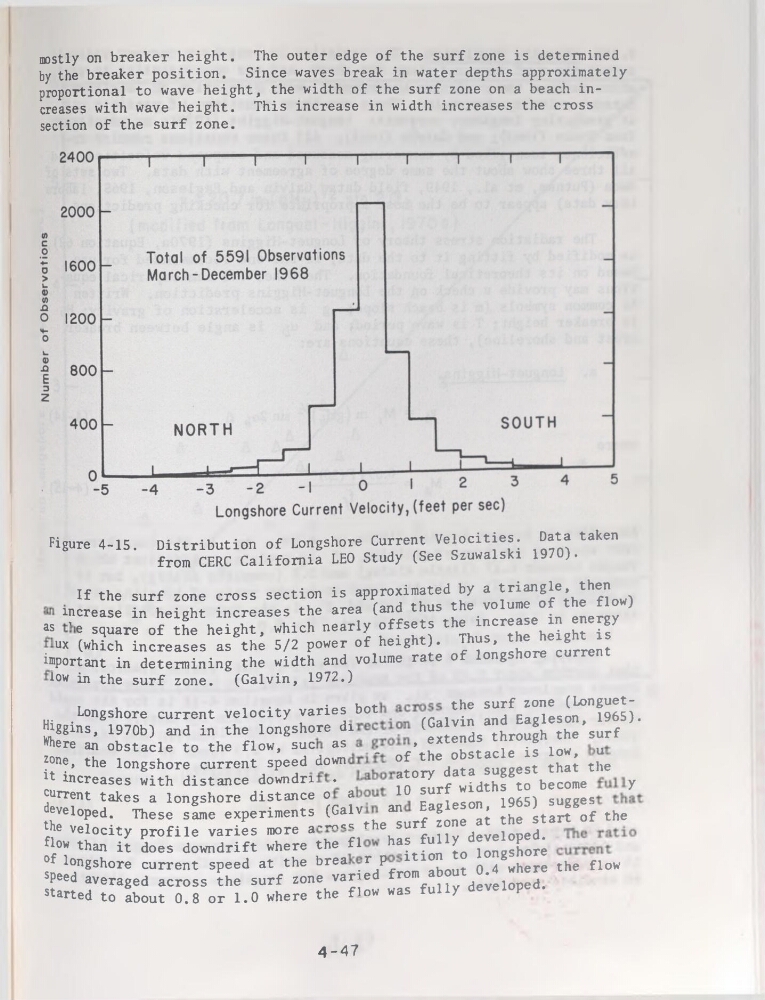
Figure 4-15. Distribution of Longshore Current Velocities. Data taken
from CERC California LEO Study (See Szuwalski 1970).
If the surf zone cross section is approximated by a triangle, then
as i?Crease in height increases the area (and thus the volume of the flow)
e square of the height, which nearly offsets the increase in energy
• ux (which increases as the 5/2 power of height). Thus, the height is
of longshore current
important in determining the width and volume rate
low in ^e surf zone. (Gaivin, 1972.)
the surf zone (LonguetLongshore current velocity varies ^ot
(Gaivin and Eagleson, 1965).
Higgins, 1970b) and in the longshore di
extends through the surf
Where an obstacle to the flow, suc as
_ of’the obstacle is low, u
zone, the longshore current speed down
atory data suggest that the
it increases with distance downdn .
10 surf widths to become
y
current takes a longshore distance o a
Eagleson, 1965) sugges
developed. These same experiments 2^Vthe^urf zone at the start of the
the velocity profile varies more a
has fuiiy developed.
flow than it does downdrift where the fl
ition to longshore
of longshore current speed at the ^,e,îriIdPfrom about 0.4 where the flow
speed averaged across the surf Z°n!J%low was fully developed.
started to about 0.8 or 1.0 where the r
4-47
by the breaker position. Since waves break in water depths approximately
proportional to wave height, the width of the surf zone on a beach increases with wave height. This increase in width increases the cross
section of the surf zone.
Figure 4-15. Distribution of Longshore Current Velocities. Data taken
from CERC California LEO Study (See Szuwalski 1970).
If the surf zone cross section is approximated by a triangle, then
as i?Crease in height increases the area (and thus the volume of the flow)
e square of the height, which nearly offsets the increase in energy
• ux (which increases as the 5/2 power of height). Thus, the height is
of longshore current
important in determining the width and volume rate
low in ^e surf zone. (Gaivin, 1972.)
the surf zone (LonguetLongshore current velocity varies ^ot
(Gaivin and Eagleson, 1965).
Higgins, 1970b) and in the longshore di
extends through the surf
Where an obstacle to the flow, suc as
_ of’the obstacle is low, u
zone, the longshore current speed down
atory data suggest that the
it increases with distance downdn .
10 surf widths to become
y
current takes a longshore distance o a
Eagleson, 1965) sugges
developed. These same experiments 2^Vthe^urf zone at the start of the
the velocity profile varies more a
has fuiiy developed.
flow than it does downdrift where the fl
ition to longshore
of longshore current speed at the ^,e,îriIdPfrom about 0.4 where the flow
speed averaged across the surf Z°n!J%low was fully developed.
started to about 0.8 or 1.0 where the r
4-47