

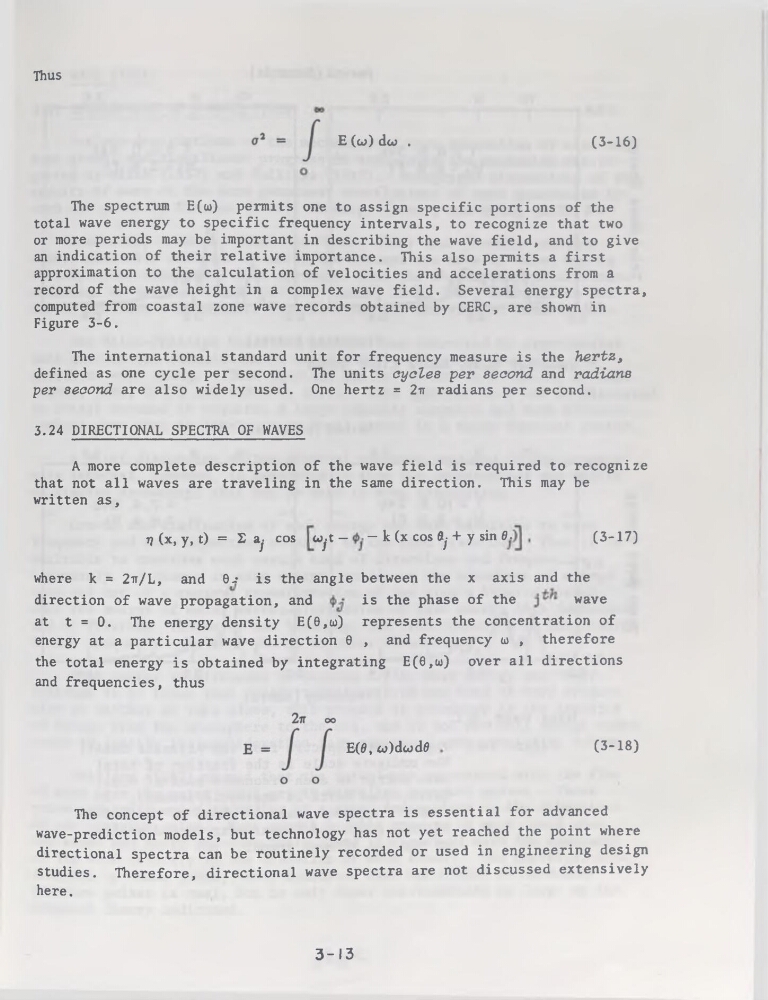
Thus
E (w) dc*> .
(3-16)
The spectrum E(œ) permits one to assign spécifie portions of the
total wave energy to spécifie frequency intervals, to recognize that two
or more periods may be important in describing the wave field, and to give
an indication of their relative importance. This also permits a first
approximation to the calculation of velocities and accélérations from a
record of the wave height in a complex wave field. Several energy spectra,
computed from Coastal zone wave records obtained by CERC, are shown in
Figure 3-6.
The international standard unit for frequency measure is the hertz,
defined as one cycle per second. The units cycles per second and radians
per second are also widely used. One hertz = 2tt radians per second.
3.24 DIRECTIONAL SPECTRA OF WAVES
A more complété description of the wave field is required to recognize
that not ail waves are traveling in the same direction. This may be
written as,
17 (x, y, t) = S ay cos a>yt — — k (x cos fly + y sin 6(3-17)
where k = 2it/L, and ©-• is the angle between the x axis and the
direction of wave propagation, and
is the phase of the
wave
at t = 0. The energy density E(0,œ) represents the concentration of
energy at a particular wave direction 0 , and frequency œ , therefore
the total energy is obtained by integrating E(0,œ) over ail directions
and frequencies, thus
E(0, w)dwd0
(3-18)
The concept of directional wave spectra is essential for advanced
wave-prediction models, but technology has not yet reached the point where
directional spectra can be routinely recorded or used in engineering design
studies. Therefore, directional wave spectra are not discussed extensively
here.
3-13
E (w) dc*> .
(3-16)
The spectrum E(œ) permits one to assign spécifie portions of the
total wave energy to spécifie frequency intervals, to recognize that two
or more periods may be important in describing the wave field, and to give
an indication of their relative importance. This also permits a first
approximation to the calculation of velocities and accélérations from a
record of the wave height in a complex wave field. Several energy spectra,
computed from Coastal zone wave records obtained by CERC, are shown in
Figure 3-6.
The international standard unit for frequency measure is the hertz,
defined as one cycle per second. The units cycles per second and radians
per second are also widely used. One hertz = 2tt radians per second.
3.24 DIRECTIONAL SPECTRA OF WAVES
A more complété description of the wave field is required to recognize
that not ail waves are traveling in the same direction. This may be
written as,
17 (x, y, t) = S ay cos a>yt — — k (x cos fly + y sin 6(3-17)
where k = 2it/L, and ©-• is the angle between the x axis and the
direction of wave propagation, and
is the phase of the
wave
at t = 0. The energy density E(0,œ) represents the concentration of
energy at a particular wave direction 0 , and frequency œ , therefore
the total energy is obtained by integrating E(0,œ) over ail directions
and frequencies, thus
E(0, w)dwd0
(3-18)
The concept of directional wave spectra is essential for advanced
wave-prediction models, but technology has not yet reached the point where
directional spectra can be routinely recorded or used in engineering design
studies. Therefore, directional wave spectra are not discussed extensively
here.
3-13