

Chap. 8. Mouvement d'une particule chargée ...
À f = 0, yo = o et Voy = 0, on en déduit donc ■
qE
y(0) = A cos 0 +---- 7 = 0
ma)ÿ(0) = -Awsin^» = 0
(8.15)
L'équation Aa) sin = 0 conduit à ci E
Q
L’équation A cos +
= 0 donne A =------- z------Comme A est une
H
ma)2
ma)1 cos cp
qE
grandeur positive, cela conduit à cos 0 < 0 : donc cf) = tt et A =
La solution cherchée est donc :
qE
qE
qE
qE
qE
y(/) = ------- COS(ûrt + 77) + ----- X- =---------z COS (Dt + ---- z = ------y(l — COS (Dt)
ma)mar
ma)ma)1
ma)~
(8.16)
Déterminons, maintenant, l’expression de x(z).
On a x = — B y
m
Une première intégration conduit à : x = — By car yo = 0m
qE
Comme y(r) =---- z(l - cos art) alors
ma)q
qE ,,
qE
q „
x = — B x ---- r(l — cos art) =---- (1 — cos art)
car
a)——B.
m
ma)mœ
m
En intégrant l'équation précédente, et comme x 0 - 0, on aboutit à :
/
qE
x(r) = —
ma)
1 .
\
qE z
t-----sin ait =----- -(ut — sin (Dt)
a)
/
ma)1
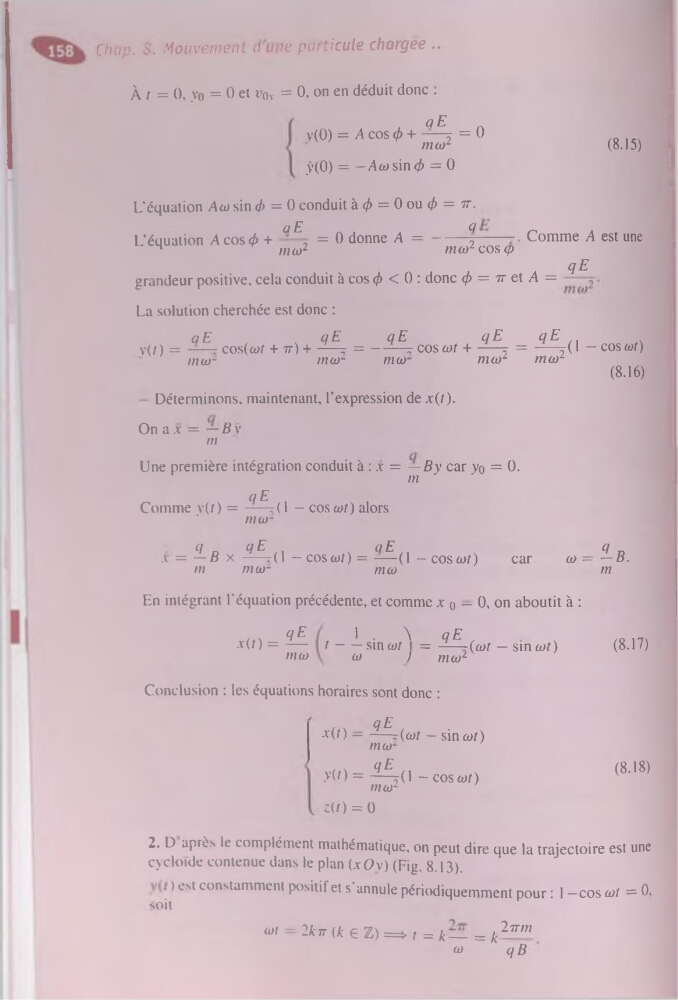
Conclusion : les équations horaires sont donc :
. .
qE
x(t) —---- z(a)t — sin art)
ma). .
qE
>’(0 =---- 7(1 - cos art)
ma)1
Z(t) = 0
(8.17)
(8.18)
2. D après le complément mathématique, on peut dire que la trajectoire est une
cycloïde contenue dans le plan (xOv) (Fig. 8.13).
>esl constamment positif et s'annule périodiquemment pour : I -cos at = 0,
soit
O)t = IkTT (keZ)=^t=k~= k277""1
À f = 0, yo = o et Voy = 0, on en déduit donc ■
qE
y(0) = A cos 0 +---- 7 = 0
ma)ÿ(0) = -Awsin^» = 0
(8.15)
L'équation Aa) sin = 0 conduit à ci E
Q
L’équation A cos +
= 0 donne A =------- z------Comme A est une
H
ma)2
ma)1 cos cp
qE
grandeur positive, cela conduit à cos 0 < 0 : donc cf) = tt et A =
La solution cherchée est donc :
qE
qE
qE
qE
qE
y(/) = ------- COS(ûrt + 77) + ----- X- =---------z COS (Dt + ---- z = ------y(l — COS (Dt)
ma)mar
ma)ma)1
ma)~
(8.16)
Déterminons, maintenant, l’expression de x(z).
On a x = — B y
m
Une première intégration conduit à : x = — By car yo = 0m
qE
Comme y(r) =---- z(l - cos art) alors
ma)q
qE ,,
qE
q „
x = — B x ---- r(l — cos art) =---- (1 — cos art)
car
a)——B.
m
ma)mœ
m
En intégrant l'équation précédente, et comme x 0 - 0, on aboutit à :
/
qE
x(r) = —
ma)
1 .
\
qE z
t-----sin ait =----- -(ut — sin (Dt)
a)
/
ma)1
Conclusion : les équations horaires sont donc :
. .
qE
x(t) —---- z(a)t — sin art)
ma). .
qE
>’(0 =---- 7(1 - cos art)
ma)1
Z(t) = 0
(8.17)
(8.18)
2. D après le complément mathématique, on peut dire que la trajectoire est une
cycloïde contenue dans le plan (xOv) (Fig. 8.13).
>esl constamment positif et s'annule périodiquemment pour : I -cos at = 0,
soit
O)t = IkTT (keZ)=^t=k~= k277""1