

62
Chemical Oceanography, 4th Edition
where S P is the practical salinity. The value of S R provides the best estimate of the absolute salinity of standard seawater that was used in measuring the physical properties of seawater. The
values of S R are used as a concentration variable for all the physical and thermodynamic properties of seawater. This provides a salinity standard that can be used to examine the changes in
the physical properties of seawater over time and a theoretical model for electrolyte mixtures.
The composition of seawater is not constant. It varies from place to place due to the
addition of nutrients from the breakdown of plants and the precipitation and dissolution
of CaCO 3 . This was first pointed out by Brewer and Bradshaw (1975). They suggested that
these changes in composition can change the density of deep waters and affect the density–
conductivity relationship of seawater. This paper led to the examination of the density–
salinity relationship of waters collected around the world by my group. The changes in the
absolute salinity δS A were given by
δS A = S A – S R
(2.14)
The value of δS A is estimated from the difference between the measured densities and
the values determined from the equation of state of seawater as a function of salinity
and temperature (Δρ) using
δS A = Δρ/0.7519 kg m –1 /(g kg –1 )
(2.15)
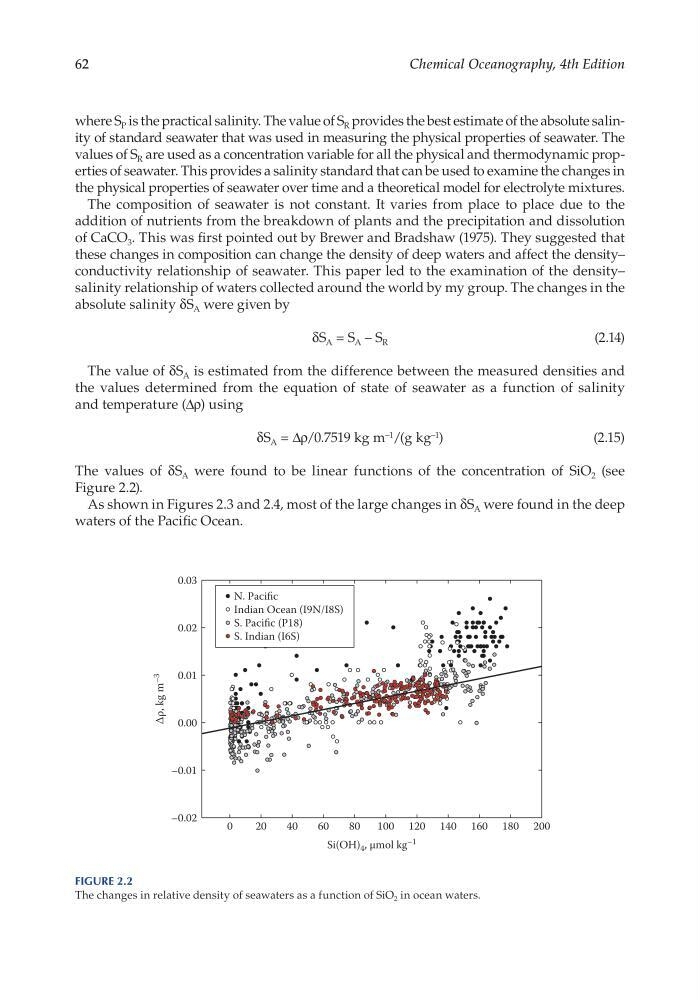
The values of δS A were found to be linear functions of the concentration of SiO 2 (see
Figure 2.2).
As shown in Figures 2.3 and 2.4, most of the large changes in δS A were found in the deep
waters of the Pacific Ocean.
Si(OH) 4 , µmol kg
–1
0
20
40
60
80
100 120 140 160 180 200
∆ρ, kg m
–3
–0.02
–0.01
0.00
0.01
0.02
0.03
N. Pacific
Indian Ocean (I9N/I8S)
S. Pacific (P18)
S. Indian (I6S)
Figure 2.2
The changes in relative density of seawaters as a function of SiO 2 in ocean waters.
Chemical Oceanography, 4th Edition
where S P is the practical salinity. The value of S R provides the best estimate of the absolute salinity of standard seawater that was used in measuring the physical properties of seawater. The
values of S R are used as a concentration variable for all the physical and thermodynamic properties of seawater. This provides a salinity standard that can be used to examine the changes in
the physical properties of seawater over time and a theoretical model for electrolyte mixtures.
The composition of seawater is not constant. It varies from place to place due to the
addition of nutrients from the breakdown of plants and the precipitation and dissolution
of CaCO 3 . This was first pointed out by Brewer and Bradshaw (1975). They suggested that
these changes in composition can change the density of deep waters and affect the density–
conductivity relationship of seawater. This paper led to the examination of the density–
salinity relationship of waters collected around the world by my group. The changes in the
absolute salinity δS A were given by
δS A = S A – S R
(2.14)
The value of δS A is estimated from the difference between the measured densities and
the values determined from the equation of state of seawater as a function of salinity
and temperature (Δρ) using
δS A = Δρ/0.7519 kg m –1 /(g kg –1 )
(2.15)
The values of δS A were found to be linear functions of the concentration of SiO 2 (see
Figure 2.2).
As shown in Figures 2.3 and 2.4, most of the large changes in δS A were found in the deep
waters of the Pacific Ocean.
Si(OH) 4 , µmol kg
–1
0
20
40
60
80
100 120 140 160 180 200
∆ρ, kg m
–3
–0.02
–0.01
0.00
0.01
0.02
0.03
N. Pacific
Indian Ocean (I9N/I8S)
S. Pacific (P18)
S. Indian (I6S)
Figure 2.2
The changes in relative density of seawaters as a function of SiO 2 in ocean waters.