

61
Composition of the Major Components of Seawater
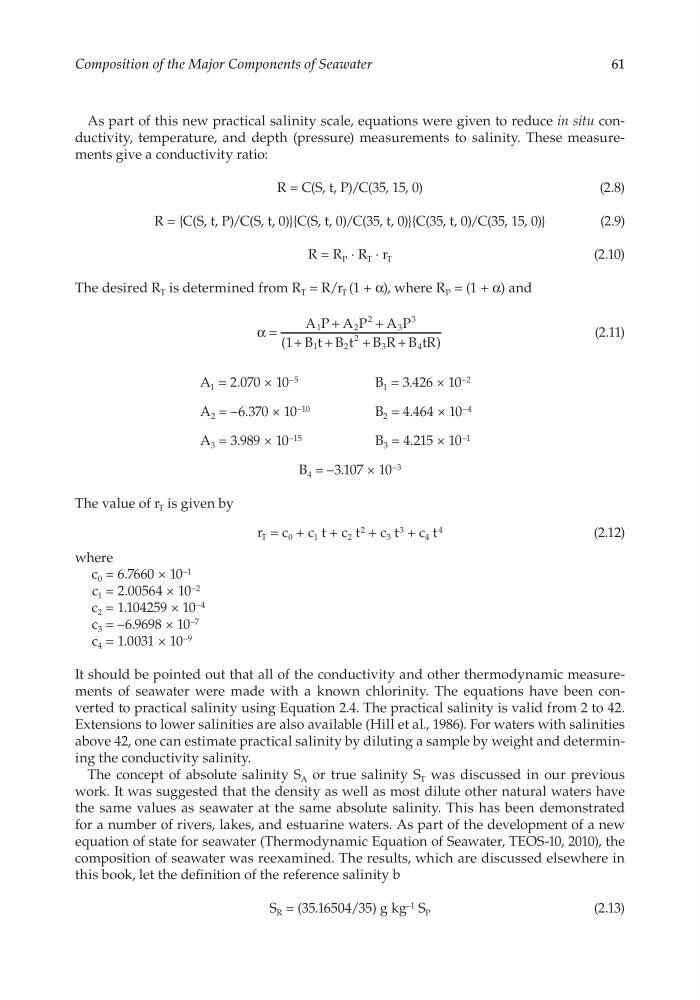
As part of this new practical salinity scale, equations were given to reduce in situ conductivity, temperature, and depth (pressure) measurements to salinity. These measurements give a conductivity ratio:
R = C(S, t, P)/C(35, 15, 0)
(2.8)
R = {C(S, t, P)/C(S, t, 0)}{C(S, t, 0)/C(35, t, 0)}{C(35, t, 0)/C(35, 15, 0)}
(2.9)
R = R P · R T · r T
(2.10)
The desired R T is determined from R T = R/ r T (1 + α), where R P = (1 + α) and
α =
+
+
+
+
+
+
A P A P A P
B t B t B R B tR
1
2
2
3
3
1
2
2
3
4
1
(
)
(2.11)
A 1 = 2.070 × 10 –5
B 1 = 3.426 × 10 –2
A 2 = –6.370 × 10 –10
B 2 = 4.464 × 10 –4
A 3 = 3.989 × 10 –15
B 3 = 4.215 × 10 –1
B 4 = –3.107 × 10 –3
The value of r T is given by
r T = c 0 + c 1 t + c 2 t 2 + c 3 t 3 + c 4 t 4
(2.12)
where
c 0 = 6.7660 × 10 –1
c 1 = 2.00564 × 10 –2
c 2 = 1.104259 × 10 –4
c 3 = –6.9698 × 10 –7
c 4 = 1.0031 × 10 –9
It should be pointed out that all of the conductivity and other thermodynamic measurements of seawater were made with a known chlorinity. The equations have been converted to practical salinity using Equation 2.4. The practical salinity is valid from 2 to 42.
Extensions to lower salinities are also available (Hill et al., 1986). For waters with salinities
above 42, one can estimate practical salinity by diluting a sample by weight and determining the conductivity salinity.
The concept of absolute salinity S A or true salinity S T was discussed in our previous
work. It was suggested that the density as well as most dilute other natural waters have
the same values as seawater at the same absolute salinity. This has been demonstrated
for a number of rivers, lakes, and estuarine waters. As part of the development of a new
equation of state for seawater (Thermodynamic Equation of Seawater, TEOS-10, 2010), the
composition of seawater was reexamined. The results, which are discussed elsewhere in
this book, let the definition of the reference salinity b
S R = (35.16504/35) g kg –1 S P
(2.13)
Composition of the Major Components of Seawater
As part of this new practical salinity scale, equations were given to reduce in situ conductivity, temperature, and depth (pressure) measurements to salinity. These measurements give a conductivity ratio:
R = C(S, t, P)/C(35, 15, 0)
(2.8)
R = {C(S, t, P)/C(S, t, 0)}{C(S, t, 0)/C(35, t, 0)}{C(35, t, 0)/C(35, 15, 0)}
(2.9)
R = R P · R T · r T
(2.10)
The desired R T is determined from R T = R/ r T (1 + α), where R P = (1 + α) and
α =
+
+
+
+
+
+
A P A P A P
B t B t B R B tR
1
2
2
3
3
1
2
2
3
4
1
(
)
(2.11)
A 1 = 2.070 × 10 –5
B 1 = 3.426 × 10 –2
A 2 = –6.370 × 10 –10
B 2 = 4.464 × 10 –4
A 3 = 3.989 × 10 –15
B 3 = 4.215 × 10 –1
B 4 = –3.107 × 10 –3
The value of r T is given by
r T = c 0 + c 1 t + c 2 t 2 + c 3 t 3 + c 4 t 4
(2.12)
where
c 0 = 6.7660 × 10 –1
c 1 = 2.00564 × 10 –2
c 2 = 1.104259 × 10 –4
c 3 = –6.9698 × 10 –7
c 4 = 1.0031 × 10 –9
It should be pointed out that all of the conductivity and other thermodynamic measurements of seawater were made with a known chlorinity. The equations have been converted to practical salinity using Equation 2.4. The practical salinity is valid from 2 to 42.
Extensions to lower salinities are also available (Hill et al., 1986). For waters with salinities
above 42, one can estimate practical salinity by diluting a sample by weight and determining the conductivity salinity.
The concept of absolute salinity S A or true salinity S T was discussed in our previous
work. It was suggested that the density as well as most dilute other natural waters have
the same values as seawater at the same absolute salinity. This has been demonstrated
for a number of rivers, lakes, and estuarine waters. As part of the development of a new
equation of state for seawater (Thermodynamic Equation of Seawater, TEOS-10, 2010), the
composition of seawater was reexamined. The results, which are discussed elsewhere in
this book, let the definition of the reference salinity b
S R = (35.16504/35) g kg –1 S P
(2.13)