

49
Descriptive Oceanography
sills between Greenland and Iceland. The temperature and salinity of this water are,
respectively, 2°C and 35.0. This water flows to the south and, after mixing with bottom
waters, flows into the South Pacific and South Indian Oceans. It is thus the major water
mass of deep- ocean basins. From 14 C data, estimates have been made of the time it takes
for these waters to make a complete cycle. These estimates were given by Stuiver, Quay,
and Ostlund (1983). The estimates came from using a simple box model to account for
the 14 C measurements. The net flow of the water from the Atlantic to the Circumpolar is
4 Sv, while the net flow from the Circumpolar to the Indian is 20 Sv and to the Pacific
is 25 Sv. The upwelling in the Atlantic (10 Sv), Indian (20 Sv), and Pacific (25 Sv) are balanced by the downwelling of North Atlantic waters (14 Sv) and Antarctic bottom water
formed in the Circumpolar region (41 Sv). The 550-yr estimate for the replacement time
for deep Pacific waters is much shorter than earlier estimates (1000 to 1500 yr) made
using simpler box models.
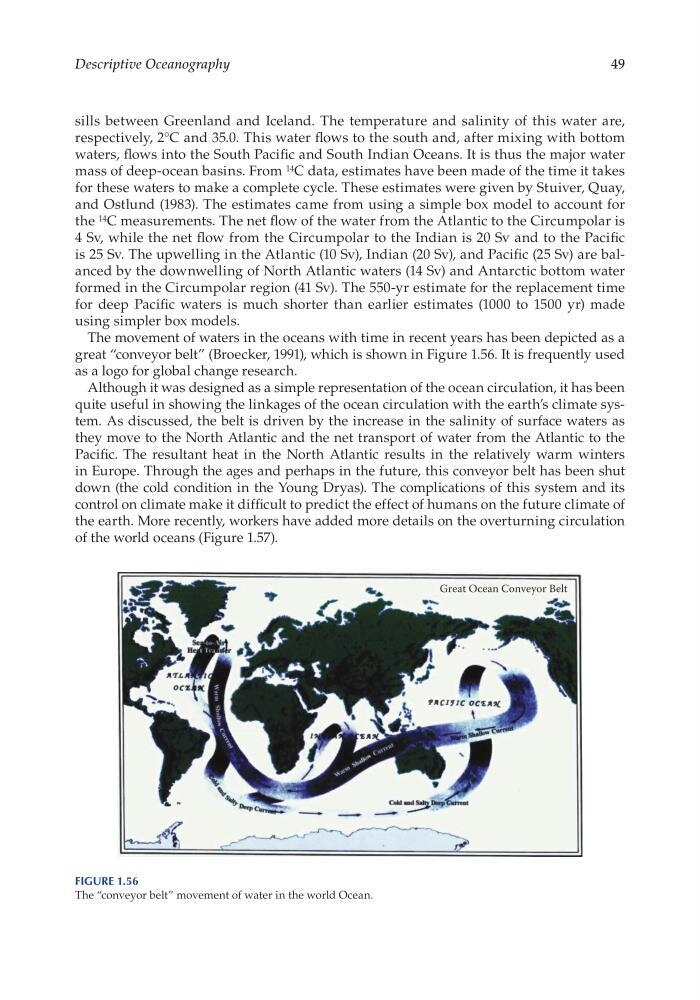
The movement of waters in the oceans with time in recent years has been depicted as a
great “conveyor belt” (Broecker, 1991), which is shown in Figure 1.56. It is frequently used
as a logo for global change research.
Although it was designed as a simple representation of the ocean circulation, it has been
quite useful in showing the linkages of the ocean circulation with the earth’s climate system. As discussed, the belt is driven by the increase in the salinity of surface waters as
they move to the North Atlantic and the net transport of water from the Atlantic to the
Pacific. The resultant heat in the North Atlantic results in the relatively warm winters
in Europe. Through the ages and perhaps in the future, this conveyor belt has been shut
down (the cold condition in the Young Dryas). The complications of this system and its
control on climate make it difficult to predict the effect of humans on the future climate of
the earth. More recently, workers have added more details on the overturning circulation
of the world oceans (Figure 1.57).
Great Ocean Conveyor Belt
Figure 1.56
The “conveyor belt” movement of water in the world Ocean.
Descriptive Oceanography
sills between Greenland and Iceland. The temperature and salinity of this water are,
respectively, 2°C and 35.0. This water flows to the south and, after mixing with bottom
waters, flows into the South Pacific and South Indian Oceans. It is thus the major water
mass of deep- ocean basins. From 14 C data, estimates have been made of the time it takes
for these waters to make a complete cycle. These estimates were given by Stuiver, Quay,
and Ostlund (1983). The estimates came from using a simple box model to account for
the 14 C measurements. The net flow of the water from the Atlantic to the Circumpolar is
4 Sv, while the net flow from the Circumpolar to the Indian is 20 Sv and to the Pacific
is 25 Sv. The upwelling in the Atlantic (10 Sv), Indian (20 Sv), and Pacific (25 Sv) are balanced by the downwelling of North Atlantic waters (14 Sv) and Antarctic bottom water
formed in the Circumpolar region (41 Sv). The 550-yr estimate for the replacement time
for deep Pacific waters is much shorter than earlier estimates (1000 to 1500 yr) made
using simpler box models.
The movement of waters in the oceans with time in recent years has been depicted as a
great “conveyor belt” (Broecker, 1991), which is shown in Figure 1.56. It is frequently used
as a logo for global change research.
Although it was designed as a simple representation of the ocean circulation, it has been
quite useful in showing the linkages of the ocean circulation with the earth’s climate system. As discussed, the belt is driven by the increase in the salinity of surface waters as
they move to the North Atlantic and the net transport of water from the Atlantic to the
Pacific. The resultant heat in the North Atlantic results in the relatively warm winters
in Europe. Through the ages and perhaps in the future, this conveyor belt has been shut
down (the cold condition in the Young Dryas). The complications of this system and its
control on climate make it difficult to predict the effect of humans on the future climate of
the earth. More recently, workers have added more details on the overturning circulation
of the world oceans (Figure 1.57).
Great Ocean Conveyor Belt
Figure 1.56
The “conveyor belt” movement of water in the world Ocean.