

44
Chemical Oceanography, 4th Edition
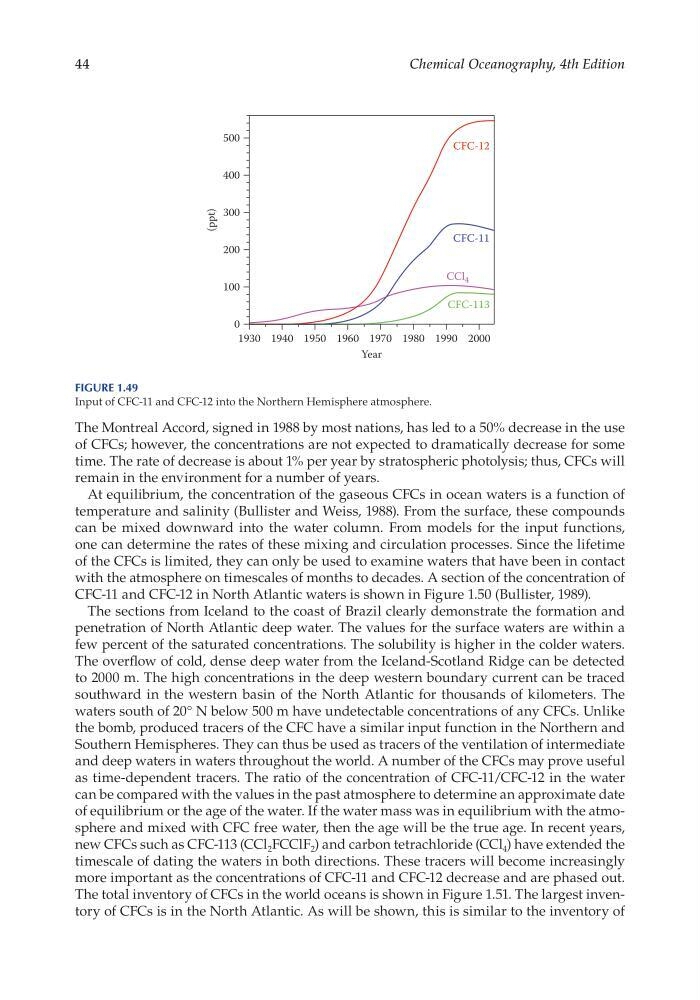
The Montreal Accord, signed in 1988 by most nations, has led to a 50% decrease in the use
of CFCs; however, the concentrations are not expected to dramatically decrease for some
time. The rate of decrease is about 1% per year by stratospheric photolysis; thus, CFCs will
remain in the environment for a number of years.
At equilibrium, the concentration of the gaseous CFCs in ocean waters is a function of
temperature and salinity (Bullister and Weiss, 1988). From the surface, these compounds
can be mixed downward into the water column. From models for the input functions,
one can determine the rates of these mixing and circulation processes. Since the lifetime
of the CFCs is limited, they can only be used to examine waters that have been in contact
with the atmosphere on timescales of months to decades. A section of the concentration of
CFC-11 and CFC-12 in North Atlantic waters is shown in Figure 1.50 (Bullister, 1989).
The sections from Iceland to the coast of Brazil clearly demonstrate the formation and
penetration of North Atlantic deep water. The values for the surface waters are within a
few percent of the saturated concentrations. The solubility is higher in the colder waters.
The overflow of cold, dense deep water from the Iceland- Scotland Ridge can be detected
to 2000 m. The high concentrations in the deep western boundary current can be traced
southward in the western basin of the North Atlantic for thousands of kilometers. The
waters south of 20° N below 500 m have undetectable concentrations of any CFCs. Unlike
the bomb, produced tracers of the CFC have a similar input function in the Northern and
Southern Hemispheres. They can thus be used as tracers of the ventilation of intermediate
and deep waters in waters throughout the world. A number of the CFCs may prove useful
as time- dependent tracers. The ratio of the concentration of CFC-11/CFC-12 in the water
can be compared with the values in the past atmosphere to determine an approximate date
of equilibrium or the age of the water. If the water mass was in equilibrium with the atmosphere and mixed with CFC free water, then the age will be the true age. In recent years,
new CFCs such as CFC-113 (CCl 2 FCClF 2 ) and carbon tetrachloride (CCl 4 ) have extended the
timescale of dating the waters in both directions. These tracers will become increasingly
more important as the concentrations of CFC-11 and CFC-12 decrease and are phased out.
The total inventory of CFCs in the world oceans is shown in Figure 1.51. The largest inventory of CFCs is in the North Atlantic. As will be shown, this is similar to the inventory of
400
500
0
1930 1940 1950
Year
1960 1970 1980 1990 2000
100
(ppt)
200
300
CFC-12
CFC-11
CFC-113
CCl 4
Figure 1.49
Input of CFC-11 and CFC-12 into the Northern Hemisphere atmosphere.
Chemical Oceanography, 4th Edition
The Montreal Accord, signed in 1988 by most nations, has led to a 50% decrease in the use
of CFCs; however, the concentrations are not expected to dramatically decrease for some
time. The rate of decrease is about 1% per year by stratospheric photolysis; thus, CFCs will
remain in the environment for a number of years.
At equilibrium, the concentration of the gaseous CFCs in ocean waters is a function of
temperature and salinity (Bullister and Weiss, 1988). From the surface, these compounds
can be mixed downward into the water column. From models for the input functions,
one can determine the rates of these mixing and circulation processes. Since the lifetime
of the CFCs is limited, they can only be used to examine waters that have been in contact
with the atmosphere on timescales of months to decades. A section of the concentration of
CFC-11 and CFC-12 in North Atlantic waters is shown in Figure 1.50 (Bullister, 1989).
The sections from Iceland to the coast of Brazil clearly demonstrate the formation and
penetration of North Atlantic deep water. The values for the surface waters are within a
few percent of the saturated concentrations. The solubility is higher in the colder waters.
The overflow of cold, dense deep water from the Iceland- Scotland Ridge can be detected
to 2000 m. The high concentrations in the deep western boundary current can be traced
southward in the western basin of the North Atlantic for thousands of kilometers. The
waters south of 20° N below 500 m have undetectable concentrations of any CFCs. Unlike
the bomb, produced tracers of the CFC have a similar input function in the Northern and
Southern Hemispheres. They can thus be used as tracers of the ventilation of intermediate
and deep waters in waters throughout the world. A number of the CFCs may prove useful
as time- dependent tracers. The ratio of the concentration of CFC-11/CFC-12 in the water
can be compared with the values in the past atmosphere to determine an approximate date
of equilibrium or the age of the water. If the water mass was in equilibrium with the atmosphere and mixed with CFC free water, then the age will be the true age. In recent years,
new CFCs such as CFC-113 (CCl 2 FCClF 2 ) and carbon tetrachloride (CCl 4 ) have extended the
timescale of dating the waters in both directions. These tracers will become increasingly
more important as the concentrations of CFC-11 and CFC-12 decrease and are phased out.
The total inventory of CFCs in the world oceans is shown in Figure 1.51. The largest inventory of CFCs is in the North Atlantic. As will be shown, this is similar to the inventory of
400
500
0
1930 1940 1950
Year
1960 1970 1980 1990 2000
100
(ppt)
200
300
CFC-12
CFC-11
CFC-113
CCl 4
Figure 1.49
Input of CFC-11 and CFC-12 into the Northern Hemisphere atmosphere.