

42
Chemical Oceanography, 4th Edition
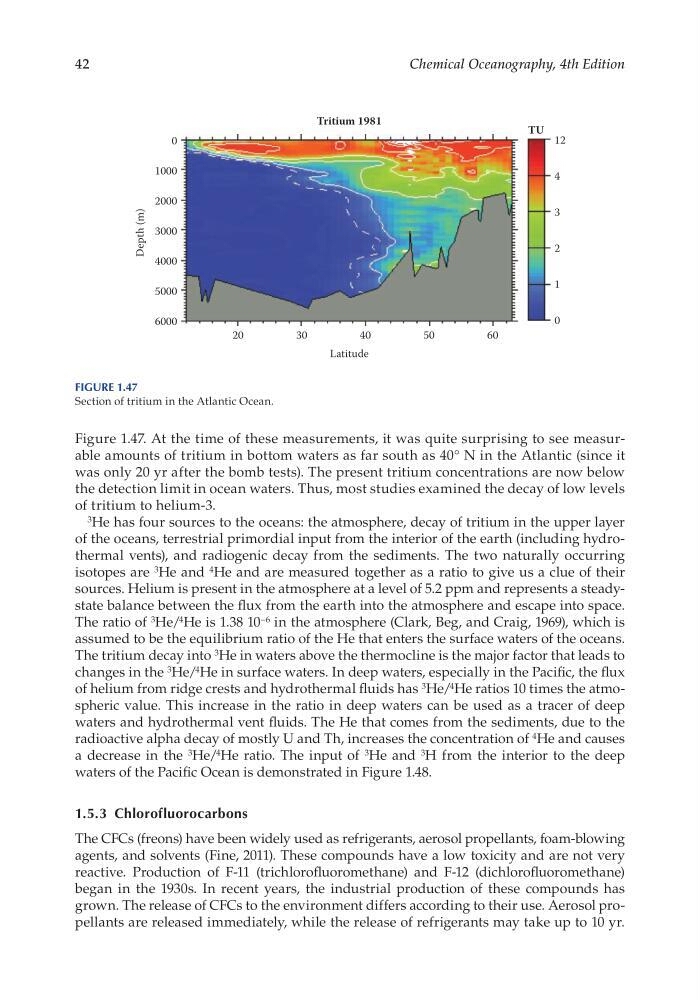
Figure 1.47. At the time of these measurements, it was quite surprising to see measurable amounts of tritium in bottom waters as far south as 40° N in the Atlantic (since it
was only 20 yr after the bomb tests). The present tritium concentrations are now below
the detection limit in ocean waters. Thus, most studies examined the decay of low levels
of tritium to helium-3.
3 He has four sources to the oceans: the atmosphere, decay of tritium in the upper layer
of the oceans, terrestrial primordial input from the interior of the earth (including hydrothermal vents), and radiogenic decay from the sediments. The two naturally occurring
isotopes are 3 He and 4 He and are measured together as a ratio to give us a clue of their
sources. Helium is present in the atmosphere at a level of 5.2 ppm and represents a steadystate balance between the flux from the earth into the atmosphere and escape into space.
The ratio of 3 He/ 4 He is 1.38 10 –6 in the atmosphere (Clark, Beg, and Craig, 1969), which is
assumed to be the equilibrium ratio of the He that enters the surface waters of the oceans.
The tritium decay into 3 He in waters above the thermocline is the major factor that leads to
changes in the 3 He/ 4 He in surface waters. In deep waters, especially in the Pacific, the flux
of helium from ridge crests and hydrothermal fluids has 3 He/ 4 He ratios 10 times the atmospheric value. This increase in the ratio in deep waters can be used as a tracer of deep
waters and hydrothermal vent fluids. The He that comes from the sediments, due to the
radioactive alpha decay of mostly U and Th, increases the concentration of 4 He and causes
a decrease in the 3 He/ 4 He ratio. The input of 3 He and 3 H from the interior to the deep
waters of the Pacific Ocean is demonstrated in Figure 1.48.
1.5.3 Chlorofluorocarbons
The CFCs (freons) have been widely used as refrigerants, aerosol propellants, foam- blowing
agents, and solvents (Fine, 2011). These compounds have a low toxicity and are not very
reactive. Production of F-11 (trichlorofluoromethane) and F-12 (dichlorofluoromethane)
began in the 1930s. In recent years, the industrial production of these compounds has
grown. The release of CFCs to the environment differs according to their use. Aerosol propellants are released immediately, while the release of refrigerants may take up to 10 yr.
6000
20
30
Latitude
Tritium 1981
TU
40
50
12
4
3
2
1
0
60
Depth (m)
5000
4000
3000
2000
1000
0
Figure 1.47
Section of tritium in the Atlantic Ocean.
Chemical Oceanography, 4th Edition
Figure 1.47. At the time of these measurements, it was quite surprising to see measurable amounts of tritium in bottom waters as far south as 40° N in the Atlantic (since it
was only 20 yr after the bomb tests). The present tritium concentrations are now below
the detection limit in ocean waters. Thus, most studies examined the decay of low levels
of tritium to helium-3.
3 He has four sources to the oceans: the atmosphere, decay of tritium in the upper layer
of the oceans, terrestrial primordial input from the interior of the earth (including hydrothermal vents), and radiogenic decay from the sediments. The two naturally occurring
isotopes are 3 He and 4 He and are measured together as a ratio to give us a clue of their
sources. Helium is present in the atmosphere at a level of 5.2 ppm and represents a steadystate balance between the flux from the earth into the atmosphere and escape into space.
The ratio of 3 He/ 4 He is 1.38 10 –6 in the atmosphere (Clark, Beg, and Craig, 1969), which is
assumed to be the equilibrium ratio of the He that enters the surface waters of the oceans.
The tritium decay into 3 He in waters above the thermocline is the major factor that leads to
changes in the 3 He/ 4 He in surface waters. In deep waters, especially in the Pacific, the flux
of helium from ridge crests and hydrothermal fluids has 3 He/ 4 He ratios 10 times the atmospheric value. This increase in the ratio in deep waters can be used as a tracer of deep
waters and hydrothermal vent fluids. The He that comes from the sediments, due to the
radioactive alpha decay of mostly U and Th, increases the concentration of 4 He and causes
a decrease in the 3 He/ 4 He ratio. The input of 3 He and 3 H from the interior to the deep
waters of the Pacific Ocean is demonstrated in Figure 1.48.
1.5.3 Chlorofluorocarbons
The CFCs (freons) have been widely used as refrigerants, aerosol propellants, foam- blowing
agents, and solvents (Fine, 2011). These compounds have a low toxicity and are not very
reactive. Production of F-11 (trichlorofluoromethane) and F-12 (dichlorofluoromethane)
began in the 1930s. In recent years, the industrial production of these compounds has
grown. The release of CFCs to the environment differs according to their use. Aerosol propellants are released immediately, while the release of refrigerants may take up to 10 yr.
6000
20
30
Latitude
Tritium 1981
TU
40
50
12
4
3
2
1
0
60
Depth (m)
5000
4000
3000
2000
1000
0
Figure 1.47
Section of tritium in the Atlantic Ocean.