

41
Descriptive Oceanography
where e – is an electron or beta particle, and 3 He is helium-3. Tritium is measured by lowlevel beta counting or detecting the daughter 3 He product using a mass spectrophotometer. The first method has a detection limit of 0.05 TU (1 tritium unit equals a 3 H/ 1 H ratio
of 10 –18 ), while the second method, which involves the measurement of the ratio of T/ 3 He,
has a detection limit of 0.003 TU. This ratio is measured after the sample is stored for about
6 months. When both tritium and helium-3 are measured, it is possible to estimate the
isolation time of a water parcel (similar to the 14 C method). The time can be determined
from the 3 He/ T ratio by
t = (12.4)ln[( 3 He/ 3 H) + 1)]
(1.5)
It is necessary to correct for the presence of any primordial 3 He when using this equation. It should also be noted that the mixing effects are not linear due to the exponential
relationship between 3 He and 3 H. Thus, the resulting age of the mixture of two water
masses will not be the arithmetic mean of the two end members. This can be illustrated in
the following example of mixing component A and B:
Component
A
B
1/2(A + B)
TU
6.0
0.5
3.25
3 He (%)
3.5
1.8
2.6
Age (yr)
2.1
10.2
2.8
The actual age of the final mixture A plus B is 7.8 yr not 2.8 yr.
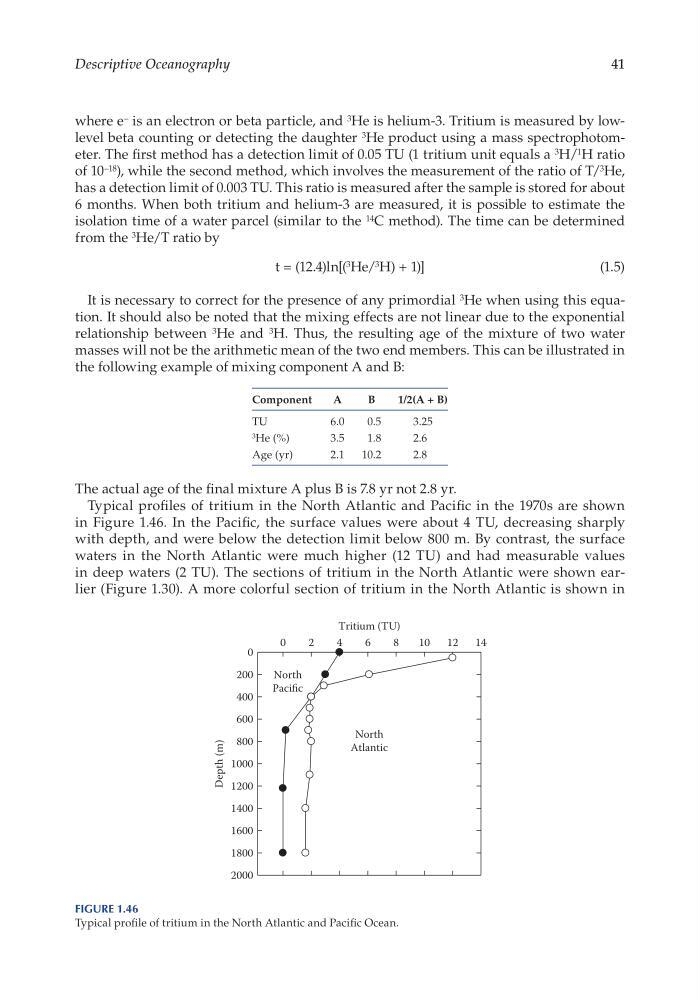
Typical profiles of tritium in the North Atlantic and Pacific in the 1970s are shown
in Figure 1.46. In the Pacific, the surface values were about 4 TU, decreasing sharply
with depth, and were below the detection limit below 800 m. By contrast, the surface
waters in the North Atlantic were much higher (12 TU) and had measurable values
in deep waters (2 TU). The sections of tritium in the North Atlantic were shown earlier (Figure 1.30). A more colorful section of tritium in the North Atlantic is shown in
Tritium (TU)
0
2
4
6
8
10
12
14
Depth (m)
0
200
400
600
800
1000
1200
1400
1600
1800
2000
North
Atlantic
North
Pacific
Figure 1.46
Typical profile of tritium in the North Atlantic and Pacific Ocean.
Descriptive Oceanography
where e – is an electron or beta particle, and 3 He is helium-3. Tritium is measured by lowlevel beta counting or detecting the daughter 3 He product using a mass spectrophotometer. The first method has a detection limit of 0.05 TU (1 tritium unit equals a 3 H/ 1 H ratio
of 10 –18 ), while the second method, which involves the measurement of the ratio of T/ 3 He,
has a detection limit of 0.003 TU. This ratio is measured after the sample is stored for about
6 months. When both tritium and helium-3 are measured, it is possible to estimate the
isolation time of a water parcel (similar to the 14 C method). The time can be determined
from the 3 He/ T ratio by
t = (12.4)ln[( 3 He/ 3 H) + 1)]
(1.5)
It is necessary to correct for the presence of any primordial 3 He when using this equation. It should also be noted that the mixing effects are not linear due to the exponential
relationship between 3 He and 3 H. Thus, the resulting age of the mixture of two water
masses will not be the arithmetic mean of the two end members. This can be illustrated in
the following example of mixing component A and B:
Component
A
B
1/2(A + B)
TU
6.0
0.5
3.25
3 He (%)
3.5
1.8
2.6
Age (yr)
2.1
10.2
2.8
The actual age of the final mixture A plus B is 7.8 yr not 2.8 yr.
Typical profiles of tritium in the North Atlantic and Pacific in the 1970s are shown
in Figure 1.46. In the Pacific, the surface values were about 4 TU, decreasing sharply
with depth, and were below the detection limit below 800 m. By contrast, the surface
waters in the North Atlantic were much higher (12 TU) and had measurable values
in deep waters (2 TU). The sections of tritium in the North Atlantic were shown earlier (Figure 1.30). A more colorful section of tritium in the North Atlantic is shown in
Tritium (TU)
0
2
4
6
8
10
12
14
Depth (m)
0
200
400
600
800
1000
1200
1400
1600
1800
2000
North
Atlantic
North
Pacific
Figure 1.46
Typical profile of tritium in the North Atlantic and Pacific Ocean.