

499
Processes in the Oceans
or polysulfides were not found by spectroscopic techniques. The total equivalent sulfur of
the products and reactants was constant, indicating that SO 4
2– , SO 3
2– , and S 2 O 3
2– were the
main products. The distribution of products from the oxidation of H 2 S in seawater was
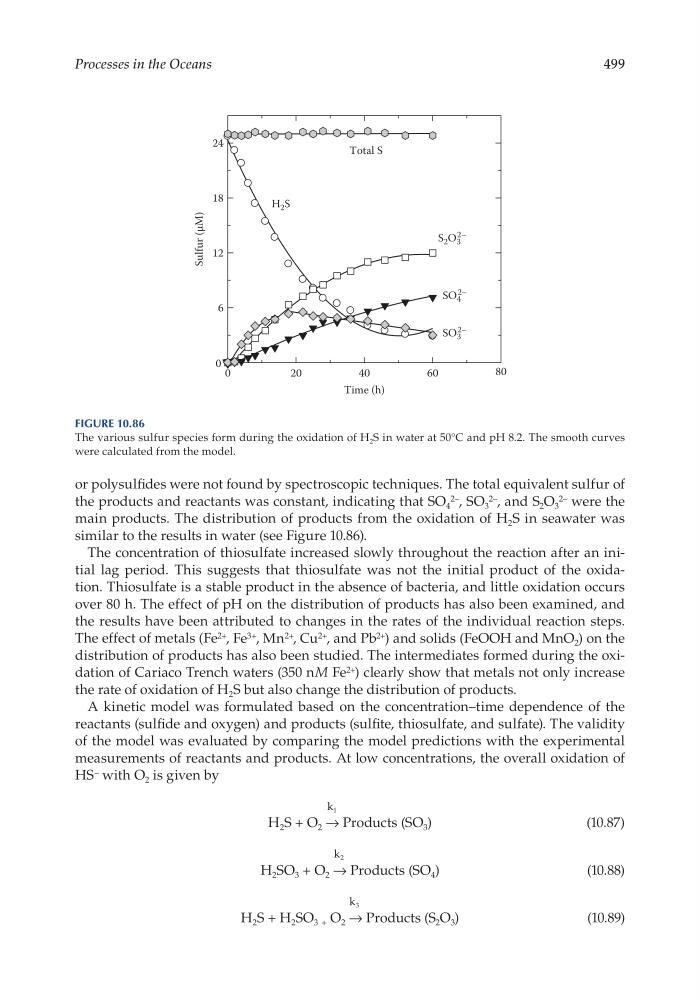
similar to the results in water (see Figure 10.86).
The concentration of thiosulfate increased slowly throughout the reaction after an initial lag period. This suggests that thiosulfate was not the initial product of the oxidation. Thiosulfate is a stable product in the absence of bacteria, and little oxidation occurs
over 80 h. The effect of pH on the distribution of products has also been examined, and
the results have been attributed to changes in the rates of the individual reaction steps.
The effect of metals (Fe 2+ , Fe 3+ , Mn 2+ , Cu 2+ , and Pb 2+ ) and solids (FeOOH and MnO 2 ) on the
distribution of products has also been studied. The intermediates formed during the oxidation of Cariaco Trench waters (350 nM Fe 2+ ) clearly show that metals not only increase
the rate of oxidation of H 2 S but also change the distribution of products.
A kinetic model was formulated based on the concentration–time dependence of the
reactants (sulfide and oxygen) and products (sulfite, thiosulfate, and sulfate). The validity
of the model was evaluated by comparing the model predictions with the experimental
measurements of reactants and products. At low concentrations, the overall oxidation of
HS – with O 2 is given by
k 1
H 2 S + O 2 → Products (SO 3 )
(10.87)
k 2
H 2 SO 3 + O 2 → Products (SO 4 )
(10.88)
k 3
H 2 S + H 2 SO 3 + O 2 → Products (S 2 O 3 )
(10.89)
Time (h)
0
20
40
60
80
Sulfur (µM)
0
6
12
18
24
Total S
S 2 O 3
2–
SO 3
2–
SO 4
2–
H 2 S
Figure 10.86
The various sulfur species form during the oxidation of H 2 S in water at 50°C and pH 8.2. The smooth curves
were calculated from the model.
Processes in the Oceans
or polysulfides were not found by spectroscopic techniques. The total equivalent sulfur of
the products and reactants was constant, indicating that SO 4
2– , SO 3
2– , and S 2 O 3
2– were the
main products. The distribution of products from the oxidation of H 2 S in seawater was
similar to the results in water (see Figure 10.86).
The concentration of thiosulfate increased slowly throughout the reaction after an initial lag period. This suggests that thiosulfate was not the initial product of the oxidation. Thiosulfate is a stable product in the absence of bacteria, and little oxidation occurs
over 80 h. The effect of pH on the distribution of products has also been examined, and
the results have been attributed to changes in the rates of the individual reaction steps.
The effect of metals (Fe 2+ , Fe 3+ , Mn 2+ , Cu 2+ , and Pb 2+ ) and solids (FeOOH and MnO 2 ) on the
distribution of products has also been studied. The intermediates formed during the oxidation of Cariaco Trench waters (350 nM Fe 2+ ) clearly show that metals not only increase
the rate of oxidation of H 2 S but also change the distribution of products.
A kinetic model was formulated based on the concentration–time dependence of the
reactants (sulfide and oxygen) and products (sulfite, thiosulfate, and sulfate). The validity
of the model was evaluated by comparing the model predictions with the experimental
measurements of reactants and products. At low concentrations, the overall oxidation of
HS – with O 2 is given by
k 1
H 2 S + O 2 → Products (SO 3 )
(10.87)
k 2
H 2 SO 3 + O 2 → Products (SO 4 )
(10.88)
k 3
H 2 S + H 2 SO 3 + O 2 → Products (S 2 O 3 )
(10.89)
Time (h)
0
20
40
60
80
Sulfur (µM)
0
6
12
18
24
Total S
S 2 O 3
2–
SO 3
2–
SO 4
2–
H 2 S
Figure 10.86
The various sulfur species form during the oxidation of H 2 S in water at 50°C and pH 8.2. The smooth curves
were calculated from the model.