

490
Chemical Oceanography, 4th Edition
been even greater. The removal of sulfide by formation of iron sulfides is restricted to a
continuing supply of iron. At pH 7.0, about 30% of the total hydrogen sulfide is in H 2 S(aq).
Diffusion might be a pathway for H 2 S to escape into upper oxic water and be oxidized. In
addition, there is evidence of the early diagenetic incorporation of inorganic sulfur into
organic compounds.
Like other anoxic basins, the evolution of anoxic conditions in the Framvaren started
from the bottom because of the restricted supply of dissolved oxygen. The hydrogen sulfide concentration is mainly controlled by the supply of organic matter and its encounter
with oxygen—either through the injection of fresh seawater over the sill or by vertical
exchange through the oxic–anoxic interface. A simple vertical advection–diffusion model
is commonly used to examine the flux of chemical species and explain the sequence of
redox reactions occurring across the interface (Brewer and Murray, 1973). One difficulty of
this approach is that horizontal transport might be important because diffusion and mixing are more rapid along, rather than across, isopycnal surfaces. As discussed, the lateral
mixing is significant near the interface in the Framvaren.
The upward sulfide electron gradient (140 × 10 –3 mol e – m –4 ) was about three times
greater than the downward O 2 electron gradient (58.4 × 10 –3 mol e – m –4 ). The extremely
steep gradient of sulfide in the Framvaren results from the high content of sulfide in the
water column and the shallow depth of the basin. This deficiency of an oxygen gradient
suggests that the downward flux of O 2 cannot account for the oxidation of upward sulfide.
There are three possible alternatives for sulfide oxidation. First, oxidized metals such as
MnO 2 and FeOOH could serve as oxidants (Millero, 1991a). The sharp maximum peaks
of Mn(II) and Fe(II) (Figure 10.73) just below the interface result from the reductive dissolution of Mn and Fe oxides by sulfide. One difficulty with this metal oxide hypothesis
is that the sum of the vertical electron gradients of Mn(II) and Fe(II) is much less than that
of sulfide. This problem can be overcome if the particulate oxides are mainly transported
horizontally into the intermediate layer through the sill. A second possible explanation
is that photosynthetic sulfide oxidation by phototrophic sulfur bacteria takes place in the
22.4
23.2
24.0
24.8
25.6
1930 1940 1950 1960 1970 1980 1990
Salinity
Salinity
Temperature (°C)
Time (y)
7.2
7.6
8.0
8.4
8.8
Temperature
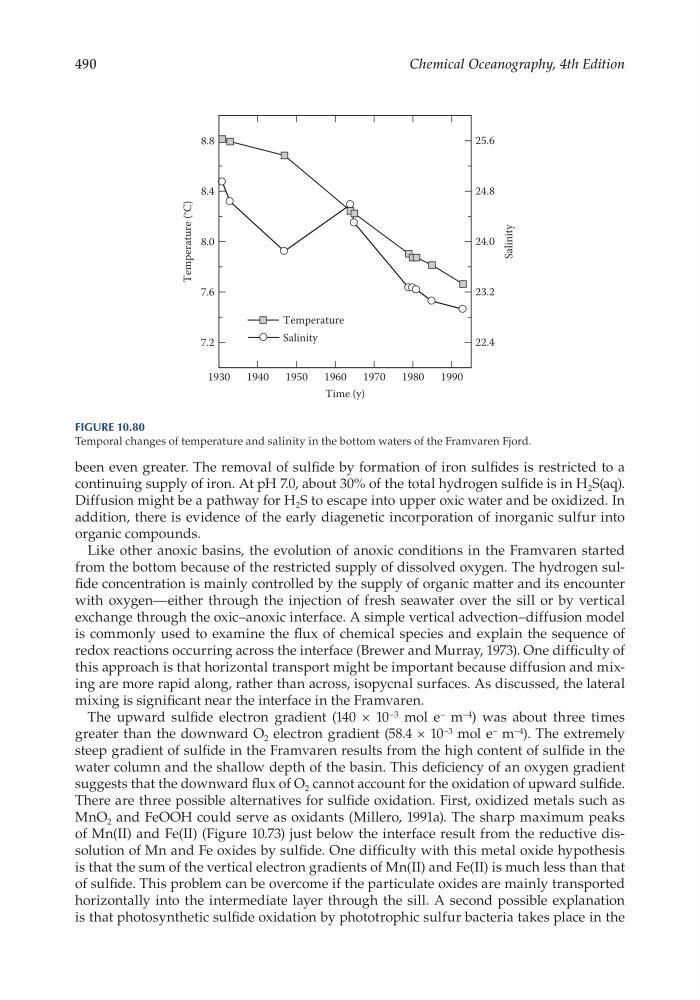
Figure 10.80
Temporal changes of temperature and salinity in the bottom waters of the Framvaren Fjord.
Chemical Oceanography, 4th Edition
been even greater. The removal of sulfide by formation of iron sulfides is restricted to a
continuing supply of iron. At pH 7.0, about 30% of the total hydrogen sulfide is in H 2 S(aq).
Diffusion might be a pathway for H 2 S to escape into upper oxic water and be oxidized. In
addition, there is evidence of the early diagenetic incorporation of inorganic sulfur into
organic compounds.
Like other anoxic basins, the evolution of anoxic conditions in the Framvaren started
from the bottom because of the restricted supply of dissolved oxygen. The hydrogen sulfide concentration is mainly controlled by the supply of organic matter and its encounter
with oxygen—either through the injection of fresh seawater over the sill or by vertical
exchange through the oxic–anoxic interface. A simple vertical advection–diffusion model
is commonly used to examine the flux of chemical species and explain the sequence of
redox reactions occurring across the interface (Brewer and Murray, 1973). One difficulty of
this approach is that horizontal transport might be important because diffusion and mixing are more rapid along, rather than across, isopycnal surfaces. As discussed, the lateral
mixing is significant near the interface in the Framvaren.
The upward sulfide electron gradient (140 × 10 –3 mol e – m –4 ) was about three times
greater than the downward O 2 electron gradient (58.4 × 10 –3 mol e – m –4 ). The extremely
steep gradient of sulfide in the Framvaren results from the high content of sulfide in the
water column and the shallow depth of the basin. This deficiency of an oxygen gradient
suggests that the downward flux of O 2 cannot account for the oxidation of upward sulfide.
There are three possible alternatives for sulfide oxidation. First, oxidized metals such as
MnO 2 and FeOOH could serve as oxidants (Millero, 1991a). The sharp maximum peaks
of Mn(II) and Fe(II) (Figure 10.73) just below the interface result from the reductive dissolution of Mn and Fe oxides by sulfide. One difficulty with this metal oxide hypothesis
is that the sum of the vertical electron gradients of Mn(II) and Fe(II) is much less than that
of sulfide. This problem can be overcome if the particulate oxides are mainly transported
horizontally into the intermediate layer through the sill. A second possible explanation
is that photosynthetic sulfide oxidation by phototrophic sulfur bacteria takes place in the
22.4
23.2
24.0
24.8
25.6
1930 1940 1950 1960 1970 1980 1990
Salinity
Salinity
Temperature (°C)
Time (y)
7.2
7.6
8.0
8.4
8.8
Temperature
Figure 10.80
Temporal changes of temperature and salinity in the bottom waters of the Framvaren Fjord.