

483
Processes in the Oceans
distribution of the transmission of light (see Figure 10.75). This high biological activity
can effectively control the biogeochemistry of metals and nonmetals. The increase in the
particles in the deep waters is related to the formation of metal sulfides and polysulfides.
Framboidal pyrite (FeS 2 ) has been found in the deep waters (see Table 10.10).
Much of our understanding of anaerobic microbial decomposition of organic matter has
come from studies of these systems (Richards, 1965; Grasshoff, 1975). Dyrssen (1989) has
used a stoichiometric model of the organic matter based on available data to show that more
sulfate was reduced than sulfide found in the Framvaren. Yao and Millero (1995) examined
the distribution of chemicals at a central station of the Framvaren. The maximum temperature occurred at the surface and decreased sharply with depth to 14 m (Figure 10.68).
The temperature slightly increased in the middle of the intermediate layer and reached a
submaximum at 16.5 m (Figure 10.67). This temperature structure might have been due to
the intrusion of the surface water of Hellvikfjord through the sill, which may also have
contributed to the renewal of the upper 10- to 20-m waters. There was a steep salinity
Ni (nM)
0
2
4
6
8
Depth (m)
0
20
40
60
80
100
120
140
160
180
200
Cu (nM)
0
2
4
6
Depth (m)
0
20
40
60
80
100
120
140
160
180
200
Cd (pM)
0
200
400
600
Depth (m)
0
20
40
60
80
100
120
140
160
180
200
Zn (nM)
0
20
40
60
Depth (m)
0
20
40
60
80
100
120
140
160
180
200
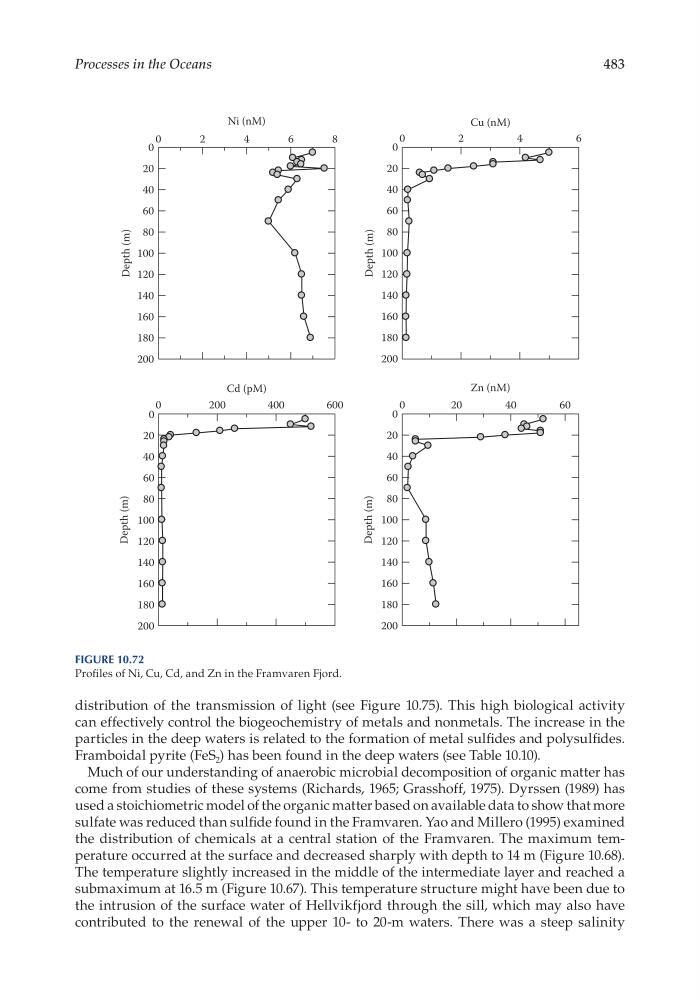
Figure 10.72
Profiles of Ni, Cu, Cd, and Zn in the Framvaren Fjord.
Processes in the Oceans
distribution of the transmission of light (see Figure 10.75). This high biological activity
can effectively control the biogeochemistry of metals and nonmetals. The increase in the
particles in the deep waters is related to the formation of metal sulfides and polysulfides.
Framboidal pyrite (FeS 2 ) has been found in the deep waters (see Table 10.10).
Much of our understanding of anaerobic microbial decomposition of organic matter has
come from studies of these systems (Richards, 1965; Grasshoff, 1975). Dyrssen (1989) has
used a stoichiometric model of the organic matter based on available data to show that more
sulfate was reduced than sulfide found in the Framvaren. Yao and Millero (1995) examined
the distribution of chemicals at a central station of the Framvaren. The maximum temperature occurred at the surface and decreased sharply with depth to 14 m (Figure 10.68).
The temperature slightly increased in the middle of the intermediate layer and reached a
submaximum at 16.5 m (Figure 10.67). This temperature structure might have been due to
the intrusion of the surface water of Hellvikfjord through the sill, which may also have
contributed to the renewal of the upper 10- to 20-m waters. There was a steep salinity
Ni (nM)
0
2
4
6
8
Depth (m)
0
20
40
60
80
100
120
140
160
180
200
Cu (nM)
0
2
4
6
Depth (m)
0
20
40
60
80
100
120
140
160
180
200
Cd (pM)
0
200
400
600
Depth (m)
0
20
40
60
80
100
120
140
160
180
200
Zn (nM)
0
20
40
60
Depth (m)
0
20
40
60
80
100
120
140
160
180
200
Figure 10.72
Profiles of Ni, Cu, Cd, and Zn in the Framvaren Fjord.