

482
Chemical Oceanography, 4th Edition
Fe(II) concentration with time. The lower value of 0.89 μM found in the winter might have
resulted from the oxidation of Fe(II) near the interface by O 2 caused by the enhanced water
mixing in this season. The concentrations of dissolved Fe(II) decreased rapidly below the
maximum to less than 40 nM in the bottom water, probably due to the formation of iron
sulfide minerals (Skei, 1988a,b).
Due to the unusual chemical and microbiological properties, the Framvaren has been
widely used as a natural laboratory to study anaerobic processes since the 1930s. Earlier
studies on the hydrography, currents, trace metals, isotopes, microbiology, sedimentation, and seismology of the fjord have been reviewed (Skei, 1988a,b). Unlike most other
anoxic basins, the O 2 –H 2 S interface (~18 m) in the Framvaren is at a depth of significant
light penetration. Dense populations of photosynthetic bacteria were present at the redox
boundary (Skei, 1988a,b), as indicated by the measurements of ATP (Figure 10.74) near the
interface. There is also a concentration of particles at the interface, as shown by the vertical
Mn (µM)
0
4
8
12
16
Fe (nM)
0
500
1000
1500
2000
Co (nM)
0
2
4
6
8
10
Pb (pM)
0
200
400
600
Depth (m)
0
20
40
60
80
100
120
140
160
180
200
Depth (m)
0
20
40
60
80
100
120
140
160
180
200
Depth (m)
0
20
40
60
80
100
120
140
160
180
200
Depth (m)
0
20
40
60
80
100
120
140
160
180
200
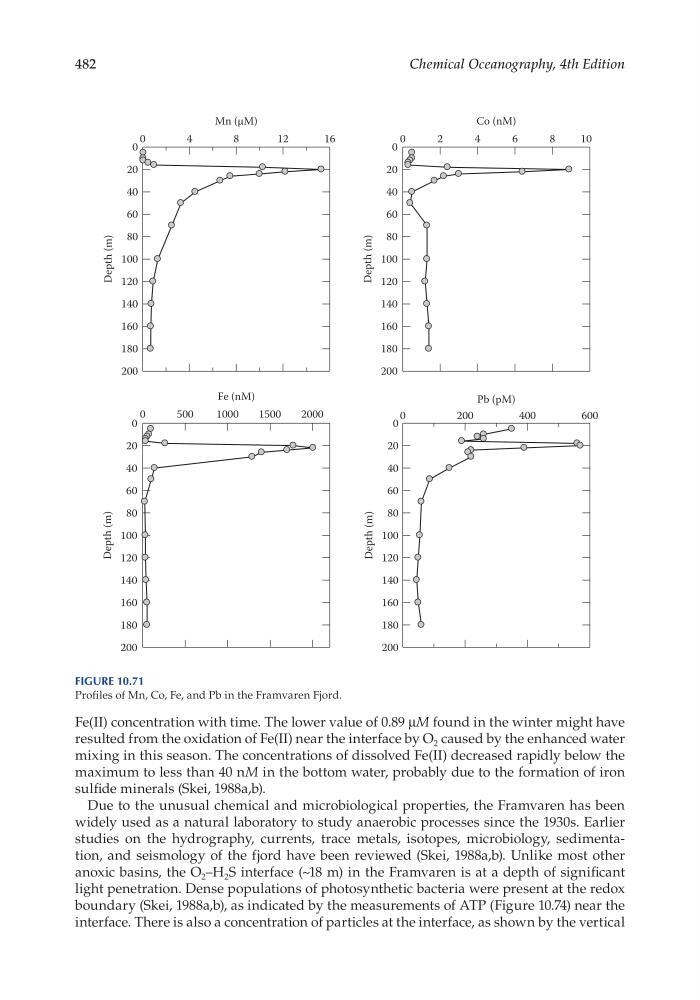
Figure 10.71
Profiles of Mn, Co, Fe, and Pb in the Framvaren Fjord.
Chemical Oceanography, 4th Edition
Fe(II) concentration with time. The lower value of 0.89 μM found in the winter might have
resulted from the oxidation of Fe(II) near the interface by O 2 caused by the enhanced water
mixing in this season. The concentrations of dissolved Fe(II) decreased rapidly below the
maximum to less than 40 nM in the bottom water, probably due to the formation of iron
sulfide minerals (Skei, 1988a,b).
Due to the unusual chemical and microbiological properties, the Framvaren has been
widely used as a natural laboratory to study anaerobic processes since the 1930s. Earlier
studies on the hydrography, currents, trace metals, isotopes, microbiology, sedimentation, and seismology of the fjord have been reviewed (Skei, 1988a,b). Unlike most other
anoxic basins, the O 2 –H 2 S interface (~18 m) in the Framvaren is at a depth of significant
light penetration. Dense populations of photosynthetic bacteria were present at the redox
boundary (Skei, 1988a,b), as indicated by the measurements of ATP (Figure 10.74) near the
interface. There is also a concentration of particles at the interface, as shown by the vertical
Mn (µM)
0
4
8
12
16
Fe (nM)
0
500
1000
1500
2000
Co (nM)
0
2
4
6
8
10
Pb (pM)
0
200
400
600
Depth (m)
0
20
40
60
80
100
120
140
160
180
200
Depth (m)
0
20
40
60
80
100
120
140
160
180
200
Depth (m)
0
20
40
60
80
100
120
140
160
180
200
Depth (m)
0
20
40
60
80
100
120
140
160
180
200
Figure 10.71
Profiles of Mn, Co, Fe, and Pb in the Framvaren Fjord.