

479
Processes in the Oceans
and the H 2 S increases to concentrations as high as 6 mM or 6000 μM. These values are the
highest levels of H 2 S found in any anoxic basin.
The concentration of metals in the Framvaren has been determined by a number of
workers. The results from Haraldsson and Westerlund (1988) for some metals are shown
in Figure 10.71 and Figure 10.72. The results are similar to those shown earlier for the
Black Sea. Mn 2+ , Fe 2+ , Co 2+ , and Pb 2+ concentrations have the characteristic maximum near
the oxic–anoxic interface; Ni 2+ shows no changes across the interface. The concentrations
of Cu 2+ , Zn 2+ , and Cd 2+ show slight maximum concentrations near the interface and large
decreases in the deeper waters caused by the low solubility of their metal sulfides. The
oxidation of H 2 S with O 2 in the Framvaren has been shown to be greatly enhanced by
the high content of Fe and Mn. Only low levels of the intermediates SO 3
2– and S 2 O 3
2– were
found near the interface.
The dissolved Mn and Fe together with O 2 and H 2 S near the interface are shown in
Figure 10.73 (Yao and Millero, 1995). The concentrations of dissolved Mn increased rapidly below 15 m, corresponding to the rapid decrease of O 2 , and reached a maximum at
21 m, where the concentration of H 2 S was 12 μM. The maximum dissolved Mn found in
this study, 18.0 μM, was higher than previous values of 10.5 μM (Jacobs, Emerson, and
Farsund
F1
E
0
2000
Scale
4000 m
W
N
S
Ofteeord
Framvaren
L y n g d a ls s o r d
Hellvikkorden
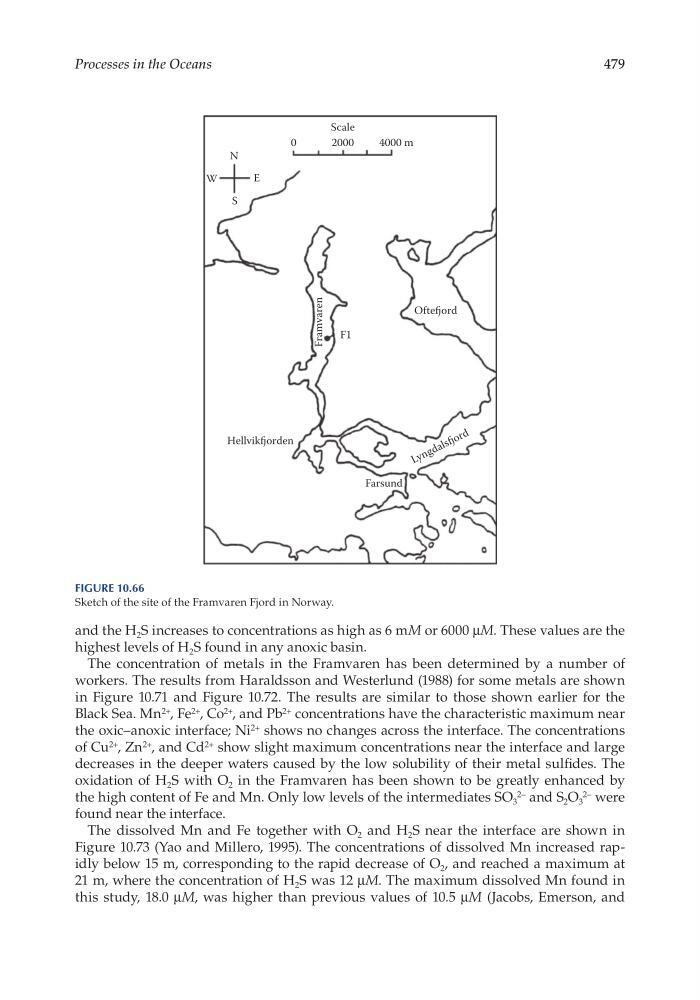
Figure 10.66
Sketch of the site of the Framvaren Fjord in Norway.
Processes in the Oceans
and the H 2 S increases to concentrations as high as 6 mM or 6000 μM. These values are the
highest levels of H 2 S found in any anoxic basin.
The concentration of metals in the Framvaren has been determined by a number of
workers. The results from Haraldsson and Westerlund (1988) for some metals are shown
in Figure 10.71 and Figure 10.72. The results are similar to those shown earlier for the
Black Sea. Mn 2+ , Fe 2+ , Co 2+ , and Pb 2+ concentrations have the characteristic maximum near
the oxic–anoxic interface; Ni 2+ shows no changes across the interface. The concentrations
of Cu 2+ , Zn 2+ , and Cd 2+ show slight maximum concentrations near the interface and large
decreases in the deeper waters caused by the low solubility of their metal sulfides. The
oxidation of H 2 S with O 2 in the Framvaren has been shown to be greatly enhanced by
the high content of Fe and Mn. Only low levels of the intermediates SO 3
2– and S 2 O 3
2– were
found near the interface.
The dissolved Mn and Fe together with O 2 and H 2 S near the interface are shown in
Figure 10.73 (Yao and Millero, 1995). The concentrations of dissolved Mn increased rapidly below 15 m, corresponding to the rapid decrease of O 2 , and reached a maximum at
21 m, where the concentration of H 2 S was 12 μM. The maximum dissolved Mn found in
this study, 18.0 μM, was higher than previous values of 10.5 μM (Jacobs, Emerson, and
Farsund
F1
E
0
2000
Scale
4000 m
W
N
S
Ofteeord
Framvaren
L y n g d a ls s o r d
Hellvikkorden
Figure 10.66
Sketch of the site of the Framvaren Fjord in Norway.