

476
Chemical Oceanography, 4th Edition
note that the 210 Pb dating of the sediments (Hughen et al., 1996) indicate that some disturbance of the sediment water interface occurred around 1932 and 1897, apparently due to
earthquakes around 1900 and 1929. These events could also have influenced the turnover of
the waters in the trench that we estimate occurred around 1920. The concentrations of PO 4
3–
and SiO 2 were estimated to be 1 and 2 μM, respectively, at the time of turnover based on
their rates of increase. These concentrations are in good agreement with the concentration
of these compounds in the Caribbean Sea (e.g., silica is 25 μM in the deep Caribbean Sea).
The increase in the rates of oxidation of H 2 S by Fe(II) at low concentrations is truly a
catalytic effect. This is presumably caused by the oxidation of Fe(II) (Millero et al., 1987):
Fe(OH) 2 + O 2 → Fe(OH) 2
+ + O 2
–
(10.68)
The oxidation products O 2
– and Fe(OH) 2
+ may also oxidize H 2 S. The reaction of dissolved
or particulate Fe(III) with H 2 S can regenerate Fe(II) to complete the catalytic cycle. The
overall reaction is given by
2 FeOOH + HS – + 5 H + → 2 Fe 2+ + S 0 + 4 H 2 O
(10.69)
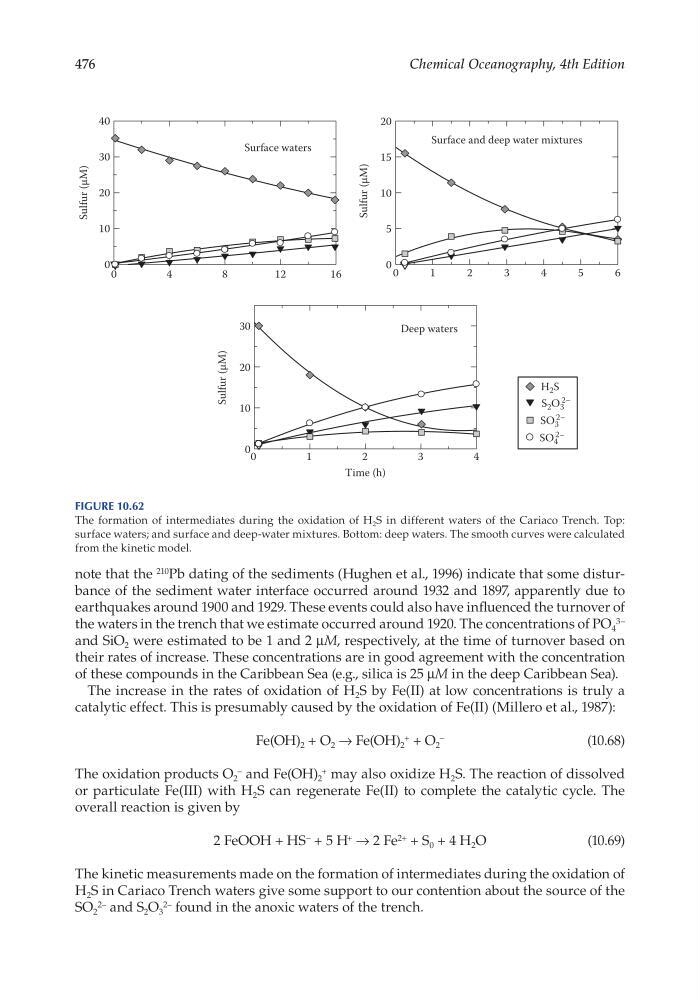
The kinetic measurements made on the formation of intermediates during the oxidation of
H 2 S in Cariaco Trench waters give some support to our contention about the source of the
SO 2
2– and S 2 O 3
2– found in the anoxic waters of the trench.
0
4
8
12
16
Sulfur (µM)
0
10
20
30
40
0
1
2
3
4
5
6
Sulfur (µM)
0
5
10
15
20
Time (h)
0
1
2
3
4
Sulfur (µM)
0
10
20
30
H 2 S
S 2 O 3
2–
SO 3
2–
SO 4
2–
Surface waters
Surface and deep water mixtures
Deep waters
Figure 10.62
The formation of intermediates during the oxidation of H 2 S in different waters of the Cariaco Trench. Top:
surface waters; and surface and deep-water mixtures. Bottom: deep waters. The smooth curves were calculated
from the kinetic model.
Chemical Oceanography, 4th Edition
note that the 210 Pb dating of the sediments (Hughen et al., 1996) indicate that some disturbance of the sediment water interface occurred around 1932 and 1897, apparently due to
earthquakes around 1900 and 1929. These events could also have influenced the turnover of
the waters in the trench that we estimate occurred around 1920. The concentrations of PO 4
3–
and SiO 2 were estimated to be 1 and 2 μM, respectively, at the time of turnover based on
their rates of increase. These concentrations are in good agreement with the concentration
of these compounds in the Caribbean Sea (e.g., silica is 25 μM in the deep Caribbean Sea).
The increase in the rates of oxidation of H 2 S by Fe(II) at low concentrations is truly a
catalytic effect. This is presumably caused by the oxidation of Fe(II) (Millero et al., 1987):
Fe(OH) 2 + O 2 → Fe(OH) 2
+ + O 2
–
(10.68)
The oxidation products O 2
– and Fe(OH) 2
+ may also oxidize H 2 S. The reaction of dissolved
or particulate Fe(III) with H 2 S can regenerate Fe(II) to complete the catalytic cycle. The
overall reaction is given by
2 FeOOH + HS – + 5 H + → 2 Fe 2+ + S 0 + 4 H 2 O
(10.69)
The kinetic measurements made on the formation of intermediates during the oxidation of
H 2 S in Cariaco Trench waters give some support to our contention about the source of the
SO 2
2– and S 2 O 3
2– found in the anoxic waters of the trench.
0
4
8
12
16
Sulfur (µM)
0
10
20
30
40
0
1
2
3
4
5
6
Sulfur (µM)
0
5
10
15
20
Time (h)
0
1
2
3
4
Sulfur (µM)
0
10
20
30
H 2 S
S 2 O 3
2–
SO 3
2–
SO 4
2–
Surface waters
Surface and deep water mixtures
Deep waters
Figure 10.62
The formation of intermediates during the oxidation of H 2 S in different waters of the Cariaco Trench. Top:
surface waters; and surface and deep-water mixtures. Bottom: deep waters. The smooth curves were calculated
from the kinetic model.