

472
Chemical Oceanography, 4th Edition
decreases to 7.9 below the oxic–anoxic interface. A profile of TCO 2 in the eastern basin is
also shown in Figure 10.60. The minimum value of 2.0 mM appeared at the surface, and
the value became constant below 1000 m (2.40 mM). The TA was calculated based on the
known pH and total CO 2 . The profile of TA is also shown in Figure 10.60. The maximum in
the surface water at a depth of 60 m is consistent with the salinity maximum. The salinitycorrected TA does not show this effect. The TA increases with depth below the oxic–anoxic
interface because of the bacterial anaerobic respiration of organic matter to bicarbonate
and simultaneous reduction of sulfate to sulfide. The dissolution of CaCO 3 may also be
part of the cause of the increase in the deep waters.
The rates of oxidation of H 2 S in surface waters (with added NaHS), deep waters, and
mixtures of surface and deep waters were measured on the cruise. A comparison of the
rates in the different waters is shown in Figure 10.61 along with the half- times for these
runs. The cause of the acceleration of the rates of oxidation of H 2 S is the high concentrations of Fe 2+ and Mn 2+ . At the maximum levels of Fe 2+ in the Cariaco Trench, one would
expect the rates of oxidation to be 17 times faster. These estimates are the same order as
found in our direct measurements. The calculated half- times (t 1/2 = 17.2, 2.7, and 1.5 h,
respectively, for the surface, mixed, and deep waters) are in good agreement with the measured values (t 1/2 = 17.2, 3.0, and 1.6 h).
The intermediates SO 3
2– and S 2 O 3
2– were determined, along with the disappearance of
H 2 S, during the course of the oxidation of sulfide in the waters of the Cariaco Trench.
The results are shown in Figure 10.62. The decrease of H 2 S and resultant increase of
[NH 4 ] (µM)
0
5
10
15
20
25
Depth (m)
0
200
400
600
800
1000
1200
1400
[SiO 2 ] (µM)
0
20
40
60
80
100
[PO 4 ] (µM)
0
1
2
3
4
NH 4
Si
PO 4
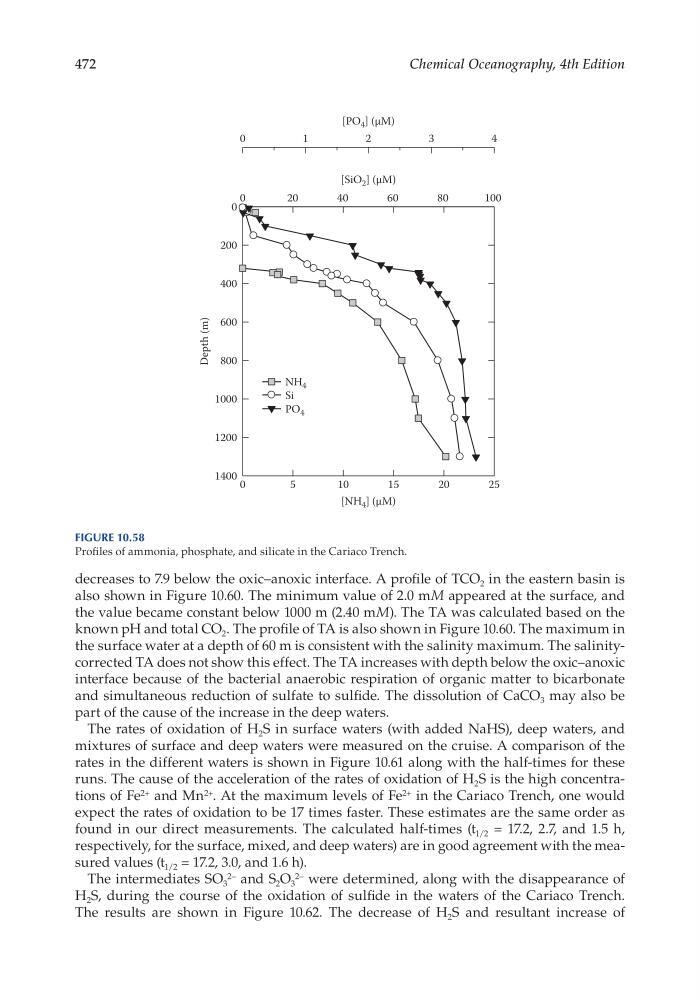
Figure 10.58
Profiles of ammonia, phosphate, and silicate in the Cariaco Trench.
Chemical Oceanography, 4th Edition
decreases to 7.9 below the oxic–anoxic interface. A profile of TCO 2 in the eastern basin is
also shown in Figure 10.60. The minimum value of 2.0 mM appeared at the surface, and
the value became constant below 1000 m (2.40 mM). The TA was calculated based on the
known pH and total CO 2 . The profile of TA is also shown in Figure 10.60. The maximum in
the surface water at a depth of 60 m is consistent with the salinity maximum. The salinitycorrected TA does not show this effect. The TA increases with depth below the oxic–anoxic
interface because of the bacterial anaerobic respiration of organic matter to bicarbonate
and simultaneous reduction of sulfate to sulfide. The dissolution of CaCO 3 may also be
part of the cause of the increase in the deep waters.
The rates of oxidation of H 2 S in surface waters (with added NaHS), deep waters, and
mixtures of surface and deep waters were measured on the cruise. A comparison of the
rates in the different waters is shown in Figure 10.61 along with the half- times for these
runs. The cause of the acceleration of the rates of oxidation of H 2 S is the high concentrations of Fe 2+ and Mn 2+ . At the maximum levels of Fe 2+ in the Cariaco Trench, one would
expect the rates of oxidation to be 17 times faster. These estimates are the same order as
found in our direct measurements. The calculated half- times (t 1/2 = 17.2, 2.7, and 1.5 h,
respectively, for the surface, mixed, and deep waters) are in good agreement with the measured values (t 1/2 = 17.2, 3.0, and 1.6 h).
The intermediates SO 3
2– and S 2 O 3
2– were determined, along with the disappearance of
H 2 S, during the course of the oxidation of sulfide in the waters of the Cariaco Trench.
The results are shown in Figure 10.62. The decrease of H 2 S and resultant increase of
[NH 4 ] (µM)
0
5
10
15
20
25
Depth (m)
0
200
400
600
800
1000
1200
1400
[SiO 2 ] (µM)
0
20
40
60
80
100
[PO 4 ] (µM)
0
1
2
3
4
NH 4
Si
PO 4
Figure 10.58
Profiles of ammonia, phosphate, and silicate in the Cariaco Trench.