

466
Chemical Oceanography, 4th Edition
to NH 4 , which increases in the deeper anoxic waters. The PO 4 is adsorbed to FeO 2 and
MnO 2 at the interface. In the anoxic waters, FeO 2 and MnO 2 are reduced to Fe 2+ and Mn 2+
by the H 2 S. This releases the adsorbed PO 4 to the anoxic waters. The diffusion of Fe 2+ and
Mn 2+ to the oxygenated waters results in the formation of FeO 2 and MnO 2 , and the cycle
is repeated. The FeO 2 is formed by reaction of O 2 with Fe 2+ ; while the Mn 2+ is converted to
MnO 2 by Mn- oxidizing bacteria.
10.3.2 Cariaco Trench
The Cariaco Trench (Figure 10.55) is located in the Caribbean Sea off the continental shelf
north of Venezuela. It is about 200 km long and 50 km wide with a maximum depth of
about 1400 m. The basin is separated from the rest of the Caribbean Sea by a 146-m sill
(Richards, 1965). The surface waters of the trench can exchange freely with the offshore
water. The deep part of the basin is divided by a saddle at 900 m into two subbasins, the
Ni (nM)
0
2
4
6
8
10 12
Cu (nM)
0
2
4
6
8
Cd (pM)
0
50
100
150
200
Depth (m)
0
400
800
1200
1600
2000
Zn (nM)
0
2
4
6
8
10
12
Depth (m)
0
400
800
1200
1600
2000
Depth (m)
0
400
800
1200
1600
2000
Depth (m)
0
400
800
1200
1600
2000
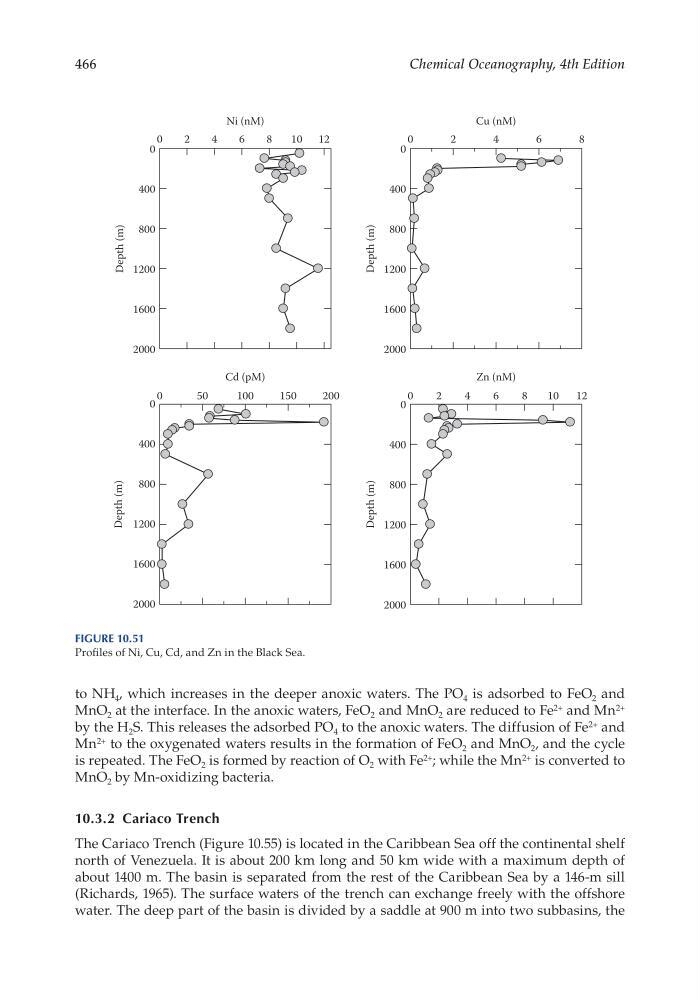
Figure 10.51
Profiles of Ni, Cu, Cd, and Zn in the Black Sea.
Chemical Oceanography, 4th Edition
to NH 4 , which increases in the deeper anoxic waters. The PO 4 is adsorbed to FeO 2 and
MnO 2 at the interface. In the anoxic waters, FeO 2 and MnO 2 are reduced to Fe 2+ and Mn 2+
by the H 2 S. This releases the adsorbed PO 4 to the anoxic waters. The diffusion of Fe 2+ and
Mn 2+ to the oxygenated waters results in the formation of FeO 2 and MnO 2 , and the cycle
is repeated. The FeO 2 is formed by reaction of O 2 with Fe 2+ ; while the Mn 2+ is converted to
MnO 2 by Mn- oxidizing bacteria.
10.3.2 Cariaco Trench
The Cariaco Trench (Figure 10.55) is located in the Caribbean Sea off the continental shelf
north of Venezuela. It is about 200 km long and 50 km wide with a maximum depth of
about 1400 m. The basin is separated from the rest of the Caribbean Sea by a 146-m sill
(Richards, 1965). The surface waters of the trench can exchange freely with the offshore
water. The deep part of the basin is divided by a saddle at 900 m into two subbasins, the
Ni (nM)
0
2
4
6
8
10 12
Cu (nM)
0
2
4
6
8
Cd (pM)
0
50
100
150
200
Depth (m)
0
400
800
1200
1600
2000
Zn (nM)
0
2
4
6
8
10
12
Depth (m)
0
400
800
1200
1600
2000
Depth (m)
0
400
800
1200
1600
2000
Depth (m)
0
400
800
1200
1600
2000
Figure 10.51
Profiles of Ni, Cu, Cd, and Zn in the Black Sea.