

463
Processes in the Oceans
at the interface leads to the maximum of the reduced Fe(II) and Mn(II). Cu(II), Cd(II), and
Pb(II) and other metals are adsorbed in the oxic water to Fe(OH) 3 and MnO 2 solids and
increased below the interface when the solids react with H 2 S. The concentrations of the
metals decrease in the deeper waters because of the low solubility of the sulfides of these
metals. Ni(II) shows little change across the interface because it does not appear to be
adsorbed on Fe(OH) 3 and MnO 2 , and the concentrations are below the saturation levels in
sulfidic waters.
Schijf et al. (1991) measured the rare earths in the Black Sea. Their results for La 3+ are
shown in Figure 10.52. The concentrations of the rare earths go through a minimum at a
depth of 100 m (σ θ = 16.1) in the suboxic zone (no O 2 or H 2 S) and increase to a maximum
at about 400 m. The Ce concentrations show redox changes, unlike the other rare earths
(Figure 10.52). All the rare earths are involved in the redox cycling that occurs across the
O 2 (µM)
0
100
200
300
400
Depth (m)
0
50
100
150
200
250
300
H 2 S (µM)
0
20
40
60
80 100
NH 4 (µM)
0
10
20
30
1975
1988
PO 4 (µM)
0
2
4
6
8 0
50
100
150
200
250
300
O 2
H 2 S
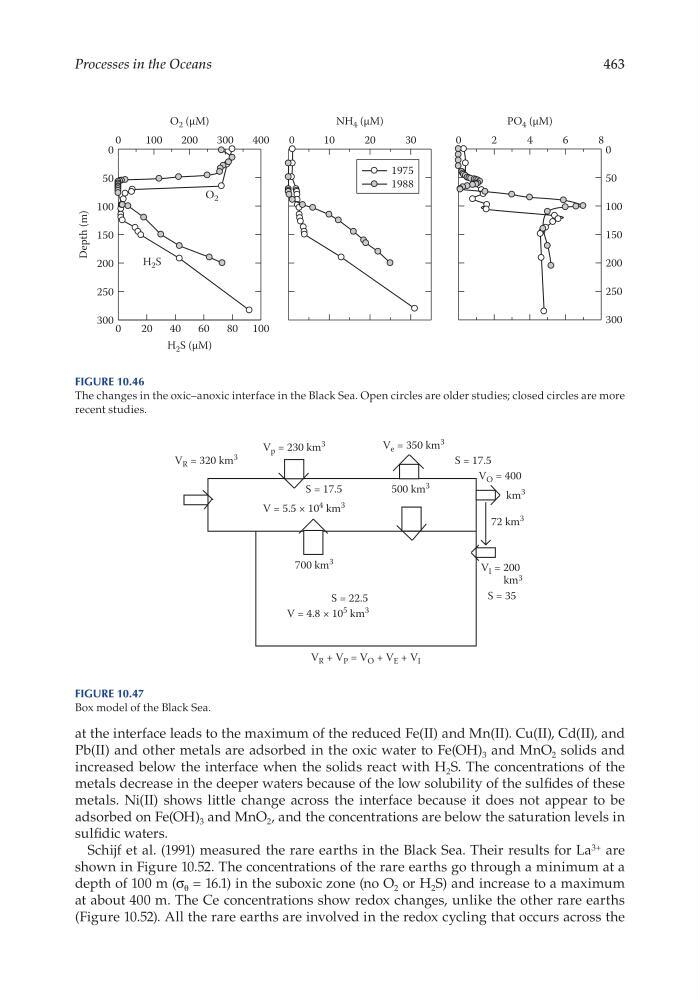
Figure 10.46
The changes in the oxic–anoxic interface in the Black Sea. Open circles are older studies; closed circles are more
recent studies.
V p = 230 km
3
V e = 350 km
3
V R = 320 km
3
S = 17.5
V O = 400
S = 17.5
km
3
V = 5.5 × 10
4 km
3
72 km
3
700 km
3
V I = 200
km 3
S = 22.5
S = 35
V = 4.8 × 10
5 km
3
V R + V P = V O + V E + V I
500 km
3
Figure 10.47
Box model of the Black Sea.
Processes in the Oceans
at the interface leads to the maximum of the reduced Fe(II) and Mn(II). Cu(II), Cd(II), and
Pb(II) and other metals are adsorbed in the oxic water to Fe(OH) 3 and MnO 2 solids and
increased below the interface when the solids react with H 2 S. The concentrations of the
metals decrease in the deeper waters because of the low solubility of the sulfides of these
metals. Ni(II) shows little change across the interface because it does not appear to be
adsorbed on Fe(OH) 3 and MnO 2 , and the concentrations are below the saturation levels in
sulfidic waters.
Schijf et al. (1991) measured the rare earths in the Black Sea. Their results for La 3+ are
shown in Figure 10.52. The concentrations of the rare earths go through a minimum at a
depth of 100 m (σ θ = 16.1) in the suboxic zone (no O 2 or H 2 S) and increase to a maximum
at about 400 m. The Ce concentrations show redox changes, unlike the other rare earths
(Figure 10.52). All the rare earths are involved in the redox cycling that occurs across the
O 2 (µM)
0
100
200
300
400
Depth (m)
0
50
100
150
200
250
300
H 2 S (µM)
0
20
40
60
80 100
NH 4 (µM)
0
10
20
30
1975
1988
PO 4 (µM)
0
2
4
6
8 0
50
100
150
200
250
300
O 2
H 2 S
Figure 10.46
The changes in the oxic–anoxic interface in the Black Sea. Open circles are older studies; closed circles are more
recent studies.
V p = 230 km
3
V e = 350 km
3
V R = 320 km
3
S = 17.5
V O = 400
S = 17.5
km
3
V = 5.5 × 10
4 km
3
72 km
3
700 km
3
V I = 200
km 3
S = 22.5
S = 35
V = 4.8 × 10
5 km
3
V R + V P = V O + V E + V I
500 km
3
Figure 10.47
Box model of the Black Sea.