

462
Chemical Oceanography, 4th Edition
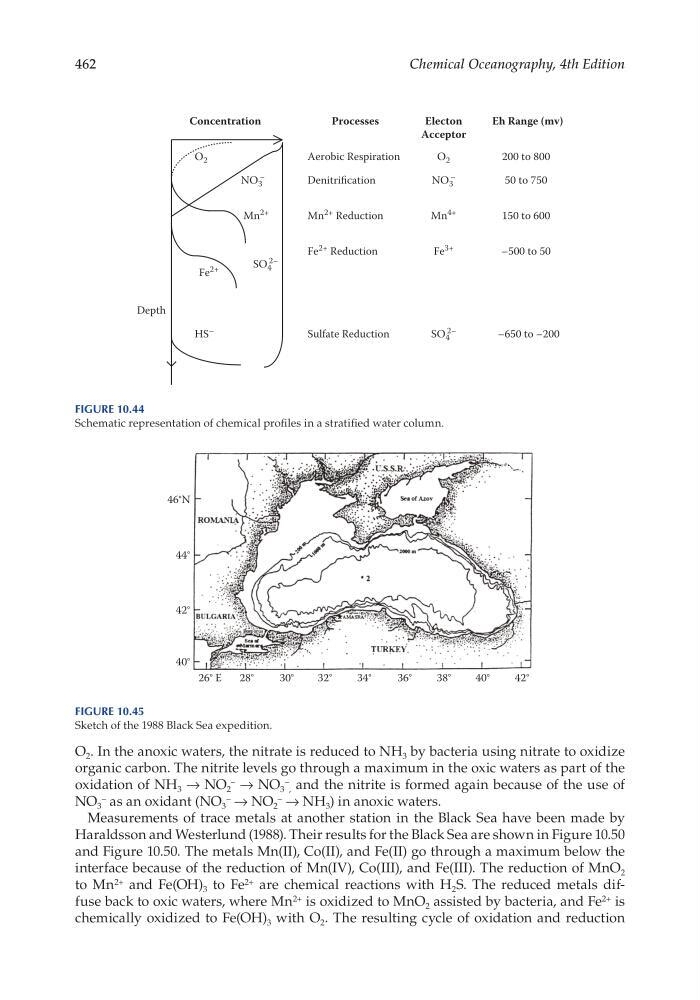
O 2 . In the anoxic waters, the nitrate is reduced to NH 3 by bacteria using nitrate to oxidize
organic carbon. The nitrite levels go through a maximum in the oxic waters as part of the
oxidation of NH 3 → NO 2
– → NO 3
–
, and the nitrite is formed again because of the use of
NO 3
– as an oxidant (NO 3
– → NO 2
– → NH 3 ) in anoxic waters.
Measurements of trace metals at another station in the Black Sea have been made by
Haraldsson and Westerlund (1988). Their results for the Black Sea are shown in Figure 10.50
and Figure 10.50. The metals Mn(II), Co(II), and Fe(II) go through a maximum below the
interface because of the reduction of Mn(IV), Co(III), and Fe(III). The reduction of MnO 2
to Mn 2+ and Fe(OH) 3 to Fe 2+ are chemical reactions with H 2 S. The reduced metals diffuse back to oxic waters, where Mn 2+ is oxidized to MnO 2 assisted by bacteria, and Fe 2+ is
chemically oxidized to Fe(OH) 3 with O 2 . The resulting cycle of oxidation and reduction
Concentration
Processes
Electon
Acceptor
Eh Range (mv)
O 2
Aerobic Respiration
O 2
200 to 800
NO 3
–
Denitrification
NO 3
–
50 to 750
Mn 2+
Mn
2+ Reduction
Mn
4+
150 to 600
Fe 2+ Reduction
Fe 3+
–500 to 50
SO 4
2–
Fe
2+
Depth
HS
–
Sulfate Reduction
SO 4
2–
–650 to –200
Figure 10.44
Schematic representation of chemical profiles in a stratified water column.
42°
40°
38°
36°
34°
32°
30°
28°
26° E
40°
42°
44°
46°N
Figure 10.45
Sketch of the 1988 Black Sea expedition.
Chemical Oceanography, 4th Edition
O 2 . In the anoxic waters, the nitrate is reduced to NH 3 by bacteria using nitrate to oxidize
organic carbon. The nitrite levels go through a maximum in the oxic waters as part of the
oxidation of NH 3 → NO 2
– → NO 3
–
, and the nitrite is formed again because of the use of
NO 3
– as an oxidant (NO 3
– → NO 2
– → NH 3 ) in anoxic waters.
Measurements of trace metals at another station in the Black Sea have been made by
Haraldsson and Westerlund (1988). Their results for the Black Sea are shown in Figure 10.50
and Figure 10.50. The metals Mn(II), Co(II), and Fe(II) go through a maximum below the
interface because of the reduction of Mn(IV), Co(III), and Fe(III). The reduction of MnO 2
to Mn 2+ and Fe(OH) 3 to Fe 2+ are chemical reactions with H 2 S. The reduced metals diffuse back to oxic waters, where Mn 2+ is oxidized to MnO 2 assisted by bacteria, and Fe 2+ is
chemically oxidized to Fe(OH) 3 with O 2 . The resulting cycle of oxidation and reduction
Concentration
Processes
Electon
Acceptor
Eh Range (mv)
O 2
Aerobic Respiration
O 2
200 to 800
NO 3
–
Denitrification
NO 3
–
50 to 750
Mn 2+
Mn
2+ Reduction
Mn
4+
150 to 600
Fe 2+ Reduction
Fe 3+
–500 to 50
SO 4
2–
Fe
2+
Depth
HS
–
Sulfate Reduction
SO 4
2–
–650 to –200
Figure 10.44
Schematic representation of chemical profiles in a stratified water column.
42°
40°
38°
36°
34°
32°
30°
28°
26° E
40°
42°
44°
46°N
Figure 10.45
Sketch of the 1988 Black Sea expedition.