

458
Chemical Oceanography, 4th Edition
are a number of processes that can alter this ratio. Under aerobic conditions, the regenerated phosphate can be absorbed on iron and manganese (hydr)oxides. Denitrification,
occurring at oxic/ anoxic interfaces, can alter the ratio of combined nitrogen (nitrate +
nitrite + ammonium) to carbon dioxide and phosphate by producing N 2 O and N 2 . It is also
possible that the organic matter has a C:N:P ratio different from 106:16:1 when lipids rather
than carbohydrates are formed or degraded. As discussed in Chapter 9, phytoplankton
can also incorporate C:N:P in ratios different from 106:16:1 depending on the availability
of these elements.
The decomposition of organic matter in anoxic basins, based on a theoretical organic molecule with the composition (CH 2 O) 106 (NH 3 ) 16 (H 3 PO 4 ) given by Equation 10.65, can be used
to examine the stoichiometry in these basins (keeping in mind the problems described).
According to this model, during sulfate reduction, sulfide, ammonia, phosphate, and total
CO 2 should accumulate in a ratio of 53 moles of sulfide to 16 moles of ammonia, to 1 mole
of phosphate, and to 106 moles of total CO 2 in the anoxic water column. The changes in
waters below the oxic–anoxic interface should be in the ratios
ΔNH 3 /ΔH 2 S = 16/53 = 0.33ΔPO 4 /ΔH 2 S = 1/53 = 0.019
ΔTCO 2 /ΔH 2 S = 106/53 = 2.0
Fe (nM)
0
50
100
150
200
Fe (nM)
0
50
100
150
200
Mo (pM)
0
1
2
3
4
5
Ag (pM)
0
2
4
6
8
10
Fe (nM)
0
50
100
150
200
Sn (pM)
0
2
4
6
8
10
Fe (nM)
0
50
100
150
200
Cd (pM)
0
1
2
3
4
Mixing
Mixing
Mixing
Mixing + removal ?
Mixing
Mixing + removal ?
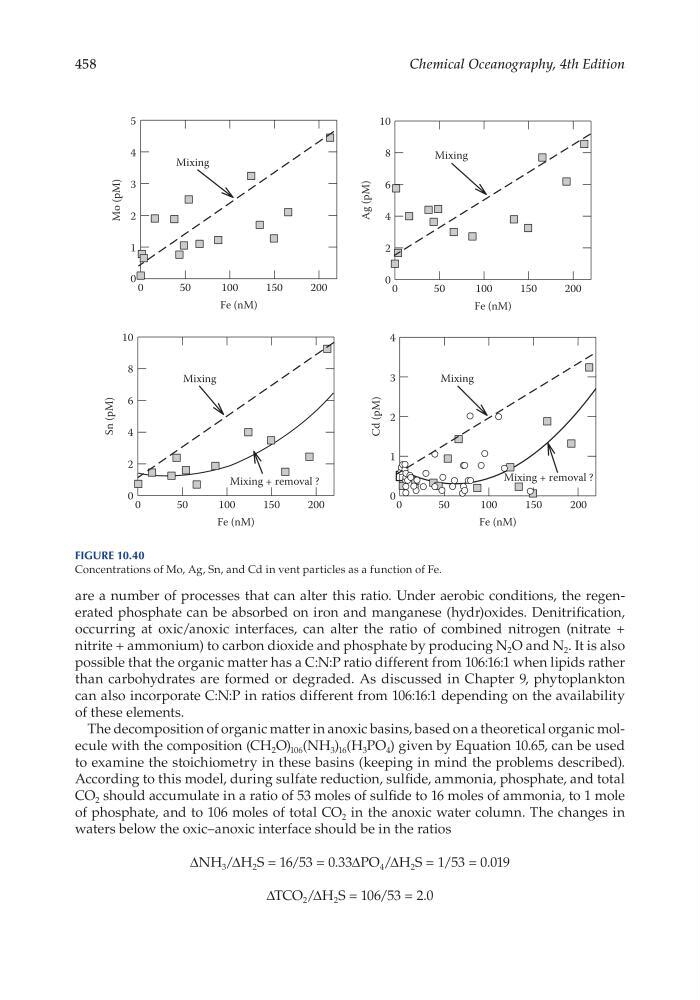
Figure 10.40
Concentrations of Mo, Ag, Sn, and Cd in vent particles as a function of Fe.
Chemical Oceanography, 4th Edition
are a number of processes that can alter this ratio. Under aerobic conditions, the regenerated phosphate can be absorbed on iron and manganese (hydr)oxides. Denitrification,
occurring at oxic/ anoxic interfaces, can alter the ratio of combined nitrogen (nitrate +
nitrite + ammonium) to carbon dioxide and phosphate by producing N 2 O and N 2 . It is also
possible that the organic matter has a C:N:P ratio different from 106:16:1 when lipids rather
than carbohydrates are formed or degraded. As discussed in Chapter 9, phytoplankton
can also incorporate C:N:P in ratios different from 106:16:1 depending on the availability
of these elements.
The decomposition of organic matter in anoxic basins, based on a theoretical organic molecule with the composition (CH 2 O) 106 (NH 3 ) 16 (H 3 PO 4 ) given by Equation 10.65, can be used
to examine the stoichiometry in these basins (keeping in mind the problems described).
According to this model, during sulfate reduction, sulfide, ammonia, phosphate, and total
CO 2 should accumulate in a ratio of 53 moles of sulfide to 16 moles of ammonia, to 1 mole
of phosphate, and to 106 moles of total CO 2 in the anoxic water column. The changes in
waters below the oxic–anoxic interface should be in the ratios
ΔNH 3 /ΔH 2 S = 16/53 = 0.33ΔPO 4 /ΔH 2 S = 1/53 = 0.019
ΔTCO 2 /ΔH 2 S = 106/53 = 2.0
Fe (nM)
0
50
100
150
200
Fe (nM)
0
50
100
150
200
Mo (pM)
0
1
2
3
4
5
Ag (pM)
0
2
4
6
8
10
Fe (nM)
0
50
100
150
200
Sn (pM)
0
2
4
6
8
10
Fe (nM)
0
50
100
150
200
Cd (pM)
0
1
2
3
4
Mixing
Mixing
Mixing
Mixing + removal ?
Mixing
Mixing + removal ?
Figure 10.40
Concentrations of Mo, Ag, Sn, and Cd in vent particles as a function of Fe.