

457
Processes in the Oceans
(CH 2 O) 106 (NH 3 ) 16 H 3 PO 4 + 84.8HNO 3 → 106CO 2 + 42.4N 2 + 148.4H 2 O + 16NH 3 + H 3 PO 4
(10.64)
and
(CH 2 O) 106 (NH 3 ) 16 H 3 PO 4 + 94.4HNO 3 → 106CO 2 + 55.2N 2 + 177.2H 2 O + H 3 PO 4 (10.65)
MnO 2 reduction occurs next, with Mn 4+ being the electron acceptor, followed by NO 3
–
reduction to NH 4
+ and reduction of Fe 3+ to Fe 2+ . Since the concentrations of these electron acceptors are not very high, these processes do not dominate the oxidation of organic
material. The next electron acceptor is SO 4
2– , and sulfate reduction occurs according to
(CH2O) 106 (NH 3 ) 16 H 3 PO 4 + 53SO 4
2– → 53CO 2 + 53HCO 3
–
+ 53HS –
+ 16NH 3 + 53H 2 O + H 3 PO 4
(10.66)
No oxidation of NH 3 occurs, and the ratio of changes in H 2 S to NH 3 is 3.3.
The decomposition can also occur with CO 2 as the electron acceptor and the resultant
formation of CH 4 :
(CH 2 O) 106 (NH 3 ) 16 H 3 PO 4 → 53CO 2 + 53CH 4 + 16NH 3 + H 3 PO 4
(10.67)
These equations can be used to predict the steady- state concentrations of C, N, P, and S
in anoxic systems. There are some deficiencies in this approach because it does not account
for mixing or the rates at which the system is driven to a steady state. According to the
model, carbon, nitrogen, and phosphate are released in the atomic ratio of 106:16:1. There
125
Manganese (nM)
Iron (nM)
1800
2000
2200
2400
1800
2000
0.01
20
East valley wall
West
valley wall
Axis of spreading
40
50
60
5 km
30
10
20
2200
2400
Depth (m)
Temperature anomaly (°C)
Light attenuation anomaly (10 –3 m
–1 )
175
225
25
0.005
0.04
0.03
0.02
0 .0 5
0.025
0.045
75
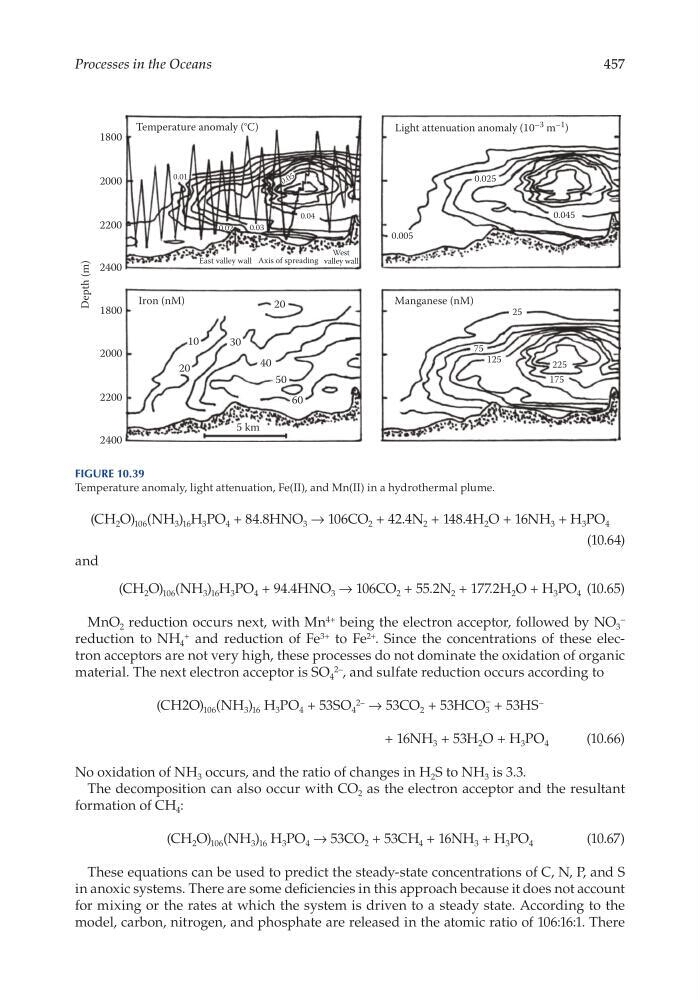
Figure 10.39
Temperature anomaly, light attenuation, Fe(II), and Mn(II) in a hydrothermal plume.
Processes in the Oceans
(CH 2 O) 106 (NH 3 ) 16 H 3 PO 4 + 84.8HNO 3 → 106CO 2 + 42.4N 2 + 148.4H 2 O + 16NH 3 + H 3 PO 4
(10.64)
and
(CH 2 O) 106 (NH 3 ) 16 H 3 PO 4 + 94.4HNO 3 → 106CO 2 + 55.2N 2 + 177.2H 2 O + H 3 PO 4 (10.65)
MnO 2 reduction occurs next, with Mn 4+ being the electron acceptor, followed by NO 3
–
reduction to NH 4
+ and reduction of Fe 3+ to Fe 2+ . Since the concentrations of these electron acceptors are not very high, these processes do not dominate the oxidation of organic
material. The next electron acceptor is SO 4
2– , and sulfate reduction occurs according to
(CH2O) 106 (NH 3 ) 16 H 3 PO 4 + 53SO 4
2– → 53CO 2 + 53HCO 3
–
+ 53HS –
+ 16NH 3 + 53H 2 O + H 3 PO 4
(10.66)
No oxidation of NH 3 occurs, and the ratio of changes in H 2 S to NH 3 is 3.3.
The decomposition can also occur with CO 2 as the electron acceptor and the resultant
formation of CH 4 :
(CH 2 O) 106 (NH 3 ) 16 H 3 PO 4 → 53CO 2 + 53CH 4 + 16NH 3 + H 3 PO 4
(10.67)
These equations can be used to predict the steady- state concentrations of C, N, P, and S
in anoxic systems. There are some deficiencies in this approach because it does not account
for mixing or the rates at which the system is driven to a steady state. According to the
model, carbon, nitrogen, and phosphate are released in the atomic ratio of 106:16:1. There
125
Manganese (nM)
Iron (nM)
1800
2000
2200
2400
1800
2000
0.01
20
East valley wall
West
valley wall
Axis of spreading
40
50
60
5 km
30
10
20
2200
2400
Depth (m)
Temperature anomaly (°C)
Light attenuation anomaly (10 –3 m
–1 )
175
225
25
0.005
0.04
0.03
0.02
0 .0 5
0.025
0.045
75
Figure 10.39
Temperature anomaly, light attenuation, Fe(II), and Mn(II) in a hydrothermal plume.