

454
Chemical Oceanography, 4th Edition
advection. Anoxia normally occurs in enclosed basins where physical barriers (sills) and
density stratification limit the advection of O 2 to the deep waters. There are two types of
anoxic basins. The most common occurs because of a strong halocline (salinity gradient),
which is the result of a net outflow of low- salinity water from a positive estuary. The halocline prevents low- salinity oxic waters from mixing with the high- salinity deep waters.
Examples of this type of basin are the Black Sea, the Baltic Sea, and many fjords such as
the Framvaren in Norway. The second type of basin arises because of a strong thermocline
that prevents the mixing of surface and deep waters. The Cariaco Trench off the coast of
Venezuela is an example of this type of basin. It is a deep trench with a maximum depth of
Mg (mmol kg
–1 )
0
10
20
30
40
50
60
Cl
(mmol
kg
–1 )
510
530
550
570
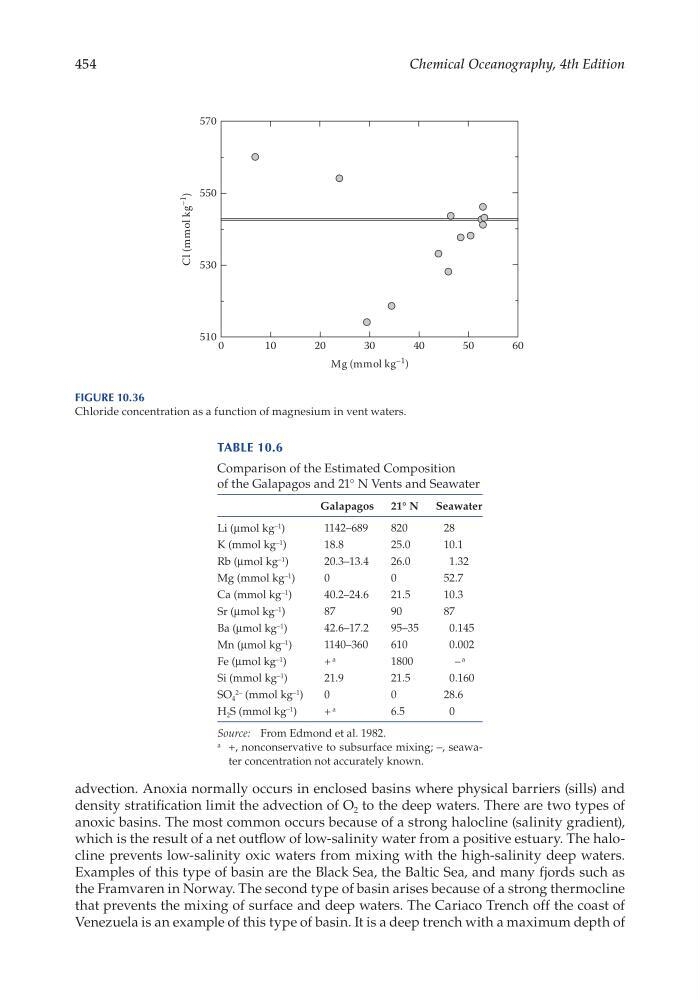
Figure 10.36
Chloride concentration as a function of magnesium in vent waters.
Table 10.6
Comparison of the Estimated Composition
of the Galapagos and 21° N Vents and Seawater
Galapagos
21° N
Seawater
Li (μmol kg –1 )
1142–689
820
28
K (mmol kg –1 )
18.8
25.0
10.1
Rb (μmol kg –1 )
20.3–13.4
26.0
1.32
Mg (mmol kg –1 )
0
0
52.7
Ca (mmol kg –1 )
40.2–24.6
21.5
10.3
Sr (μmol kg –1 )
87
90
87
Ba (μmol kg –1 )
42.6–17.2
95–35
0.145
Mn (μmol kg –1 )
1140–360
610
0.002
Fe (μmol kg –1 )
+ a
1800
– a
Si (mmol kg –1 )
21.9
21.5
0.160
SO 4
2– (mmol kg –1 )
0
0
28.6
H 2 S (mmol kg –1 )
+ a
6.5
0
Source: From Edmond et al. 1982.
a +, nonconservative to subsurface mixing; –, seawater concentration not accurately known.
Chemical Oceanography, 4th Edition
advection. Anoxia normally occurs in enclosed basins where physical barriers (sills) and
density stratification limit the advection of O 2 to the deep waters. There are two types of
anoxic basins. The most common occurs because of a strong halocline (salinity gradient),
which is the result of a net outflow of low- salinity water from a positive estuary. The halocline prevents low- salinity oxic waters from mixing with the high- salinity deep waters.
Examples of this type of basin are the Black Sea, the Baltic Sea, and many fjords such as
the Framvaren in Norway. The second type of basin arises because of a strong thermocline
that prevents the mixing of surface and deep waters. The Cariaco Trench off the coast of
Venezuela is an example of this type of basin. It is a deep trench with a maximum depth of
Mg (mmol kg
–1 )
0
10
20
30
40
50
60
Cl
(mmol
kg
–1 )
510
530
550
570
Figure 10.36
Chloride concentration as a function of magnesium in vent waters.
Table 10.6
Comparison of the Estimated Composition
of the Galapagos and 21° N Vents and Seawater
Galapagos
21° N
Seawater
Li (μmol kg –1 )
1142–689
820
28
K (mmol kg –1 )
18.8
25.0
10.1
Rb (μmol kg –1 )
20.3–13.4
26.0
1.32
Mg (mmol kg –1 )
0
0
52.7
Ca (mmol kg –1 )
40.2–24.6
21.5
10.3
Sr (μmol kg –1 )
87
90
87
Ba (μmol kg –1 )
42.6–17.2
95–35
0.145
Mn (μmol kg –1 )
1140–360
610
0.002
Fe (μmol kg –1 )
+ a
1800
– a
Si (mmol kg –1 )
21.9
21.5
0.160
SO 4
2– (mmol kg –1 )
0
0
28.6
H 2 S (mmol kg –1 )
+ a
6.5
0
Source: From Edmond et al. 1982.
a +, nonconservative to subsurface mixing; –, seawater concentration not accurately known.