

396
Chemical Oceanography, 4th Edition
is trapped in a nepheloid layer near the bottom. Concentrations of Fe in the nepheloid
layer along continental margins can be greater than 10 nM, and these enriched waters
from the nepheloid layer will continually resupply the euphotic zone with iron. This probably accounts for the iron concentrations greater than 1 nM observed near the islands.
The biological similarity of shipboard iron enrichment experiments and stations over the
Galapagos Platform and Bolivar Canal suggests that it is the elimination of the loss term
for iron that may be responsible for complete utilization of nutrients.
Upwelling in deep water along the equator is not nearly as effective at supplying iron to
the mixed layer. The highest dissolved iron values found in the equatorial Pacific are only
0.55 nM at depths of 2400 m. Iron concentrations at 150 m are less than 0.2 nM and thus
are unable to supply the levels of Fe needed to decrease the levels of nutrients much. Since
the upwelling of waters from the equatorial undercurrent could not produce the large iron
concentrations found, the enrichment of iron must come from the island platform. It has
also been suggested that atmospheric transport and deposition of island- derived aerosol
particles may be responsible for increased iron in the plume. Since the prevailing winds do
not have the proper orientation of the plume to supply the Fe, ocean currents may transport the island- derived materials to the plume.
The residence time of bioavailable iron added to surface waters must be very short. Iron
was not detected far from the source region downstream of the islands. This indicates that
both systems reflected a transient addition of iron rather than a sustained addition characteristic of bottle enrichments and shallow shelf stations. With a transient addition, only
a few cell divisions are possible before the iron is removed from the system. Continual
supply must occur to sustain production. The factors controlling the cycling of Fe in ocean
waters are shown in Figure 9.25. The oxidation of Fe(II) to Fe(III) is quite fast (two to three
half- times). Fe(III) is not very soluble at the high pH of seawater and can form colloidal Fe
oxides that eventually come out of solution by coagulation. The colloids can be stabilized
by organics that also can form strong complexes with Fe(III). The rapid removal of Fe
added to seawater prevents the complete removal of nutrients. The continual addition of
Fe from coastal sediments can serve as a source of Fe that can completely use up the nutrients in bottles and shallow waters near the Galapagos.
600
500
400
300
200
100
0
700
pCO
2
pCO 2
20
18
16
14
12
10
8
6
4
2
0
NO
3
NO 3
11/18/93
0:00
11/18/93
3:00
11/18/93
6:00
11/18/93
9:00
11/18/93
12:00
11/18/93
15:00
11/18/93
18:00
11/18/93
21:00
11/19/93
0:00
17
16
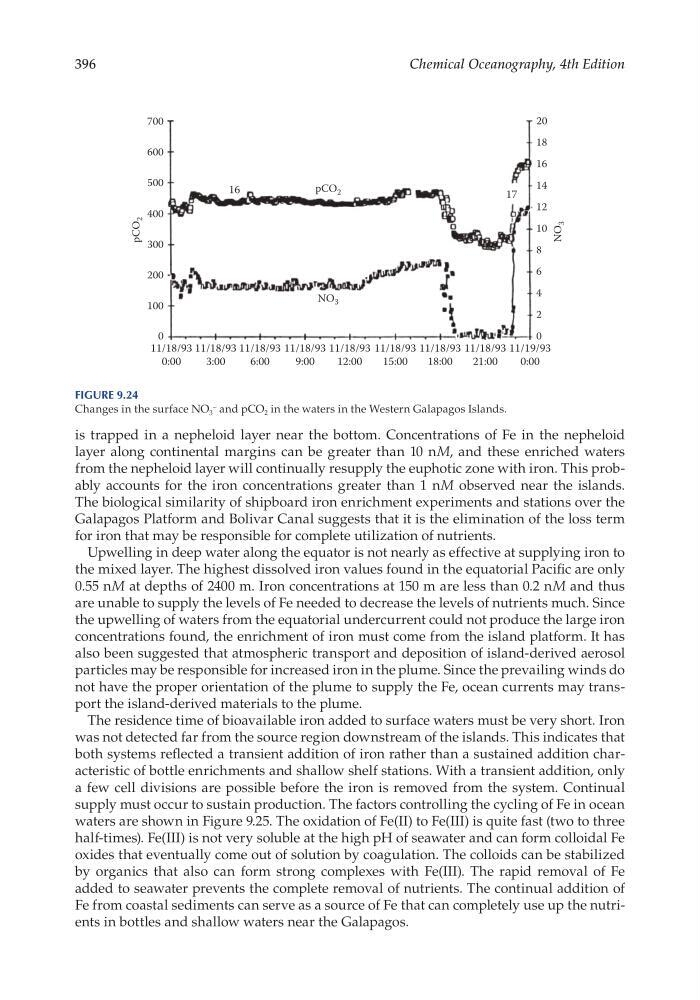
Figure 9.24
Changes in the surface NO 3
– and pCO 2 in the waters in the Western Galapagos Islands.
Chemical Oceanography, 4th Edition
is trapped in a nepheloid layer near the bottom. Concentrations of Fe in the nepheloid
layer along continental margins can be greater than 10 nM, and these enriched waters
from the nepheloid layer will continually resupply the euphotic zone with iron. This probably accounts for the iron concentrations greater than 1 nM observed near the islands.
The biological similarity of shipboard iron enrichment experiments and stations over the
Galapagos Platform and Bolivar Canal suggests that it is the elimination of the loss term
for iron that may be responsible for complete utilization of nutrients.
Upwelling in deep water along the equator is not nearly as effective at supplying iron to
the mixed layer. The highest dissolved iron values found in the equatorial Pacific are only
0.55 nM at depths of 2400 m. Iron concentrations at 150 m are less than 0.2 nM and thus
are unable to supply the levels of Fe needed to decrease the levels of nutrients much. Since
the upwelling of waters from the equatorial undercurrent could not produce the large iron
concentrations found, the enrichment of iron must come from the island platform. It has
also been suggested that atmospheric transport and deposition of island- derived aerosol
particles may be responsible for increased iron in the plume. Since the prevailing winds do
not have the proper orientation of the plume to supply the Fe, ocean currents may transport the island- derived materials to the plume.
The residence time of bioavailable iron added to surface waters must be very short. Iron
was not detected far from the source region downstream of the islands. This indicates that
both systems reflected a transient addition of iron rather than a sustained addition characteristic of bottle enrichments and shallow shelf stations. With a transient addition, only
a few cell divisions are possible before the iron is removed from the system. Continual
supply must occur to sustain production. The factors controlling the cycling of Fe in ocean
waters are shown in Figure 9.25. The oxidation of Fe(II) to Fe(III) is quite fast (two to three
half- times). Fe(III) is not very soluble at the high pH of seawater and can form colloidal Fe
oxides that eventually come out of solution by coagulation. The colloids can be stabilized
by organics that also can form strong complexes with Fe(III). The rapid removal of Fe
added to seawater prevents the complete removal of nutrients. The continual addition of
Fe from coastal sediments can serve as a source of Fe that can completely use up the nutrients in bottles and shallow waters near the Galapagos.
600
500
400
300
200
100
0
700
pCO
2
pCO 2
20
18
16
14
12
10
8
6
4
2
0
NO
3
NO 3
11/18/93
0:00
11/18/93
3:00
11/18/93
6:00
11/18/93
9:00
11/18/93
12:00
11/18/93
15:00
11/18/93
18:00
11/18/93
21:00
11/19/93
0:00
17
16
Figure 9.24
Changes in the surface NO 3
– and pCO 2 in the waters in the Western Galapagos Islands.