

391
Primary Production in the Oceans
Particulate DMSP showed a significant increase (50 to 80%) in the fertilized patch. DMSP
is produced by phytoplankton and decays to produce DMS. There were no clear changes
in DMS concentration in surface water (2.5 nM ± 0.4), which is not surprising considering
the duration of the study versus the time needed to degrade DMSP to DMS.
Fertilization studies by Smetacek et al. (2112) in the Southern Ocean have produced
diatom- dominated blooms. They found a pull down of surface CO 2 and nutrients as in
earlier studies. However, unlike the earlier studies, they were able to track the sinking
particles. They found that as much of 50% of the particles sank below 1000 m.
9.2.2 galapagos Plume Study
The Galapagos Islands lie near a sharp equatorial front that separates low- nutrient, oligotrophic waters to the north from high- nutrient waters to the south. There are strong
horizontal gradients as a result. Satellite studies show a plume of high- chlorophyll water
off the west of the Galapagos Islands (Figure 9.21) that is associated with the nutrientrich, westerly flowing, south equatorial current. Hydrographic surveys show anomalously
high chlorophyll concentrations and depleted nitrate concentrations over the Galapagos
Platform and downstream of the islands. It has been suggested that these elevated chlorophyll levels are produced by the addition of iron derived from the island platform. As
part of the IRONEX study, a series of stations were occupied both upstream (to the east)
and downstream (to the west) of the Galapagos Islands (Figure 9.22). Measurements of
trace metals as well as onboard analysis for the same parameters as measured in the patch
PP (mgC m
–3 d
–1 )
0
10
20
30
40
50
Depth (m)
0
10
20
30
40
50
60
70
80
Out
Patch
In
Patch
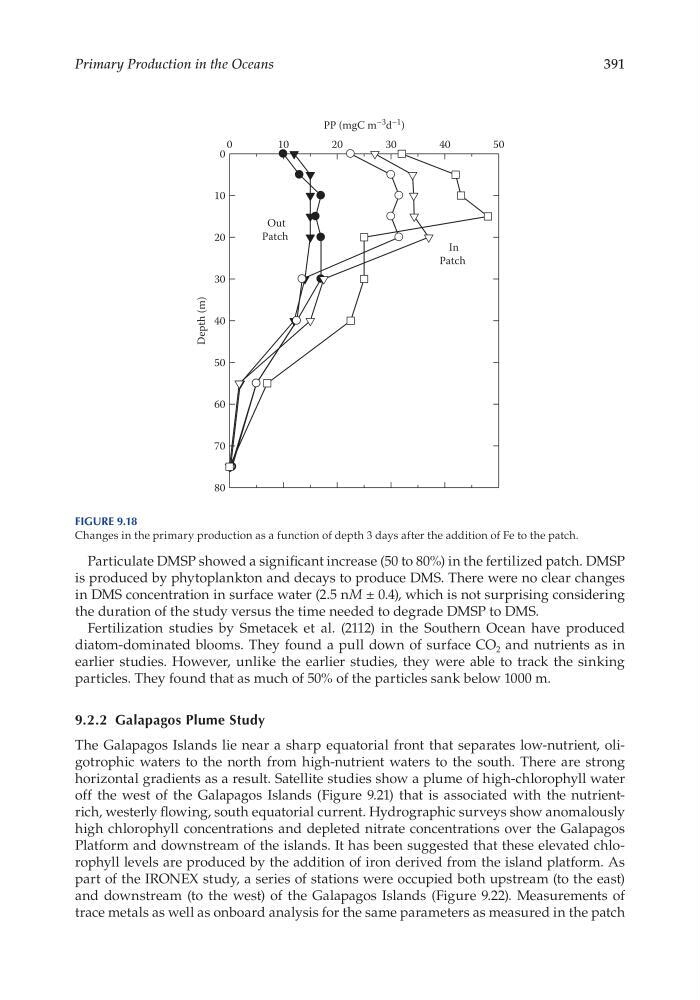
Figure 9.18
Changes in the primary production as a function of depth 3 days after the addition of Fe to the patch.
Primary Production in the Oceans
Particulate DMSP showed a significant increase (50 to 80%) in the fertilized patch. DMSP
is produced by phytoplankton and decays to produce DMS. There were no clear changes
in DMS concentration in surface water (2.5 nM ± 0.4), which is not surprising considering
the duration of the study versus the time needed to degrade DMSP to DMS.
Fertilization studies by Smetacek et al. (2112) in the Southern Ocean have produced
diatom- dominated blooms. They found a pull down of surface CO 2 and nutrients as in
earlier studies. However, unlike the earlier studies, they were able to track the sinking
particles. They found that as much of 50% of the particles sank below 1000 m.
9.2.2 galapagos Plume Study
The Galapagos Islands lie near a sharp equatorial front that separates low- nutrient, oligotrophic waters to the north from high- nutrient waters to the south. There are strong
horizontal gradients as a result. Satellite studies show a plume of high- chlorophyll water
off the west of the Galapagos Islands (Figure 9.21) that is associated with the nutrientrich, westerly flowing, south equatorial current. Hydrographic surveys show anomalously
high chlorophyll concentrations and depleted nitrate concentrations over the Galapagos
Platform and downstream of the islands. It has been suggested that these elevated chlorophyll levels are produced by the addition of iron derived from the island platform. As
part of the IRONEX study, a series of stations were occupied both upstream (to the east)
and downstream (to the west) of the Galapagos Islands (Figure 9.22). Measurements of
trace metals as well as onboard analysis for the same parameters as measured in the patch
PP (mgC m
–3 d
–1 )
0
10
20
30
40
50
Depth (m)
0
10
20
30
40
50
60
70
80
Out
Patch
In
Patch
Figure 9.18
Changes in the primary production as a function of depth 3 days after the addition of Fe to the patch.