

365
Micronutrients in the Oceans
References and Further Reading
Spencer, C.P., The micronutrient elements, Chapter 11, Chemical Oceanography, Vol. 2, 2nd ed., Riley,
J.P., and Skirrow, G., Eds., Academic Press, New York, 245–300 (1975).
Phosphorus
Abell, J., Emerson, S., and Renaud, P., Distributions of TOP, TON and TOC in the North Pacific subtropical gyre: implication for nutrient supply in the surface ocean and remineralization in the
upper thermocline, J. Mar. Res. 58, 203–222 (2000).
Armstrong, F.A.J., Phosphorus, Chapter 8, Chemical Oceanography, Vol. 1, Riley, J.P., and Skirrow, G.,
Eds., Academic Press, New York, 323–364 (1965).
Johnson, K.S., and Petty, R.L., Determination of phosphate in seawater by flow injection analysis
with injection of reagent, Anal. Chem., 54, 1185 (1982).
Torres- Valdes, S., et al., Distribution of dissolved organic nutrients and their effect on export production over the Atlantic Ocean, Global Biogeochem. Cycles, 23 (2009).
Nitrogen
Capone, D.G., Cyanobacterium trichodesmium, a globally significant marine bacteria, Science 276,
1221 (1997).
Potential Temperature (°C)
–2
0
2
4
6
8
10
12
"NO" and O
2 (µM)
200
250
300
350
400
450
500
550
600
WSW AABW
MSW
AAIW
NSW
CPBW
NPBW
EBBW
GFZW
DSW
NO 3 = 0
NO 3 = 9
NO 3 = 20
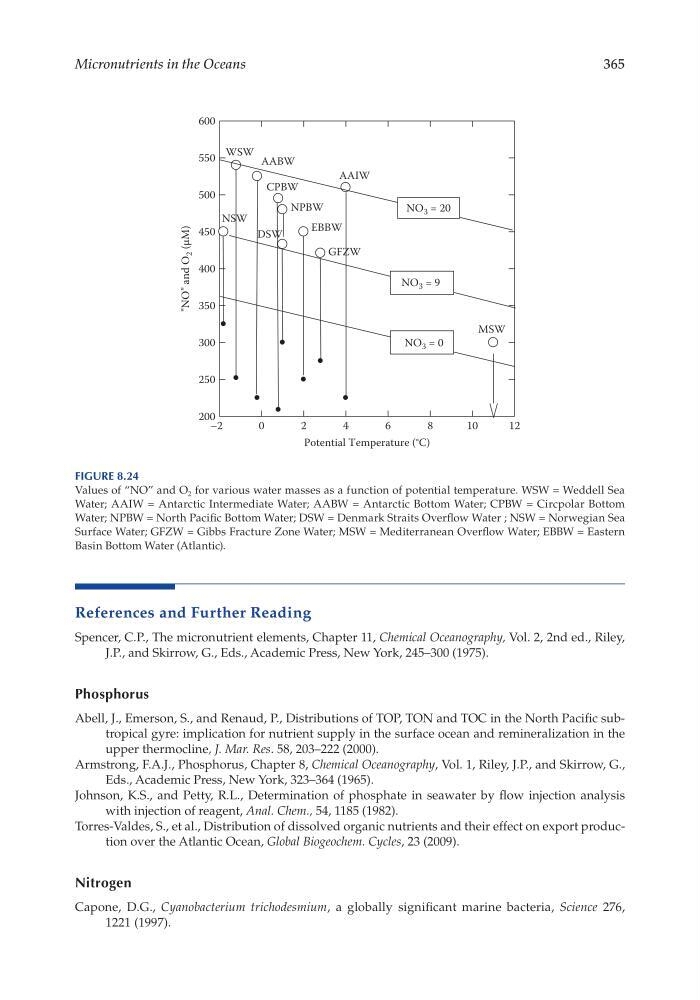
Figure 8.24
Values of “NO” and O 2 for various water masses as a function of potential temperature. WSW = Weddell Sea
Water; AAIW = Antarctic Intermediate Water; AABW = Antarctic Bottom Water; CPBW = Circpolar Bottom
Water; NPBW = North Pacific Bottom Water; DSW = Denmark Straits Overflow Water ; NSW = Norwegian Sea
Surface Water; GFZW = Gibbs Fracture Zone Water; MSW = Mediterranean Overflow Water; EBBW = Eastern
Basin Bottom Water (Atlantic).
Micronutrients in the Oceans
References and Further Reading
Spencer, C.P., The micronutrient elements, Chapter 11, Chemical Oceanography, Vol. 2, 2nd ed., Riley,
J.P., and Skirrow, G., Eds., Academic Press, New York, 245–300 (1975).
Phosphorus
Abell, J., Emerson, S., and Renaud, P., Distributions of TOP, TON and TOC in the North Pacific subtropical gyre: implication for nutrient supply in the surface ocean and remineralization in the
upper thermocline, J. Mar. Res. 58, 203–222 (2000).
Armstrong, F.A.J., Phosphorus, Chapter 8, Chemical Oceanography, Vol. 1, Riley, J.P., and Skirrow, G.,
Eds., Academic Press, New York, 323–364 (1965).
Johnson, K.S., and Petty, R.L., Determination of phosphate in seawater by flow injection analysis
with injection of reagent, Anal. Chem., 54, 1185 (1982).
Torres- Valdes, S., et al., Distribution of dissolved organic nutrients and their effect on export production over the Atlantic Ocean, Global Biogeochem. Cycles, 23 (2009).
Nitrogen
Capone, D.G., Cyanobacterium trichodesmium, a globally significant marine bacteria, Science 276,
1221 (1997).
Potential Temperature (°C)
–2
0
2
4
6
8
10
12
"NO" and O
2 (µM)
200
250
300
350
400
450
500
550
600
WSW AABW
MSW
AAIW
NSW
CPBW
NPBW
EBBW
GFZW
DSW
NO 3 = 0
NO 3 = 9
NO 3 = 20
Figure 8.24
Values of “NO” and O 2 for various water masses as a function of potential temperature. WSW = Weddell Sea
Water; AAIW = Antarctic Intermediate Water; AABW = Antarctic Bottom Water; CPBW = Circpolar Bottom
Water; NPBW = North Pacific Bottom Water; DSW = Denmark Straits Overflow Water ; NSW = Norwegian Sea
Surface Water; GFZW = Gibbs Fracture Zone Water; MSW = Mediterranean Overflow Water; EBBW = Eastern
Basin Bottom Water (Atlantic).