

17
Descriptive Oceanography
1. Wind- driven circulation is caused by the wind blowing over the surface waters.
This affects the upper few hundred meters of the oceans, yielding primarily horizontal circulation.
2. Thermohaline circulation is caused by the movement of water because of density
differences caused by changes in temperature and salinity. This leads to deep- sea
and vertical circulation.
The processes that result in mixing are eddy diffusion, caused by concentration gradients, and advection, caused by currents. The pycnocline acts as a barrier to thermohaline
mixing in the oceans.
The surface circulation of waters in the various oceans is similar and caused by the distribution of the major winds shown in Figure 1.23.
The trade winds and the westerlies combine to lead to a clockwise gyre in the Northern
Hemisphere and a counterclockwise gyre in the Southern Hemisphere (see Figure 1.24).
In the Northern Hemisphere, the waters have a right- hand component because of
the spinning of the earth. This so- called Coriolis effect has a left- hand component in the
Southern Hemisphere. In the North Atlantic and the Pacific, the currents are narrower
and faster on the western side of each ocean. This westward intensification results in the
Gulf Stream in the North Atlantic and the Kuroshio Current in the North Pacific. When
the trade winds from the north or south cross the equator, the Coriolis effect causes a
counter current in a direction opposite to that of the major gyres. The surface currents of
the oceans are divided into a number of separate currents.
4°
Pacific
Pacific Deep
Atlantic
3°
2°
1°
P o t e n t i a l T e m p e r a t u r e ( ° C )
0°
34.40
34.50
34.60
34.70
Southern
Indian
Sa lin ity
34.80
34.90
35.00
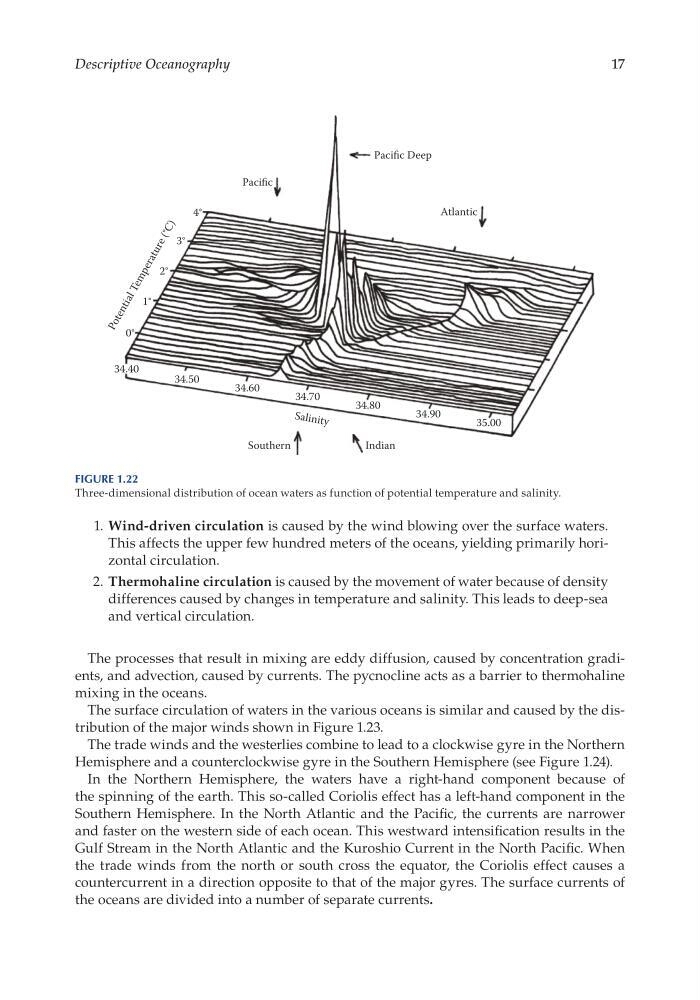
Figure 1.22
Three-dimensional distribution of ocean waters as function of potential temperature and salinity.
Descriptive Oceanography
1. Wind- driven circulation is caused by the wind blowing over the surface waters.
This affects the upper few hundred meters of the oceans, yielding primarily horizontal circulation.
2. Thermohaline circulation is caused by the movement of water because of density
differences caused by changes in temperature and salinity. This leads to deep- sea
and vertical circulation.
The processes that result in mixing are eddy diffusion, caused by concentration gradients, and advection, caused by currents. The pycnocline acts as a barrier to thermohaline
mixing in the oceans.
The surface circulation of waters in the various oceans is similar and caused by the distribution of the major winds shown in Figure 1.23.
The trade winds and the westerlies combine to lead to a clockwise gyre in the Northern
Hemisphere and a counterclockwise gyre in the Southern Hemisphere (see Figure 1.24).
In the Northern Hemisphere, the waters have a right- hand component because of
the spinning of the earth. This so- called Coriolis effect has a left- hand component in the
Southern Hemisphere. In the North Atlantic and the Pacific, the currents are narrower
and faster on the western side of each ocean. This westward intensification results in the
Gulf Stream in the North Atlantic and the Kuroshio Current in the North Pacific. When
the trade winds from the north or south cross the equator, the Coriolis effect causes a
counter current in a direction opposite to that of the major gyres. The surface currents of
the oceans are divided into a number of separate currents.
4°
Pacific
Pacific Deep
Atlantic
3°
2°
1°
P o t e n t i a l T e m p e r a t u r e ( ° C )
0°
34.40
34.50
34.60
34.70
Southern
Indian
Sa lin ity
34.80
34.90
35.00
Figure 1.22
Three-dimensional distribution of ocean waters as function of potential temperature and salinity.