

353
Micronutrients in the Oceans
respectively, of the total dissolved PO 4 and NO 3 . The TOP values are higher than the PO 4
concentrations over most of the surface with the exception of the subarctic, where PO 4 is
higher due to the outcropping of deep waters. The TOP in the surface waters is higher over
the entire range of studies. These values of TON and TOP may be an important source of
NO 3 for plants. The N/ P ratios of TON to TDN (total dissolved nitrogen) vary between
15 and 42 over this range. As discussed in the next sections, this is a much larger range
than the ratios for inorganic nitrogen and phosphate.
Knapp et al. (2005) have shown that the nitrogen isotopic composition ( 15 N/ 14 N) of DON
in the Atlantic can better constrain the dynamics of DON pool and nitrogen fixation at the
BATS station. The bulk and higher molecular weight DON have a 15 N/ 14 N that is higher
than the suspended particulate organic nitrogen. Knapp et al. (2011) have more recently
examined the 15 N/ 14 N of DON in the Atlantic and Pacific surface waters (0 to 300 m). The
average DON in the upper 100 m in both oceans was similar (4.5 to 5.0 μM). This indicates
that DON was participating in the nitrogen cycle in both regions. The average δ 15 N of
DON is different from N 2 in air (3.9% in the Atlantic and 4.7% in the Pacific). They have
developed a model to explain these results. The DON is produced from particulate organic
O 2
PON
NO 2
–
N 2
NH 4
+
2
1
3
3
4
5
(a) Arabian Sea
Increasing Water Depth
(b) ETSP
O 2
PON
NO 3
–
NO 2
–
N 2
NH 4
+
2
1
3
3
4
5
Increasing Water Depth
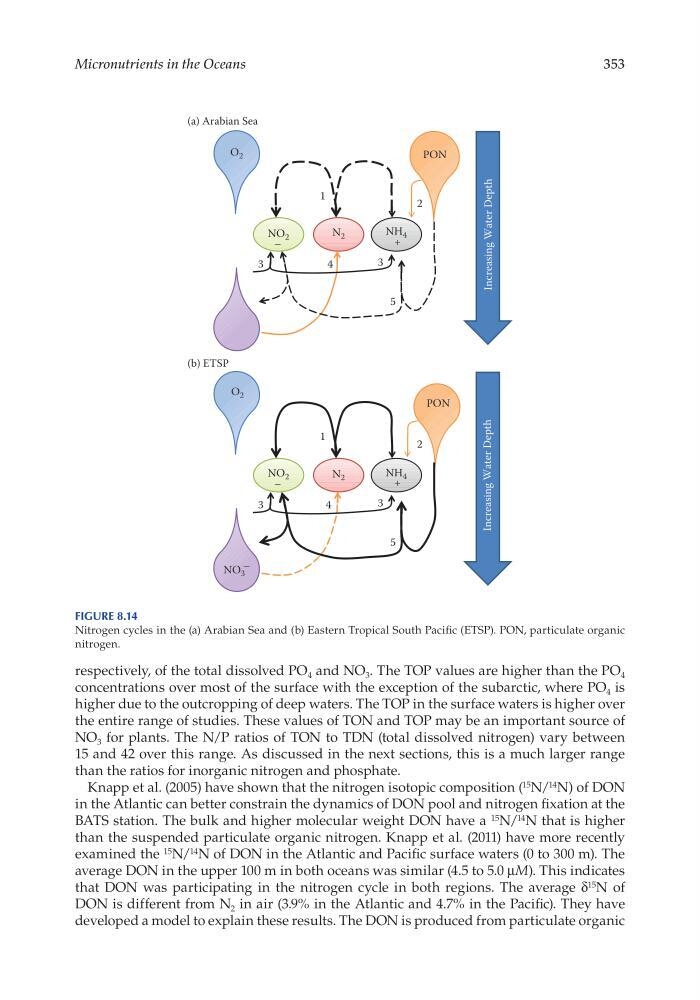
Figure 8.14
Nitrogen cycles in the (a) Arabian Sea and (b) Eastern Tropical South Pacific (ETSP). PON, particulate organic
nitrogen.
Micronutrients in the Oceans
respectively, of the total dissolved PO 4 and NO 3 . The TOP values are higher than the PO 4
concentrations over most of the surface with the exception of the subarctic, where PO 4 is
higher due to the outcropping of deep waters. The TOP in the surface waters is higher over
the entire range of studies. These values of TON and TOP may be an important source of
NO 3 for plants. The N/ P ratios of TON to TDN (total dissolved nitrogen) vary between
15 and 42 over this range. As discussed in the next sections, this is a much larger range
than the ratios for inorganic nitrogen and phosphate.
Knapp et al. (2005) have shown that the nitrogen isotopic composition ( 15 N/ 14 N) of DON
in the Atlantic can better constrain the dynamics of DON pool and nitrogen fixation at the
BATS station. The bulk and higher molecular weight DON have a 15 N/ 14 N that is higher
than the suspended particulate organic nitrogen. Knapp et al. (2011) have more recently
examined the 15 N/ 14 N of DON in the Atlantic and Pacific surface waters (0 to 300 m). The
average DON in the upper 100 m in both oceans was similar (4.5 to 5.0 μM). This indicates
that DON was participating in the nitrogen cycle in both regions. The average δ 15 N of
DON is different from N 2 in air (3.9% in the Atlantic and 4.7% in the Pacific). They have
developed a model to explain these results. The DON is produced from particulate organic
O 2
PON
NO 2
–
N 2
NH 4
+
2
1
3
3
4
5
(a) Arabian Sea
Increasing Water Depth
(b) ETSP
O 2
PON
NO 3
–
NO 2
–
N 2
NH 4
+
2
1
3
3
4
5
Increasing Water Depth
Figure 8.14
Nitrogen cycles in the (a) Arabian Sea and (b) Eastern Tropical South Pacific (ETSP). PON, particulate organic
nitrogen.