

345
Micronutrients in the Oceans
seawater. At present, two methods are being used (certain organic N compounds can
cause interference):
1. NH 3 is oxidized to NO 3
– by alkaline hypochlorite. The excess hypochlorite is then
reduced with arsenite and the NO 2
– determined as presented.
2. NH 3 is oxidized in an alkaline citrate medium with Na hypochlorite and phenol
in the presence of catalytic amounts of Na nitroprusside. A blue indophenol dye is
produced and is measured with a spectrophotometer (Catalano, 1987).
Johnson and Petty (1983) have described an inexpensive and reliable flow injection
method that can be used to determine nitrate and nitrite in seawater. The chemistry is
similar to that described, and the system is automated. It can make 75 determinations per
hour, has a detection limit of 0.1 μM, and has a precision of 1% at levels above 10 μM.
8.3.2 Distribution of Nitrogen Compounds
The nitrogen cycle in the oceans is shown in Figure 8.6. There are three major inputs of
nitrogen to ocean waters:
1. Volcanic activity (NH 3 )
2. Atmospheric (NO 2 from nitrogen fixation)
3. Rivers (fertilizers)
The components of the nitrogen cycle involve a number of oxidation and reduction processes. Nitrates are taken from surface waters during primary productivity. When the
plants die and decompose, nitrogen compounds are regenerated to the water column.
Marine birds can also cause a loss of nitrogen as NaNO 3 in guano. The large deposits
of NaNO 3 in Chilean deserts could also have been formed by bacteria fixation or volcanism. Nitrogen can be lost back to the atmosphere as N 2 O. As discussed, this gas can react
with ozone. The assimilation of fixed nitrogen (NH 3 , NO 2
– , and NO 3 ) by phytoplankton
takes place in the euphotic zone during photosynthesis. The NH 3 or NH 4
+ form is usually
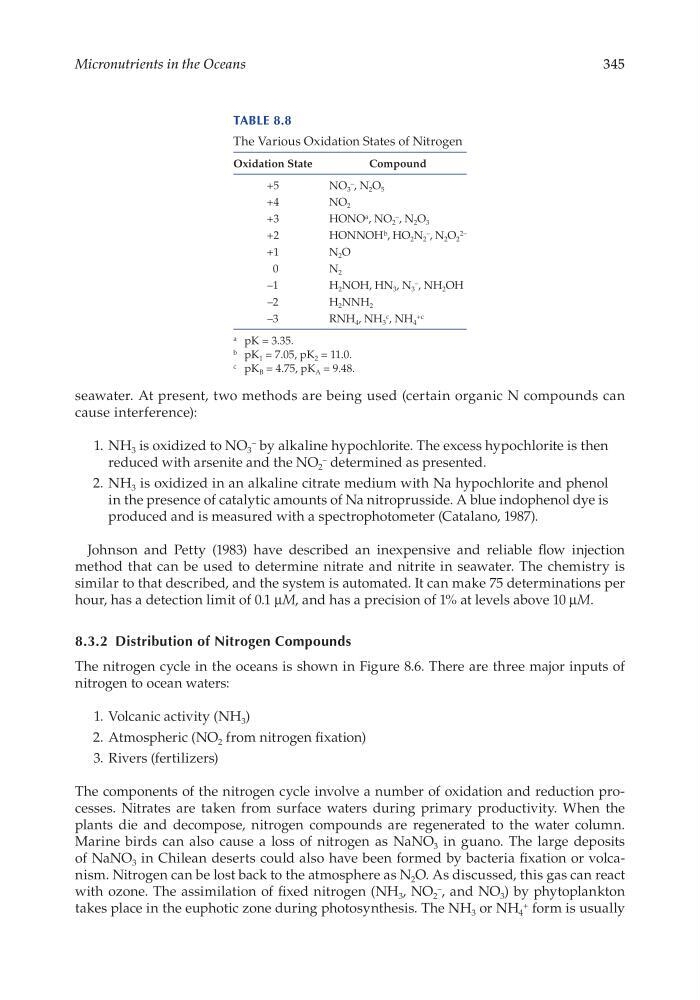
Table 8.8
The Various Oxidation States of Nitrogen
Oxidation State
Compound
+5
NO 3
– , N 2 O 5
+4
NO 2
+3
HONO a , NO 2
– , N 2 O 3
+2
HONNOH b , HO 2 N 2
– , N 2 O 2
2–
+1
N 2 O
0
N 2
–1
H 2 NOH, HN 3 , N 3
– , NH 2 OH
–2
H 2 NNH 2
–3
RNH 4 , NH 3
c , NH 4
+c
a pK = 3.35.
b pK 1 = 7.05, pK 2 = 11.0.
c pK B = 4.75, pK A = 9.48.
Micronutrients in the Oceans
seawater. At present, two methods are being used (certain organic N compounds can
cause interference):
1. NH 3 is oxidized to NO 3
– by alkaline hypochlorite. The excess hypochlorite is then
reduced with arsenite and the NO 2
– determined as presented.
2. NH 3 is oxidized in an alkaline citrate medium with Na hypochlorite and phenol
in the presence of catalytic amounts of Na nitroprusside. A blue indophenol dye is
produced and is measured with a spectrophotometer (Catalano, 1987).
Johnson and Petty (1983) have described an inexpensive and reliable flow injection
method that can be used to determine nitrate and nitrite in seawater. The chemistry is
similar to that described, and the system is automated. It can make 75 determinations per
hour, has a detection limit of 0.1 μM, and has a precision of 1% at levels above 10 μM.
8.3.2 Distribution of Nitrogen Compounds
The nitrogen cycle in the oceans is shown in Figure 8.6. There are three major inputs of
nitrogen to ocean waters:
1. Volcanic activity (NH 3 )
2. Atmospheric (NO 2 from nitrogen fixation)
3. Rivers (fertilizers)
The components of the nitrogen cycle involve a number of oxidation and reduction processes. Nitrates are taken from surface waters during primary productivity. When the
plants die and decompose, nitrogen compounds are regenerated to the water column.
Marine birds can also cause a loss of nitrogen as NaNO 3 in guano. The large deposits
of NaNO 3 in Chilean deserts could also have been formed by bacteria fixation or volcanism. Nitrogen can be lost back to the atmosphere as N 2 O. As discussed, this gas can react
with ozone. The assimilation of fixed nitrogen (NH 3 , NO 2
– , and NO 3 ) by phytoplankton
takes place in the euphotic zone during photosynthesis. The NH 3 or NH 4
+ form is usually
Table 8.8
The Various Oxidation States of Nitrogen
Oxidation State
Compound
+5
NO 3
– , N 2 O 5
+4
NO 2
+3
HONO a , NO 2
– , N 2 O 3
+2
HONNOH b , HO 2 N 2
– , N 2 O 2
2–
+1
N 2 O
0
N 2
–1
H 2 NOH, HN 3 , N 3
– , NH 2 OH
–2
H 2 NNH 2
–3
RNH 4 , NH 3
c , NH 4
+c
a pK = 3.35.
b pK 1 = 7.05, pK 2 = 11.0.
c pK B = 4.75, pK A = 9.48.