

342
Chemical Oceanography, 4th Edition
zero. As phytoplankton and other organisms die, the PO 4
3– is regenerated in the water column. A maximum occurs in both oceans near 1000 m, which is the same depth as the O 2
minimum layer. The maximum values in the Atlantic are about 1.5 μM, while in the Pacific,
values of about 3.2 μM occur. The higher values in the Pacific (and Indian) Ocean compared to the Atlantic are due to the waters being older (thus accumulating more oxidized
plant material). Sections of PO 4
3– in the Atlantic, Pacific, and Indian Oceans are shown in
Figure 8.5. The values generally follow the movement of the major water masses. The values
in deep waters increase from the North Atlantic to the North Pacific and Indian Oceans.
8.3 Nitrogen Compounds in Seawater
In addition to N 2 , the sea contains small amounts of inorganic and organic nitrogen compounds (about 1/10 the concentration of N 2 ). The forms can be dissolved or particulate and
subdivided into organic and inorganic. The principal inorganic forms are NO 3
– (1 to 500
μM), NO 2
– (0.1 to 50 μM), and NH 3 + NH 4
+ (1 to 50 μM). Small amounts of nitrous oxide,
hydroxylamine, and hyponitrite ion also occur. The difficulty with nitrogen compounds is
that they can exist in nine oxidation states (see Table 8.8).
The ammonia ion can exist in two forms depending on the pH. The dissociation of NH 4
+
is given by
NH 4
+ + H + + NH 3
(8.22)
and has a pK of 9.5 at 25°C in seawater. At a pH of 8.1, 95% of the total ammonia is NH 4
+ ,
and 5% is NH 3 . The dissociation constant of ammonia (NH 4
+ ) can be determined from
PO 4 (µM)
0.0
0.1
0.2
0.3
0.4
0.5
Depth (m)
0
10
20
30
40
50
60
70
0
10
20
30
40
50
60
70
Inorganic P
Total P
PO 4 (µM)
0.0
0.1
0.2
0.3
0.4
0.5
Summer
Winter
Inorganic P
Total P
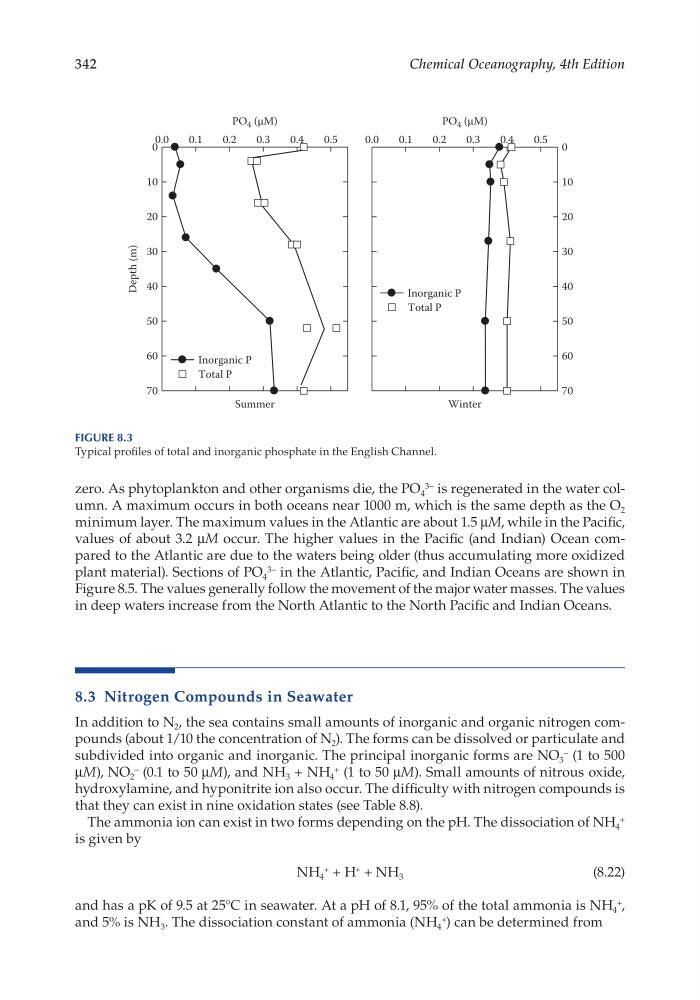
Figure 8.3
Typical profiles of total and inorganic phosphate in the English Channel.
Chemical Oceanography, 4th Edition
zero. As phytoplankton and other organisms die, the PO 4
3– is regenerated in the water column. A maximum occurs in both oceans near 1000 m, which is the same depth as the O 2
minimum layer. The maximum values in the Atlantic are about 1.5 μM, while in the Pacific,
values of about 3.2 μM occur. The higher values in the Pacific (and Indian) Ocean compared to the Atlantic are due to the waters being older (thus accumulating more oxidized
plant material). Sections of PO 4
3– in the Atlantic, Pacific, and Indian Oceans are shown in
Figure 8.5. The values generally follow the movement of the major water masses. The values
in deep waters increase from the North Atlantic to the North Pacific and Indian Oceans.
8.3 Nitrogen Compounds in Seawater
In addition to N 2 , the sea contains small amounts of inorganic and organic nitrogen compounds (about 1/10 the concentration of N 2 ). The forms can be dissolved or particulate and
subdivided into organic and inorganic. The principal inorganic forms are NO 3
– (1 to 500
μM), NO 2
– (0.1 to 50 μM), and NH 3 + NH 4
+ (1 to 50 μM). Small amounts of nitrous oxide,
hydroxylamine, and hyponitrite ion also occur. The difficulty with nitrogen compounds is
that they can exist in nine oxidation states (see Table 8.8).
The ammonia ion can exist in two forms depending on the pH. The dissociation of NH 4
+
is given by
NH 4
+ + H + + NH 3
(8.22)
and has a pK of 9.5 at 25°C in seawater. At a pH of 8.1, 95% of the total ammonia is NH 4
+ ,
and 5% is NH 3 . The dissociation constant of ammonia (NH 4
+ ) can be determined from
PO 4 (µM)
0.0
0.1
0.2
0.3
0.4
0.5
Depth (m)
0
10
20
30
40
50
60
70
0
10
20
30
40
50
60
70
Inorganic P
Total P
PO 4 (µM)
0.0
0.1
0.2
0.3
0.4
0.5
Summer
Winter
Inorganic P
Total P
Figure 8.3
Typical profiles of total and inorganic phosphate in the English Channel.