

320
Chemical Oceanography, 4th Edition
can increase the concentration of free metals in seawater. This is shown for the changes in
the free Cu 2+ in seawater as a function of time (Figure 7.72).
Similar calculations have been made for a number of divalent and trivalent ions (Millero
et al., 2009). The percentage changes for the divalent ions are shown in Figure 7.73. The
changes in the concentration of free metals can change the thermodynamic and kinetic
behavior of metals in ocean waters. This can be demonstrated for two metals, Fe 2+ and
Cu 2+ . Fe is need by plants to grow, and Cu at high concentrations is toxic to plankton
and bacteria. At the present pH (8.1) of seawater, Fe 2+ is oxidized quickly with O 2 or H 2 O 2 .
The half- time with O 2 at the surface is about 2–4 min. As shown in Figure 7.74, the rate of
0
250
500
Depth [m]
750
1000
25°N
30°N
35°N
40°N
CLIVAR P16N (2006)-WOCE P16N (1991): ∆pH m
Change in N. Pacific pH
45°N
50°N
55°N
–0.08
–0.06
–0.04
–0.02
0
0.02
0.04
0.06
0.08
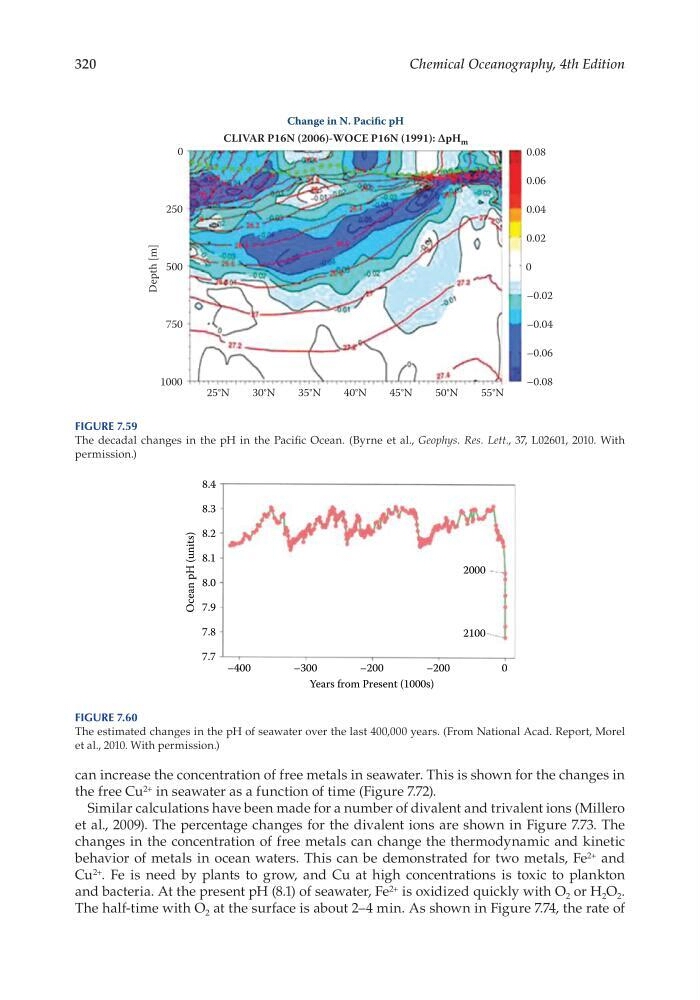
Figure 7.59
The decadal changes in the pH in the Pacific Ocean. (Byrne et al., Geophys. Res. Lett., 37, L02601, 2010. With
permission.)
8.4
8.3
8.2
8.1
8.0
Ocean pH (units)
7.9
7.8
7.7
–400
–300
–200
Years from Present (1000s)
–200
2100
2000
0
Figure 7.60
The estimated changes in the pH of seawater over the last 400,000 years. (From National Acad. Report, Morel
et al., 2010. With permission.)
Chemical Oceanography, 4th Edition
can increase the concentration of free metals in seawater. This is shown for the changes in
the free Cu 2+ in seawater as a function of time (Figure 7.72).
Similar calculations have been made for a number of divalent and trivalent ions (Millero
et al., 2009). The percentage changes for the divalent ions are shown in Figure 7.73. The
changes in the concentration of free metals can change the thermodynamic and kinetic
behavior of metals in ocean waters. This can be demonstrated for two metals, Fe 2+ and
Cu 2+ . Fe is need by plants to grow, and Cu at high concentrations is toxic to plankton
and bacteria. At the present pH (8.1) of seawater, Fe 2+ is oxidized quickly with O 2 or H 2 O 2 .
The half- time with O 2 at the surface is about 2–4 min. As shown in Figure 7.74, the rate of
0
250
500
Depth [m]
750
1000
25°N
30°N
35°N
40°N
CLIVAR P16N (2006)-WOCE P16N (1991): ∆pH m
Change in N. Pacific pH
45°N
50°N
55°N
–0.08
–0.06
–0.04
–0.02
0
0.02
0.04
0.06
0.08
Figure 7.59
The decadal changes in the pH in the Pacific Ocean. (Byrne et al., Geophys. Res. Lett., 37, L02601, 2010. With
permission.)
8.4
8.3
8.2
8.1
8.0
Ocean pH (units)
7.9
7.8
7.7
–400
–300
–200
Years from Present (1000s)
–200
2100
2000
0
Figure 7.60
The estimated changes in the pH of seawater over the last 400,000 years. (From National Acad. Report, Morel
et al., 2010. With permission.)