

279
The Carbonate System
[HCO 3
– ] = (TCO 2 K 2 *– Z)/(K R – 4)
(7.108)
[CO 3
2– ] = (A C K R – TCO 2 K R – 4 A C + Z)/2(K R – 4)
(7.109)
where K R = K 1 */K 2 *, and Z is given by
Z = [4 A C + (TCO 2 K R – A C K R ) 2 + 4(K R – 4)A C
2 ] 1/2
(7.110)
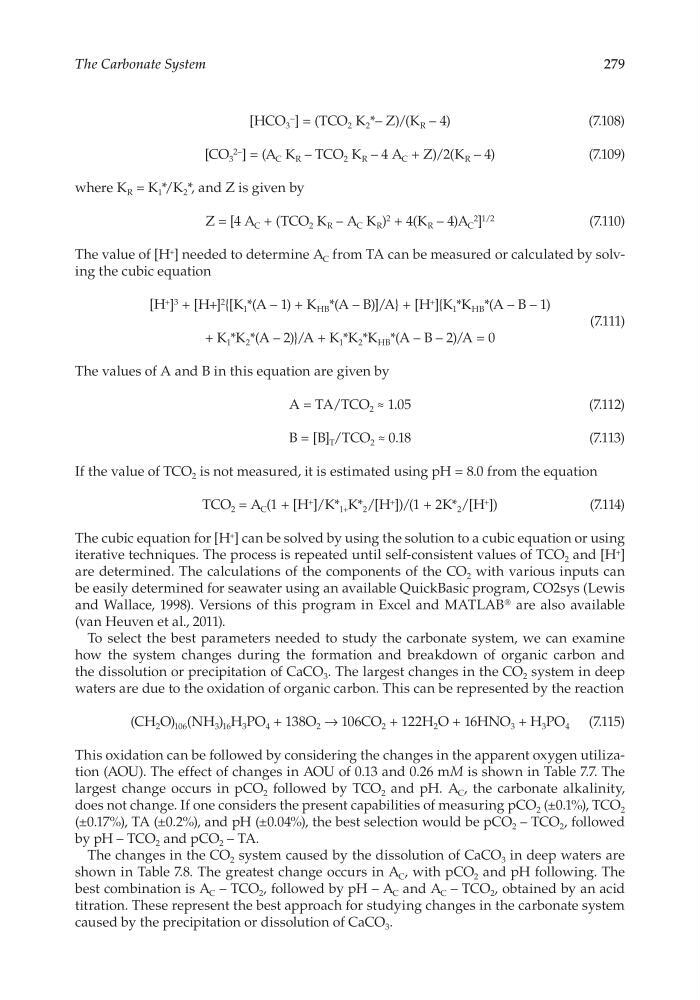
The value of [H + ] needed to determine A C from TA can be measured or calculated by solving the cubic equation
[H + ] 3 + [H+] 2 {[K 1 *(A – 1) + K HB *(A – B)]/A} + [H + ]{K 1 *K HB *(A – B – 1)
+ K 1 *K 2 *(A – 2)}/A + K 1 *K 2 *K HB *(A – B – 2)/A = 0
(7.111)
The values of A and B in this equation are given by
A = TA/ TCO 2 ≈ 1.05
(7.112)
B = [B] T / TCO 2 ≈ 0.18
(7.113)
If the value of TCO 2 is not measured, it is estimated using pH = 8.0 from the equation
TCO 2 = A C (1 + [H + ]/K* 1+ K* 2 /[H + ])/(1 + 2K* 2 /[H + ])
(7.114)
The cubic equation for [H + ] can be solved by using the solution to a cubic equation or using
iterative techniques. The process is repeated until self- consistent values of TCO 2 and [H + ]
are determined. The calculations of the components of the CO 2 with various inputs can
be easily determined for seawater using an available QuickBasic program, CO2sys (Lewis
and Wallace, 1998). Versions of this program in Excel and MATLAB • are also available
(van Heuven et al., 2011).
To select the best parameters needed to study the carbonate system, we can examine
how the system changes during the formation and breakdown of organic carbon and
the dissolution or precipitation of CaCO 3 . The largest changes in the CO 2 system in deep
waters are due to the oxidation of organic carbon. This can be represented by the reaction
(CH 2 O) 106 (NH 3 ) 16 H 3 PO 4 + 138O 2 → 106CO 2 + 122H 2 O + 16HNO 3 + H 3 PO 4 (7.115)
This oxidation can be followed by considering the changes in the apparent oxygen utilization (AOU). The effect of changes in AOU of 0.13 and 0.26 mM is shown in Table 7.7. The
largest change occurs in pCO 2 followed by TCO 2 and pH. A C , the carbonate alkalinity,
does not change. If one considers the present capabilities of measuring pCO 2 (±0.1%), TCO 2
(±0.17%), TA (±0.2%), and pH (±0.04%), the best selection would be pCO 2 – TCO 2 , followed
by pH – TCO 2 and pCO 2 – TA.
The changes in the CO 2 system caused by the dissolution of CaCO 3 in deep waters are
shown in Table 7.8. The greatest change occurs in A C , with pCO 2 and pH following. The
best combination is A C – TCO 2 , followed by pH – A C and A C – TCO 2 , obtained by an acid
titration. These represent the best approach for studying changes in the carbonate system
caused by the precipitation or dissolution of CaCO 3 .
The Carbonate System
[HCO 3
– ] = (TCO 2 K 2 *– Z)/(K R – 4)
(7.108)
[CO 3
2– ] = (A C K R – TCO 2 K R – 4 A C + Z)/2(K R – 4)
(7.109)
where K R = K 1 */K 2 *, and Z is given by
Z = [4 A C + (TCO 2 K R – A C K R ) 2 + 4(K R – 4)A C
2 ] 1/2
(7.110)
The value of [H + ] needed to determine A C from TA can be measured or calculated by solving the cubic equation
[H + ] 3 + [H+] 2 {[K 1 *(A – 1) + K HB *(A – B)]/A} + [H + ]{K 1 *K HB *(A – B – 1)
+ K 1 *K 2 *(A – 2)}/A + K 1 *K 2 *K HB *(A – B – 2)/A = 0
(7.111)
The values of A and B in this equation are given by
A = TA/ TCO 2 ≈ 1.05
(7.112)
B = [B] T / TCO 2 ≈ 0.18
(7.113)
If the value of TCO 2 is not measured, it is estimated using pH = 8.0 from the equation
TCO 2 = A C (1 + [H + ]/K* 1+ K* 2 /[H + ])/(1 + 2K* 2 /[H + ])
(7.114)
The cubic equation for [H + ] can be solved by using the solution to a cubic equation or using
iterative techniques. The process is repeated until self- consistent values of TCO 2 and [H + ]
are determined. The calculations of the components of the CO 2 with various inputs can
be easily determined for seawater using an available QuickBasic program, CO2sys (Lewis
and Wallace, 1998). Versions of this program in Excel and MATLAB • are also available
(van Heuven et al., 2011).
To select the best parameters needed to study the carbonate system, we can examine
how the system changes during the formation and breakdown of organic carbon and
the dissolution or precipitation of CaCO 3 . The largest changes in the CO 2 system in deep
waters are due to the oxidation of organic carbon. This can be represented by the reaction
(CH 2 O) 106 (NH 3 ) 16 H 3 PO 4 + 138O 2 → 106CO 2 + 122H 2 O + 16HNO 3 + H 3 PO 4 (7.115)
This oxidation can be followed by considering the changes in the apparent oxygen utilization (AOU). The effect of changes in AOU of 0.13 and 0.26 mM is shown in Table 7.7. The
largest change occurs in pCO 2 followed by TCO 2 and pH. A C , the carbonate alkalinity,
does not change. If one considers the present capabilities of measuring pCO 2 (±0.1%), TCO 2
(±0.17%), TA (±0.2%), and pH (±0.04%), the best selection would be pCO 2 – TCO 2 , followed
by pH – TCO 2 and pCO 2 – TA.
The changes in the CO 2 system caused by the dissolution of CaCO 3 in deep waters are
shown in Table 7.8. The greatest change occurs in A C , with pCO 2 and pH following. The
best combination is A C – TCO 2 , followed by pH – A C and A C – TCO 2 , obtained by an acid
titration. These represent the best approach for studying changes in the carbonate system
caused by the precipitation or dissolution of CaCO 3 .